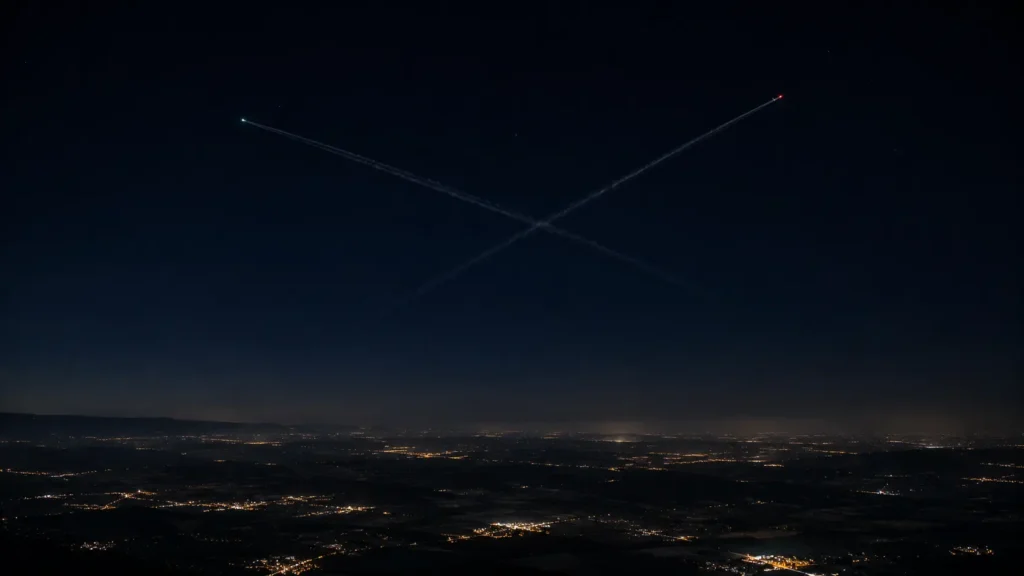
On the night of July 1, 2002, two aircraft were converging over Überlingen, Germany at 36,000 feet. A Russian passenger jet carrying 69 people. A DHL cargo Boeing 757 with two crew members. Neither could see the other. The air traffic controller managing the sector hadn’t noticed the conflict in time.
The system designed to save them both fired its warnings simultaneously. The Boeing crew obeyed immediately descending as instructed. The Russian crew followed their controller’s instruction instead, descending rather than climbing as the machine commanded.
Had both aircraft followed the automated instructions, everyone would have survived.
All 71 people aboard both aircraft died.
The tragedy didn’t expose a flaw in the technology. It exposed something more unsettling: a flaw in how human beings respond to a machine giving an order that contradicts another human being. It changed aviation rules permanently. And it remains the defining case study in understanding what TCAS the Traffic Collision Avoidance System can and cannot do.
What TCAS Actually Is
TCAS is an airborne system designed to serve as the last line of defence against mid-air collisions. It monitors the surrounding airspace for other transponder-equipped aircraft that may present a collision threat and it operates entirely independently of ground-based equipment.
That independence is the critical design principle. Air traffic controllers can be overloaded, distracted, or simply wrong. Radio communications can fail. TCAS assumes all of these things can happen simultaneously and functions without any of them.
Problems with mid-air collisions decades ago led the US Federal Aviation Administration to develop the system, now mandated worldwide on all large commercial aircraft. In Europe, TCAS is estimated to reduce the risk of mid-air collision by a factor of approximately five.
The Technical Conversation Nobody Hears
Every commercial aircraft equipped with TCAS carries a transponder — a radio transmitter-receiver that responds automatically to interrogation signals. TCAS works by interrogating the transponders of every aircraft within its detection range, extracting two pieces of information from each reply: range and altitude. By repeating this interrogation every second, the system tracks how quickly the distance is closing and whether altitudes are converging.
When a potential conflict is detected, TCAS provides two types of alerts.
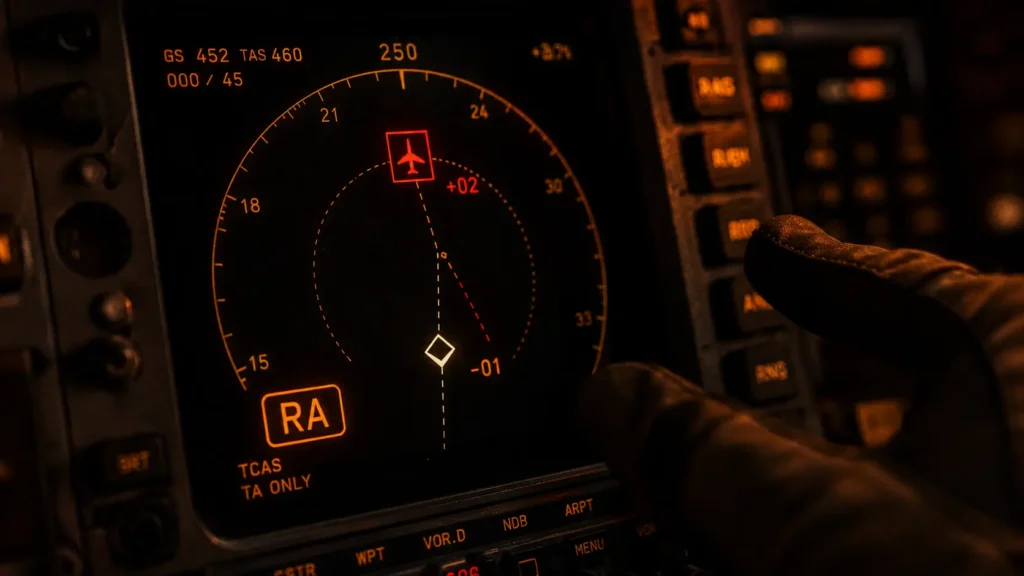
The Traffic Advisory (TA) is the first level a heads-up. The system announces “Traffic, traffic” and displays the threatening aircraft on the cockpit display. No action is required yet.
The Resolution Advisory (RA) is the system moving from warning to instruction. Commands like “Climb, climb” or “Descend, descend” tell the pilot exactly what to do. Critically, current TCAS only provides vertical guidance it will not instruct a pilot to turn left or right.
The most elegant aspect of the RA system is what happens between aircraft. TCAS II systems coordinate their resolution advisories before issuing commands to either cockpit so if one aircraft is instructed to descend, the other will typically be told to climb. The two planes negotiate an escape route with each other, automatically, in the seconds before either pilot has fully processed what is happening. No controller involved. No radio call required.
35 Seconds and a Hierarchy That Overrides the Controller
When a Resolution Advisory fires, the hierarchy is now unambiguous — a clarity written in the blood of Überlingen.
The pilot flying must respond immediately. Not after confirming with the controller. Not after discussing with the co-pilot. Immediately within five seconds. Communication with ATC comes after responding to the RA, not before.
Before July 2002, the TCAS pilot’s guide was ambiguous about whether RAs should take precedence over ATC instructions. European pilots were trained to follow TCAS exclusively. Russian pilots were trained to exercise independent judgment. The ambiguity cost 71 lives.
After Überlingen, the rule became absolute: TCAS wins. Always. Immediately.
The closing speed of two aircraft on converging paths can exceed 1,000 miles per hour. The total time from TA to potential impact is typically 35 to 45 seconds. There is no time for deliberation.
What TCAS Could Not Do The January 2025 Potomac Collision
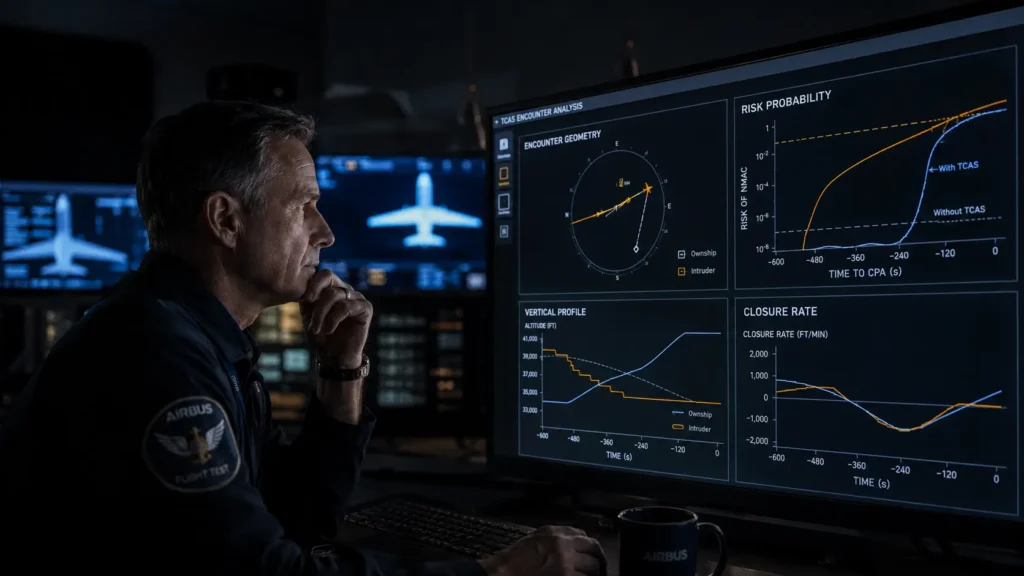
On January 29, 2025, an American Eagle regional jet collided with a US Army Black Hawk helicopter on approach to Ronald Reagan Washington National Airport, killing all 67 people aboard both aircraft.
The collision immediately raised a question: why hadn’t TCAS prevented it?
The answer is the system’s most significant structural limitation. During approach precisely when the risk of collision with other traffic is highest audio Resolution Advisory commands are automatically inhibited below a certain altitude. The suppression exists for a legitimate reason: false RAs close to the ground could cause pilots to manoeuvre dangerously near terrain. But the trade-off creates a gap exactly where traffic is densest.
Pilots may see a visual warning on their display without hearing the audio command that drives immediate response. At low altitude, in congested airspace, the last line of defence goes partially silent.
ACAS Xr where the “r” stands for rotorcraft is under development specifically to address incidents like the Potomac collision. Helicopters operate at lower altitudes and slower speeds where current TCAS is inhibited. ACAS Xr will provide collision avoidance designed specifically for rotorcraft, with different alerting thresholds that account for a helicopter’s ability to manoeuvre faster than fixed-wing aircraft.
What Comes Next ACAS X
The current TCAS II standard has been operational since the mid-1990s. Its successor ACAS X represents a fundamental redesign of the decision logic underneath the system.
Where TCAS II uses fixed, pre-programmed logic tables to generate RAs, ACAS X uses a probabilistic model a dynamic collision risk calculation that weights hundreds of variables including aircraft performance characteristics, sensor uncertainty, and the specific geometry of each encounter. The result is resolution advisories better calibrated to actual risk, with fewer false alerts and more precise guidance.
The numbers behind the current system’s impact are stark. In the decade before TCAS was widely deployed, mid-air collisions between commercial aircraft occurred regularly enough to drive repeated regulatory change. In the three decades since TCAS became mandatory, collisions between equipped aircraft in controlled airspace have become structurally rare not zero, as Überlingen demonstrated, but rare in a way that would have been unimaginable in the 1970s.
The Machine That Must Override the Human
What makes TCAS unlike almost any other safety system in aviation is its authority structure. It does not advise. It does not suggest. When the RA fires, procedure requires immediate compliance faster than conscious deliberation, faster than radio communication, faster than the human instinct to check with someone in authority.
The lesson of Überlingen is permanent: when two aircraft are closing at combined speeds approaching 1,000 miles per hour, the machine must win the argument. Not because pilots cannot be trusted but because the geometry of convergence does not leave time for the argument to happen.
The Boeing crew obeyed their TCAS. They descended as instructed. They survived.
The aircraft whose pilots trusted the controller’s voice over the machine’s instruction did not.
At 36,000 feet over a German lake, in the dark, with 35 seconds remaining, the system was right. The human was wrong. That is the case for TCAS and it has not lost the argument since.
📌 Read Also:
- How Cloudflare Stops Millions of Hackers Every Day
- How GPS Works When You’re in the Middle of Nowhere
© AiwalaNews | Global Tech & Privacy Edition | April 2026
