Digital products aren’t complicated. They’re files. You create them once, list them once, and get paid repeatedly with no shipping, no returns, and no inventory. In 2026, that simple model has become one of the most accessible side incomes available to anyone with a laptop and a few hours a week.
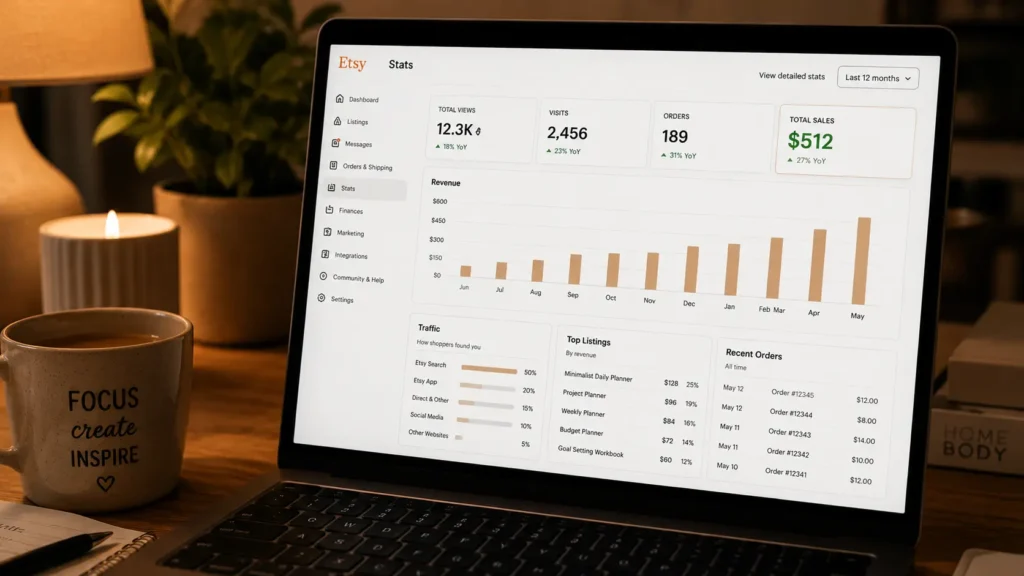
New shops typically earn $100–$500 per month in the first few months and that’s the honest, realistic starting point. Not the viral $15K/month headline. Not the overnight success story. Just a quiet, consistent $500 that compounds as your catalog grows.
Here’s the exact playbook to get there.
Why Etsy in 2026 And Why the Window Is Still Open
The numbers make a compelling case for starting now rather than waiting.
As of March 2026, Etsy has 7.5 million active sellers but 95 million active buyers. The math still favors sellers who target specific niches.
In 2026, Etsy is the number one marketplace for digital downloads, with $5.5 billion in sales and 90%+ margins. The market is competitive at the generic level but wide open at the specific level. That’s the entire strategy in one sentence. Medium
Step 1: Pick a Micro-Niche Not a Category
This is where most beginners lose before they start.
The biggest mistake beginners make is creating “general” products generic planners, generic wall art, generic journals. These compete with 50,000+ existing listings. The winning strategy is hyper-specific micro-niches with 100–500 existing products but clear demand signals.
The difference between failing and making $500/month often comes down to this single decision. “Planner” is a category. “ADHD daily planner for college students” is a micro-niche and the distinction determines everything that follows.
Sellers winning in 2026 create hyper-focused prompt packs. Real estate agents want listing prompts. Therapists need client communication drafts. Etsy sellers want product description prompts. Because results are immediate, customer satisfaction is high.
The same logic applies across every product type the more specific the audience, the less competition, and the higher the conversion rate.
Step 2: The AI Tools That Actually Matter
You don’t need to spend hundreds of dollars on tools to start.
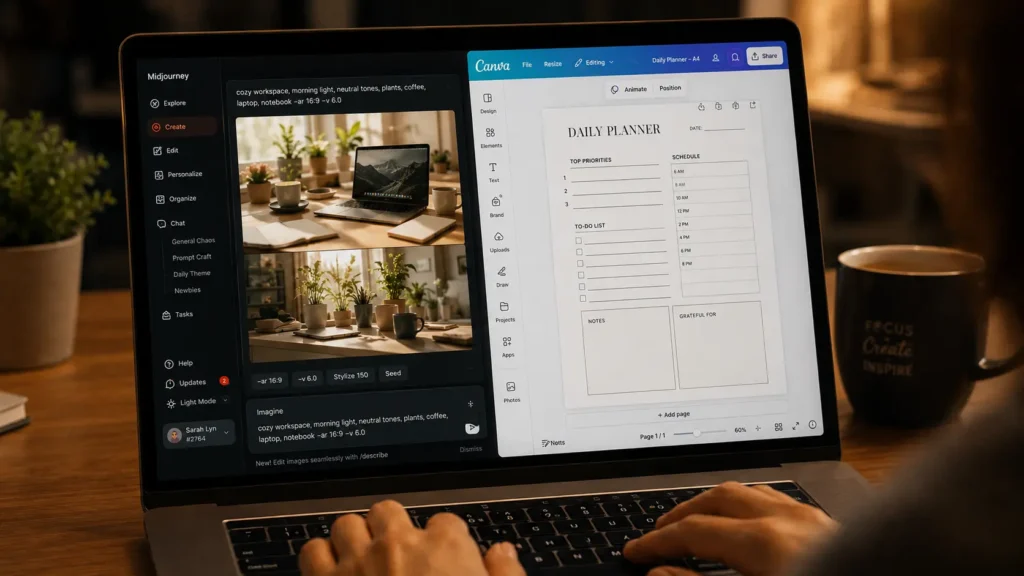
The minimum viable setup costs as little as $13 in the first month: Midjourney Basic at $10/month for image generation, Canva Free at $0 for mockups, ChatGPT API at approximately $3/month for 30 products, and $0.20 per Etsy listing. To list 30 products costs just $19 in total investment.
For digital products that don’t require image generation like planners, templates, prompt packs, or printable journals you need AI, a free Canva account, and an Etsy store. That’s genuinely it.
Step 3: The 6 Products With the Highest Demand Right Now
Top-selling categories include digital wall art prints, printable planners and journals, social media template bundles, custom pet portraits, wedding and event stationery, phone wallpaper packs, coloring pages, and clipart bundles. Digital downloads consistently outperform physical products in profit margin.
For reaching $500/month specifically, the most reliable path is printable planners and AI prompt packs both have high repeat purchase rates, strong search volume, and buyers who actively seek them out rather than browse passively.
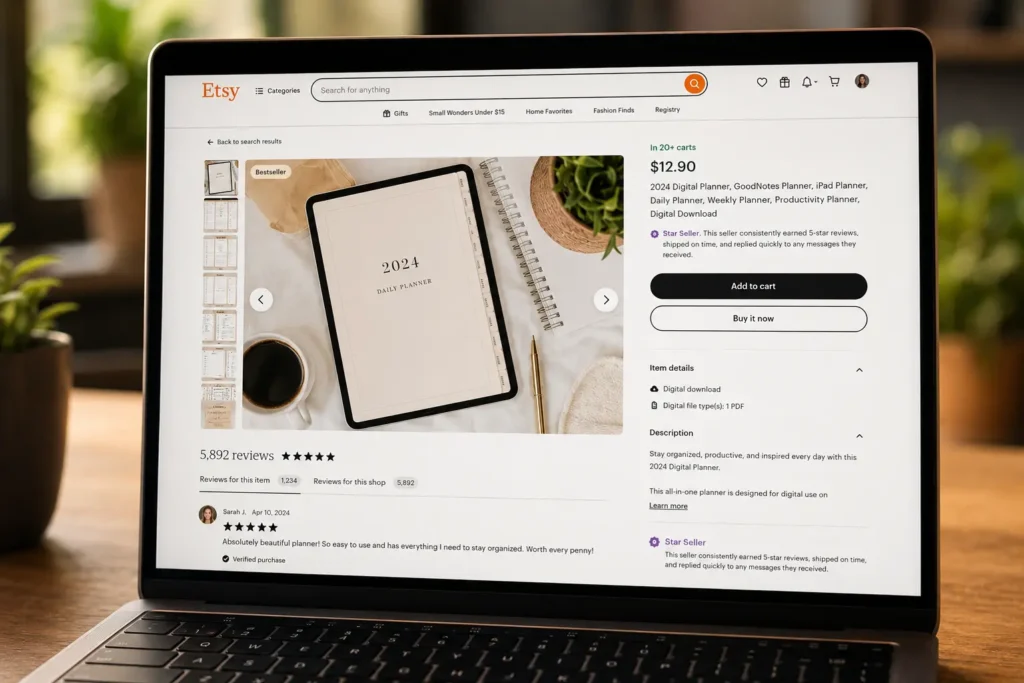
Productivity systems remain one of the strongest digital products to sell on Etsy. As work becomes more flexible, buyers want systems that help them manage time, goals, and responsibilities.
Step 4: Etsy SEO The Actual Difference Between 0 Sales and 50 Sales
Creating a good product and listing it poorly is the single most common reason new shops fail quietly.
Etsy SEO determines whether buyers find your products. Every listing needs a title front-loaded with keywords buyers actually search, all 13 available tags mixing broad terms with specific ones, and a description where the first 160 characters appear in search results lead with value and keywords, not generic greetings. Ten listing images showing the art in styled mockup rooms, close-up details, and the full collection together complete the listing.
Every file should be renamed before uploading not “final-v3.pdf” but “adhd-daily-planner-2026-printable.pdf.” Small details like this tell the algorithm exactly what your product is.
One additional tactic that consistently works: adding “2026” in the title future-proofs the listing and helps it rank all year.
Step 5: The Catalog Strategy That Builds to $500/Month
One product won’t get you there. A growing catalog will.
The winning strategy is to list 30–50 products in the first 30 days to establish catalog breadth, target 5–10 distinct micro-niches instead of putting all eggs in one basket, refresh underperforming listings after 60 days with new images and better SEO, and add 10–15 new products monthly as a consistent growth signal. Sellers who do this consistently report first sales within 14–30 days and profitability within 90 days.
The “Seasonal Refresh” strategy works particularly well: every quarter, use AI to find seasonal trends back to school, New Year’s resolutions, wedding season, tax season and create targeted product bundles for each trend. New seasonal products are created in bulk with AI while older evergreen products keep selling in the background. Revenue compounds because the catalog keeps growing.
Step 6: Bundle Strategy How $7 Products Become $27 Sales
This is the lever most beginners ignore and it’s the fastest path to $500/month.
The real money on Gumroad and Etsy is in bundles and “vaults.” A “Complete Productivity Vault” sold for $27 that includes 5 related products instead of just one planner for $7 creates enormous perceived value, and the profit margin is almost 100%.
In 2026, top Etsy sellers bundle related products into ecosystems rather than selling one planner. Bundles increase average order value while simplifying decision making for buyers. Perceived savings increase conversions, value feels higher without extra work, and upsells become natural.
Etsy’s Rules on AI Content What You Must Know Before Listing
This isn’t optional reading it’s the difference between a sustainable shop and a banned account.
Etsy’s AI disclosure policy requires creators to select an “I used AI” checkbox when listing products. This checkbox appears in the “Production Partners” section and does NOT negatively impact search rankings Etsy has confirmed this.
Best practice is to always disclose. Buyers increasingly expect and accept AI tools. Many successful sellers actively market “AI-enhanced design” as a feature, offering faster customization and more variety. Buyers care about whether the product solves their problem, looks professional, and is priced fairly production method is secondary.
One firm rule: never copy exact designs, since Etsy’s DMCA bots ban accounts for this.
Your $500/Month Realistic Timeline
| Month | Goal | Action |
|---|---|---|
| Month 1 | 30 listings live | Pick 2 micro-niches, create and list daily |
| Month 2 | First consistent sales | Refresh weak listings, add seasonal products |
| Month 3 | $500/month | Launch 2–3 bundles, run Etsy Ads at $1–3/day on best sellers |
Once you have 20+ listings with sales history, Etsy Ads at $1–5/day can accelerate growth but only advertise your proven best sellers.
The Bottom Line
The $500/month target isn’t a dream number it’s the documented starting range for new AI digital product shops that follow a consistent strategy. Some products even start ranking naturally in Etsy search. The stores keep running on their own spending one afternoon per month adding a new batch of products is enough to maintain steady revenue.
The opportunity is real. The tools are cheap. The only thing between you and your first sale is a listing that doesn’t exist yet.
Read Also:
- 🔗 AI Tools That Are Making Americans Extra Income in 2026 — The Complete Guide
- 🔗 The AI That Decides Which YouTube Videos Never Go Viral
© AiwalaNews | Global Tech & Privacy Edition | June 2026
