Every day, thousands of small businesses miss calls, ignore website visitors, and lose leads to voicemail not because they don’t care, but because they simply can’t keep up. A dentist can’t answer Instagram DMs between patients. A plumber can’t reply to website inquiries at 11pm. A restaurant can’t respond to “are you open Sunday?” sixty times a day.
That gap is a business opportunity hiding in plain sight and in 2026, you don’t need to write a single line of code to fill it.
Freelancers in this space charge $1,000 to $5,000 per bot, plus $200 to $500 monthly for maintenance and updates which makes this one of the more sustainable service models out there: build once, get paid monthly.
Why the Market Is Wide Open Right Now
The numbers behind this opportunity are hard to ignore.
The chatbot market is projected to hit around $15.57 billion by 2026, with over 78% of companies worldwide already leveraging AI in some form. Yet most small businesses the dentist, the HVAC company, the local salon haven’t touched this technology at all.
Businesses can now launch intelligent, no-code chatbots in minutes, automate up to 80% of customer inquiries, and integrate seamlessly with tools like CRMs, messaging apps, and calendars.
That gap between what’s possible and what small businesses have actually implemented is where your business lives.
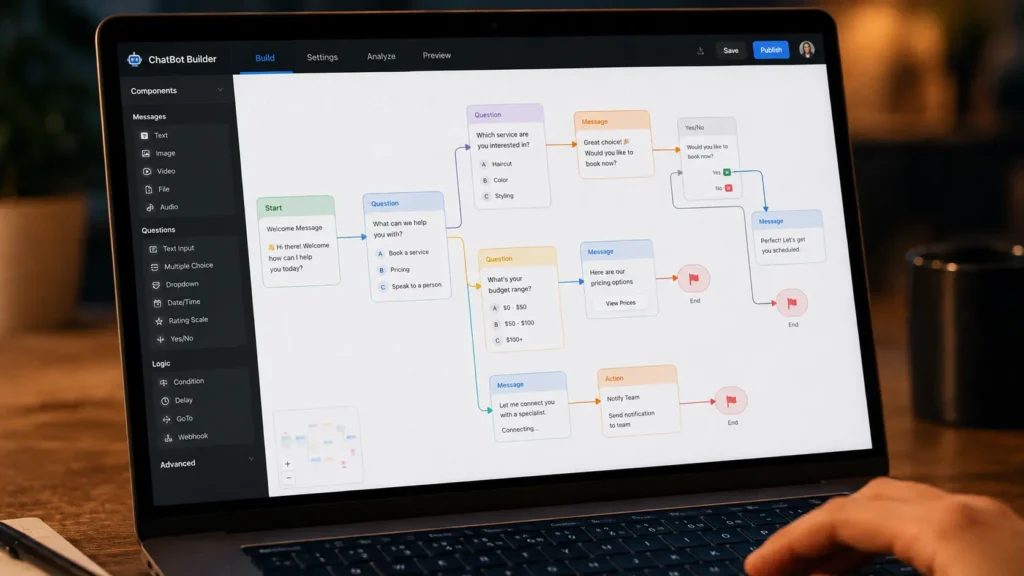
Step 1: Pick Your Platform No Coding Required
The first decision shapes everything else, but it doesn’t have to be complicated.
Platforms like Botpress, Tidio, Voiceflow, and Landbot now offer drag-and-drop interfaces, pre-built AI templates, and native integrations with tools like Shopify, HubSpot, Slack, and WhatsApp. You control the logic, the tone, and the training data without touching a single API directly.
Here’s a plain-language breakdown of which tool fits which situation:
Tidio is a good fit for small ecommerce teams that want live chat, flows, and AI support on the website with clean, polished UX. Landbot shines when the chatbot is really a guided form: lead capture, qualification, quote requests, surveys, or onboarding. Botpress works best when someone on your team can think through workflows, logic, integrations, and testing at a technical level.
For beginners, Chatbase or SiteGPT are the fastest entry points upload your own content to train the AI layer, no machine learning expertise required.
Step 2: Pick One Industry, One Problem
This is where most beginners make the mistake that kills their business before it starts.
The trick is to go narrow. Pick one industry and one problem. Don’t say “I build chatbots for businesses.” Say “I help dental practices stop losing leads to voicemail after hours.” That specificity is what gets replies.
The best-performing niches for chatbot sellers in 2026:
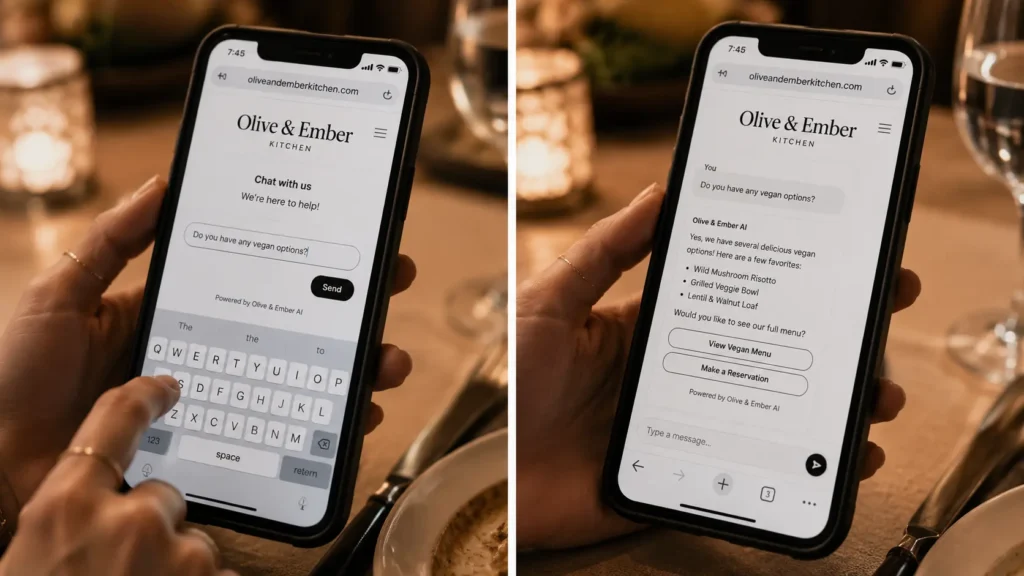
Local service businesses like dentists, plumbers, HVAC companies, and salons miss calls constantly. Real estate agents need 24/7 lead capture for property inquiries. E-commerce stores find that order status questions are 60–70% of their support volume. Coaches and consultants use FAQ and onboarding bots to save hours per week. Restaurants benefit from automation around reservations, hours, and menu questions especially at high-volume locations.
The premium isn’t in access to the tools it’s in understanding how to use them for specific industries. Anyone can sign up for Chatbase. Not everyone knows how to make it work for a dental practice’s specific booking flow and compliance needs. That’s the expertise clients pay for.
Step 3: Build the Bot The Actual Process
Once you’ve chosen your platform and your niche, building the first bot is more straightforward than most people expect.
Before you open any platform, get crystal clear on what the chatbot needs to do. Vague goals produce vague bots that frustrate users. The most effective AI chatbots are built around one or two core use cases. Once you pick your lane, define the top 10–15 questions or tasks users will bring to the bot these become the foundation of your conversation flows. A focused chatbot with excellent answers to 15 things outperforms a bloated bot that handles 100 things poorly.
Train the bot on the client’s actual content their website, FAQ page, service menu, or PDF documents. The AI then trains itself on this data within minutes, enabling it to respond naturally using business-specific information.
Then connect it to the tools the client already uses: CRM systems like HubSpot or Salesforce automatically log leads, conversations, and contact info. A chatbot that fits into the client’s existing workflow is one they’ll actually use and keep paying for.
Building an AI chatbot now takes 6–8 weeks using no-code platforms instead of 12 months meaning you can move from first conversation to paying client faster than almost any other service business. Once you’ve built 10 bots, the 11th takes a fraction of the time.
Step 4: How to Price It
Pricing this service the wrong way is the fastest path to underearning.
The standard model used by successful chatbot agencies has two parts: a one-time setup fee and a recurring monthly retainer. Freelancers in this space charge $1,000 to $5,000 per bot for initial build, plus $200 to $500 monthly for maintenance and updates.
The monthly retainer is the key it covers updates, monitoring, retraining the bot with new information, and answering client questions. For the client, it’s a tiny fraction of what they’d spend on a part-time employee. For you, it’s predictable recurring revenue that compounds as you add clients.
Agencies using white-label chatbots see 40% higher client retention rates compared to those selling one-off builds. White-labeling building on a platform, then presenting it under your own brand is exactly the model that creates a sustainable agency rather than a freelance gig.
Step 5: How to Find and Close Your First Client
The sales pitch writes itself once you understand the client’s pain.
For outreach, LinkedIn and local Facebook groups are more effective than cold email for this. A message that opens with a specific observation about their business “I noticed your website doesn’t have a live chat and I checked your Google reviews, a few people mentioned not being able to get answers quickly” gets attention.
Lead with the problem, not the technology. Small business owners don’t care that it’s built on Tidio or powered by GPT-4. They care that they’ll stop missing leads at 10pm and stop paying someone to answer the same ten questions every day.
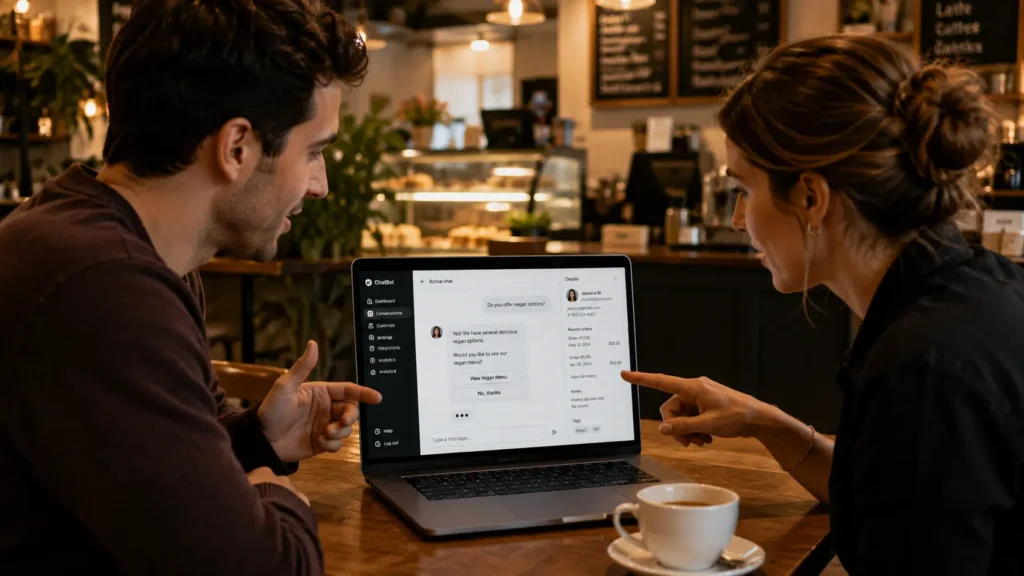
Offer a free demo build a basic bot trained on their website, shown in a 15-minute screen share. Seeing their own business name and their own product answers come back from a chatbot in real time closes more deals than any sales deck.
What Separates Chatbots That Work From Ones That Don’t
If your platform supports LLM integration and most do in 2026 add an AI fallback layer so the bot can handle unexpected questions using generative AI rather than dead-end error messages. Keep conversations short, action-oriented, and easy to navigate. Every dead end is a lost customer.
Review the outputs regularly, especially in the first few weeks, and correct anything inaccurate. A well-maintained bot is a retained client. A broken bot is a refund request.
The Bottom Line
This isn’t a piece about passive income or get-rich-quick systems. It’s about a real, service-based business with a predictable recurring revenue model one that you can build part-time, with tools that cost less than a Netflix subscription to start.
Small businesses need this solution. The tools to build it have never been more accessible. And the person who shows up with a working demo and a clear monthly price will almost always win the client.
The only question is whether that person is you.
Read Also:
- 🔗 How to Make $500/Month Selling AI-Generated Digital Products on Etsy
- 🔗 AI Tools That Are Making Americans Extra Income in 2026 — The Complete Guide
© AiwalaNews | Global Tech & Privacy Edition | June 2026
