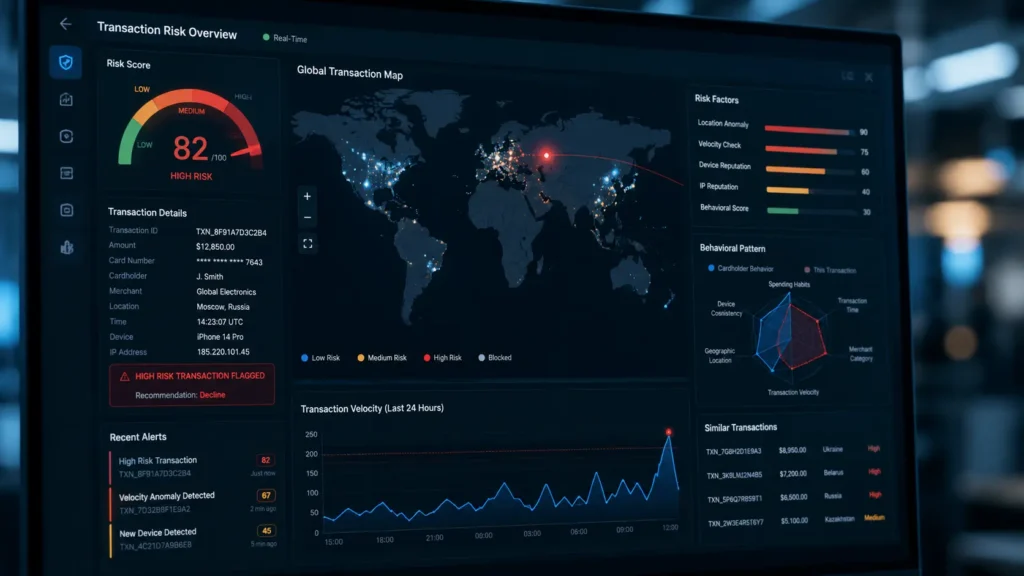
You’re standing at a checkout counter. You tap your card. The machine pauses and then flashes “DECLINED.” Your balance is fine. Your card isn’t expired. You paid your bill on time. So what just happened?
The answer isn’t a glitch, and it isn’t your bank being difficult. It’s an AI system that analyzed over 500 data points about you, your card, this merchant, this location, and this exact moment in time and decided something didn’t add up. All of it happened before you could blink.
Here’s exactly how that decision gets made and why it sometimes gets it completely wrong.
The Timeline: What Happens in 50 Milliseconds
Most people assume a card decline happens because of a simple rule too many transactions, wrong PIN, insufficient funds. The reality is far more sophisticated and far faster.
AI systems now catch fraudulent transactions in under 50 milliseconds faster than a human can blink. It takes about a millisecond to estimate the probability of fraud. The results are sent to the cardholder’s bank, where the final decision on whether to approve or decline the transaction is made.
In that single millisecond, your transaction has already been scored, profiled, and compared against hundreds of variables most of which have nothing to do with your available balance.
The practical latency target for this entire process — model inference, feature computation, and database lookups all needs to complete within 200 milliseconds, achievable with modern infrastructure including in-memory feature stores, pre-computed customer profiles, and GPU-accelerated inference.
The AI That Has Been Quietly Studying You
This is the part most cardholders never realize is happening and it starts long before you ever swipe.
Modern AI systems build behavioral profiles for each cardholder based on hundreds of data points: typical purchase amounts, preferred merchants, geographic patterns, time-of-day spending habits, device fingerprints even typing speed during online checkouts.
Visa employs neural networks in its fraud detection system, Visa Advanced Authorization, which assesses over 500 transaction attributes, including type, location, spending patterns, and time of day processing millions of transactions in milliseconds and sending fraud probability scores to banks for real-time decisions.
AI models simultaneously analyze transaction amounts, frequencies, locations, merchant categories, device characteristics, time of day, recent account activity, historical customer behavior, and dozens of other variables assigning probability-based risk scores that far exceed the accuracy of simple rule-based approaches.
So when you swipe your card, the AI isn’t just checking your balance. It’s asking: does this purchase match how this specific person normally behaves? Is the amount typical? Is the merchant familiar? Is the timing consistent with past patterns? Is the location where this person usually shops?
If the answers don’t align, the risk score climbs and if it climbs high enough, the transaction gets flagged before a human ever looks at it.
The Geographic Impossibility Trigger
This is one of the most common causes of a legitimate card being declined and it catches thousands of innocent cardholders every day.
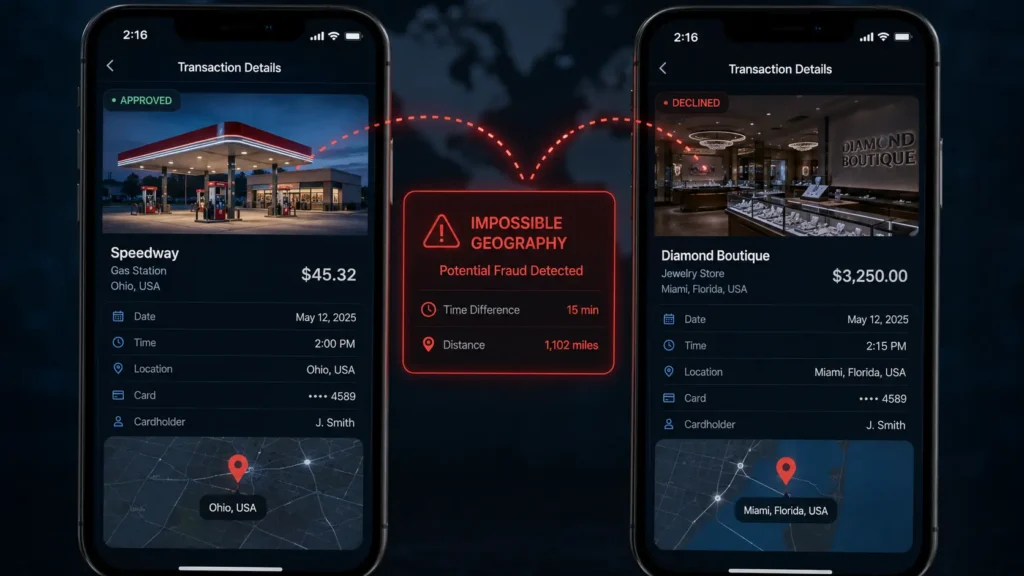
These algorithms establish what’s “normal” for your account, then flag deviations. Bought gas in Ohio at 2 PM, then attempted a jewelry purchase in Miami at 2:15 PM? The geographic impossibility triggers a block. This method catches account takeovers effectively but produces false positives when customers travel without notifying their bank.
The system isn’t wrong to flag it a genuine fraudster using a cloned card in a different state would look exactly the same. The problem is that you, the legitimate cardholder who just caught a last-minute flight, look identical to that fraudster from the AI’s perspective.
This is exactly why calling your bank before traveling even domestically still meaningfully reduces the chance of a declined card at the worst possible moment.
Fraud Rings And Why They Can Affect Your Innocent Card
There’s a less obvious reason your card sometimes gets flagged that has nothing to do with your own behavior at all.
Fraudsters don’t operate alone. AI systems map connections between accounts, devices, and merchants to identify fraud rings. When one compromised card gets used at a specific ATM, the system flags other cards used at that same ATM within a suspicious timeframe.
In other words: if you used the same ATM or merchant that a fraudster happened to use around the same time, your card can be caught in the same net purely by association. This is network-based detection, and it’s one of the reasons a card can be proactively blocked even before any suspicious transaction appears on your own account.

Test Transactions The Pattern Most People Don’t Know About
There’s another fraud signal the AI watches that most cardholders have never heard of.
If fraudsters typically make small test transactions before larger fraudulent ones, the AI recognises this sequence. This means that a small, unusual purchase say, a $1 charge at an unfamiliar vendor can actually trigger a flag on a larger purchase you make immediately afterward, because the sequence matches a known fraud pattern.
This is why multiple small transactions followed quickly by a large one can sometimes trigger a decline, even when every single purchase is completely legitimate.
The False Decline Problem Nobody Talks About
Here’s the uncomfortable truth hiding behind all this sophisticated technology: it gets it wrong. More often than banks would like to admit.
Managing false positives in fraud detection has become one of the top operational burdens in fraud monitoring, yet most fraud teams understate how often legitimate transactions get rejected.
Traditional systems often decline legitimate transactions when they appear unusual creating frustration for travellers and online shoppers. AI systems reduce false declines by 80%, according to a 2024 NPCI study. But even an 80% reduction still means millions of legitimate transactions get blocked globally every single day.
PayPal adopted deep learning models which are 10–20% more accurate than traditional ML algorithms and today, PayPal’s fraud loss rate is among the lowest in the industry at 0.28% (28 cents per $100 processed). That improvement in accuracy directly translates to fewer false declines for legitimate users showing that better AI doesn’t just catch more fraud, it also wrongly blocks fewer innocent people.
Where This Is Heading in 2026
The fraud detection arms race isn’t slowing down and the technology is evolving faster than most people realize.
As the industry looks toward 2026, the focus is shifting from generative AI which summarizes and creates to agentic AI, which executes. These autonomous systems will move beyond simple detection to proactively managing fraud investigations, and can even be deployed directly to customers, empowering them with AI-based scam assessment tools that evaluate suspicious emails or texts in real time before the customer takes action.
Behavioral biometrics now provide continuous authentication by analyzing a user’s unique patterns such as typing rhythm, device orientation, and touchscreen pressure throughout a session, allowing institutions to detect an account takeover in real time if the interaction pattern suddenly changes, even if the fraudster has legitimate credentials.
In simple terms: the AI watching your transactions is about to start watching how you hold your phone as well.
What You Can Actually Do to Avoid a Decline
Understanding the system means you can work with it instead of against it.
1. Notify your bank before traveling.
Even a quick in-app notification removes the geographic impossibility flag before it can trigger.
2. Don’t make multiple large purchases in rapid succession.
Velocity the speed and frequency of transactions is one of the strongest fraud signals the AI watches. Spacing out large purchases can make a meaningful difference.
3. Keep your contact information current.
When the AI flags a transaction, banks send a real-time text asking you to confirm. If your number is outdated, that confirmation never arrives and the transaction stays declined.
4. Use your card regularly at trusted merchants.
Consistent, predictable behavior at familiar merchants builds a strong behavioral baseline making you look trustworthy to the AI over time.
5. If declined, call immediately don’t just retry.
Retrying a declined card multiple times is itself a fraud signal. Call your bank directly, confirm your identity, and have the transaction manually approved instead.
Read Also:
- 🔗 How Banks Move Billions of Dollars Every Day Without Losing Track
- 🔗 The Invisible Companies Buying and Selling Your Data Every Day
© AiwalaNews | Global Tech & Privacy Edition | June 2026
