Whether you’re opening YouTube in New York, shopping on Amazon in Texas, or streaming Netflix in California, you’ve probably noticed that some websites load almost instantly. Yet others seem to take forever.
Most people assume it’s because they have fast internet.
In reality, your internet speed is only part of the story.
Behind the world’s fastest websites is an invisible technology that quietly delivers content from locations much closer to you. This system reduces delays, prevents network congestion, and helps billions of users access websites in milliseconds.
It’s called a Content Delivery Network, or CDN, and it has become one of the most important technologies powering the modern internet.
The Internet Is Bigger Than Most People Imagine
When you visit a website, your request doesn’t magically appear on your screen.
Normally, your device sends a request to the website’s server.
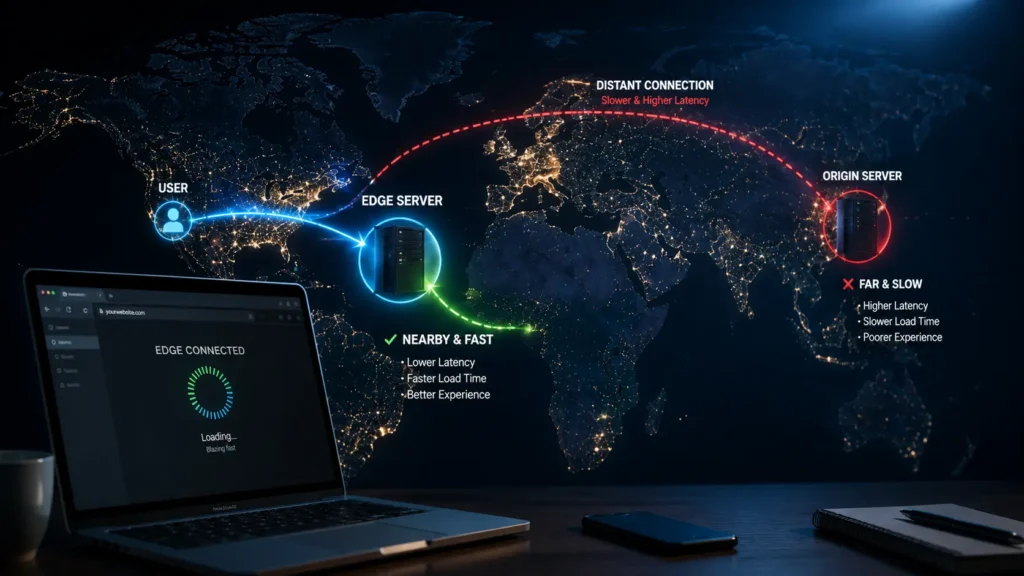
If that server is located thousands of miles away, the information has to travel through multiple internet providers, routers, fiber optic cables, and data centers before reaching your browser.
Even though data moves close to the speed of light through fiber optic cables, long distances still create noticeable delays known as latency.
The farther the server is, the longer your browser waits.

The Hidden Network That Solves This Problem
Instead of storing a website in only one location, companies use Content Delivery Networks to create copies of their content in hundreds of data centers around the world.
These locations are called edge servers.
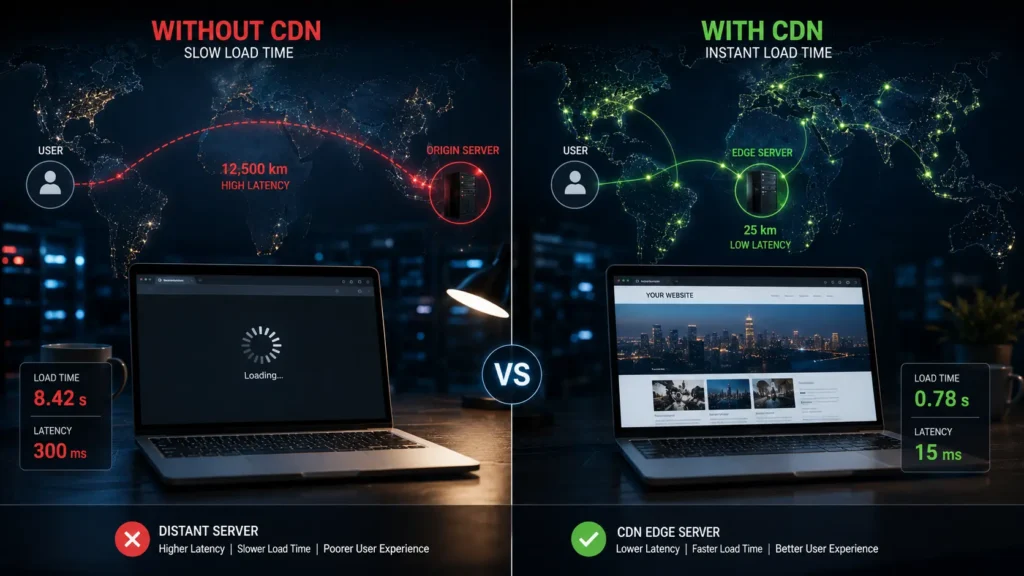
When someone visits a website, the CDN automatically sends content from the server closest to that visitor rather than the original server.
If you’re in Chicago, you may receive data from a nearby data center instead of one located in California or Europe.
The result is dramatically faster loading times.
How CDNs Work in Seconds
Imagine borrowing a book.
Instead of traveling across the country to the main library, you simply visit your neighborhood branch.
The book is the same.
The distance is much shorter.
That’s exactly how a CDN works.
When you open a website, the network quickly identifies your approximate location using your IP address.
It then routes your request to the nearest available edge server.
This entire process happens automatically in a fraction of a second.
Most users never realize it’s happening.
Why Netflix, Amazon, and YouTube Depend on CDNs
Streaming platforms deliver enormous amounts of data every second.
A single high definition movie can require several gigabytes of information.
If every viewer had to download that content from one central server, the system would quickly become overloaded.
Instead, companies distribute videos across thousands of servers worldwide.
When millions of people watch the same movie or sporting event, nearby CDN servers handle most of the traffic.
This reduces congestion while improving speed and reliability.
CDNs Also Make Websites More Reliable
Speed is only one advantage.
CDNs also improve website availability.
If one server experiences technical problems or loses power, another nearby server can immediately begin serving visitors.
This redundancy helps major websites remain online even during hardware failures or unexpected traffic spikes.
It is one reason global platforms continue operating during major events that attract millions of simultaneous users.
They Help Stop Cyberattacks Too
Many of the world’s largest websites also use CDNs as part of their cybersecurity strategy.
One of the biggest online threats is a Distributed Denial of Service, commonly known as a DDoS attack.
In these attacks, criminals attempt to overwhelm websites with enormous amounts of fake traffic.
Because CDN providers operate thousands of servers across the globe, they can absorb and distribute malicious traffic before it reaches the original website.
Companies such as Cloudflare, Akamai, and Fastly provide these protective services for businesses, governments, and media organizations.
Artificial Intelligence Is Making CDNs Smarter
Modern CDNs do much more than store copies of websites.
Many now use Artificial Intelligence to predict traffic patterns.
For example, if a major sporting event, software launch, or online sale is expected, AI systems can prepare nearby servers before visitors even arrive.
Some CDNs also detect suspicious traffic automatically, helping block cyberattacks within seconds.
This intelligent optimization keeps websites fast even during periods of extremely high demand.
Why Websites Feel Faster on Your Second Visit
Have you ever noticed that a website loads faster the second time?
Part of the reason is browser caching.
Your device temporarily stores images, logos, and other files locally.
Combined with CDN technology, caching reduces the amount of information that must be downloaded again.
The result is an even faster browsing experience.
The Future Is Edge Computing
CDNs are evolving into something even more powerful called edge computing.
Instead of simply delivering files, edge servers can now process data much closer to users.
This reduces delays for:
- Artificial Intelligence applications
- Online gaming
- Video conferencing
- Autonomous vehicles
- Smart city infrastructure
- Internet of Things devices
Processing information closer to users allows services to respond almost instantly.
The Bottom Line
Every time you visit a fast website, you’re benefiting from a hidden global network that most people never see. Content Delivery Networks quietly place website content on thousands of servers worldwide, reducing delays, improving security, and helping billions of people access information in milliseconds.
Whether you’re streaming movies, shopping online, or reading the news, this invisible infrastructure is one of the biggest reasons the modern internet feels fast, reliable, and always available.
Read Also
➡️ How Undersea Internet Cables Carry 99 Percent of Global Data
https://aiwalanews.com/how-undersea-internet-cables-carry-99-of-global-data/
➡️ How Cell Towers Find Your Phone in Seconds
https://aiwalanews.com/how-cell-towers-find-your-phone-in-seconds/
© AiwalaNews | Global Tech & Privacy Edition | April 2026
