
You type a question into Google and press Search.
Before you can even blink, millions of results appear almost instantly.
The entire process usually takes less than a second.
It feels simple.
Behind that single click, however, one of the world’s largest computing systems springs into action. Thousands of powerful computers begin working together across massive facilities known as Google data centers, processing your request, locating the most relevant information, and sending the results back in fractions of a second.
Most people use Google every day.
Very few know what actually happens after they press the Search button.
Your Search Begins Its Journey Almost Immediately
The moment you tap Search, your device creates a secure request and sends it through your internet connection.
That request travels through your internet service provider before reaching Google’s global network.
Instead of going to one giant computer, it is intelligently routed toward one of Google’s nearby data centers designed to respond as quickly as possible.
This entire journey often takes only milliseconds.
Speed matters because even tiny delays become noticeable when billions of searches happen every day.
Inside A Building Bigger Than Most People Imagine
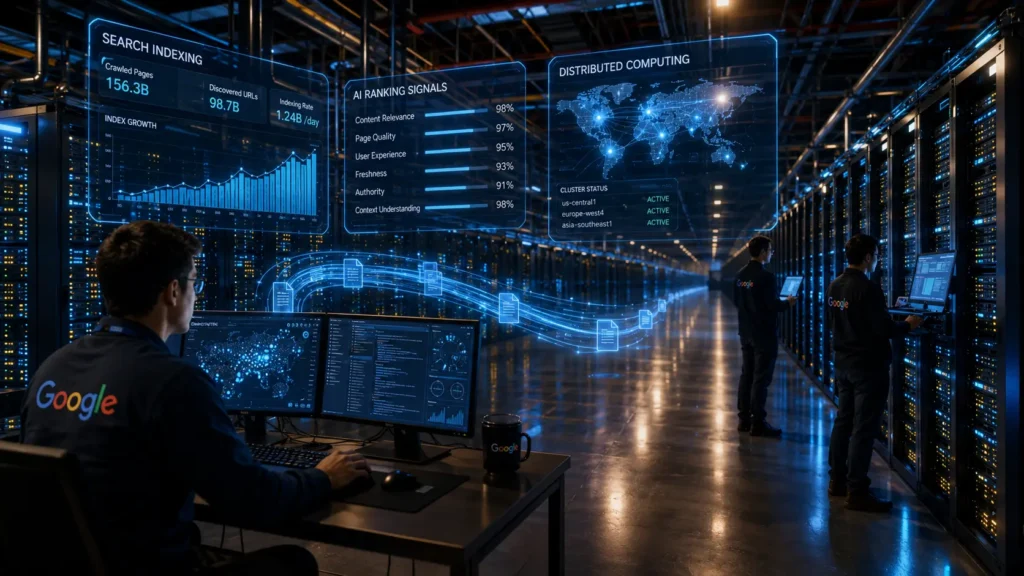
Google’s data centers are not ordinary office buildings filled with desks.
They are enormous facilities containing row after row of computer servers stretching across large halls.
Each server stores tiny pieces of information and performs specific tasks.
Together, thousands of these machines act like one enormous computer.
The buildings require advanced cooling systems because the hardware generates significant heat while processing billions of requests every day.
Keeping those servers running continuously is just as important as making them fast.
Your Search Is Split Into Many Smaller Jobs
When your search reaches Google’s systems, it is not handled by a single computer.
Instead, the request is divided into many smaller tasks.
Some servers search Google’s massive index of web pages.
Others evaluate spelling corrections.
Some analyze language and search intent.
Others rank pages based on hundreds of signals that help determine which information is likely to be most useful.
These operations happen simultaneously rather than one after another.
Working in parallel allows Google to respond with remarkable speed.
A Real World Example
Imagine searching for “best noise canceling headphones for travel.”
Within moments, Google’s systems begin comparing billions of indexed pages.
Some computers identify websites discussing headphones.
Others recognize that you are probably looking for buying advice rather than technical research.
Additional systems evaluate freshness, page quality, relevance, and overall usefulness.
Finally, the highest ranked results are assembled into the familiar search page that appears on your screen.
Although it feels instant, countless calculations have already taken place.
Google Does Not Search The Entire Internet Every Time
One common misconception is that Google scans the internet after every search.
That would take far too long.
Instead, Google maintains an enormous search index, a constantly updated collection of information gathered by automated web crawlers.
Think of it as an incredibly detailed digital library rather than the live internet itself.
When you search, Google primarily searches this index instead of visiting every website in real time.
That approach makes results dramatically faster.
Artificial Intelligence Helps Understand Meaning
Modern Google Search depends heavily on artificial intelligence.
Instead of matching only individual words, AI helps interpret what people actually mean.
For example, someone searching for “apple battery problem” could be referring to a smartphone rather than the fruit.
Machine learning models analyze context, previous language patterns, and search intent to better understand the request.
This helps Google deliver results that match the meaning behind the words rather than simply finding identical phrases.
Why Results Appear So Quickly
Several technologies work together to reduce waiting time.
Google stores copies of frequently accessed information across multiple locations.
Popular searches are often served using nearby infrastructure.
Powerful networking equipment moves enormous amounts of data every second.
High speed fiber connections link data centers around the world.
Every component is optimized to eliminate unnecessary delays.
That is why many searches feel almost instantaneous despite the enormous amount of work happening behind the scenes.
The Data Centers Never Sleep
Unlike traditional offices, Google’s data centers operate twenty four hours a day throughout the year.
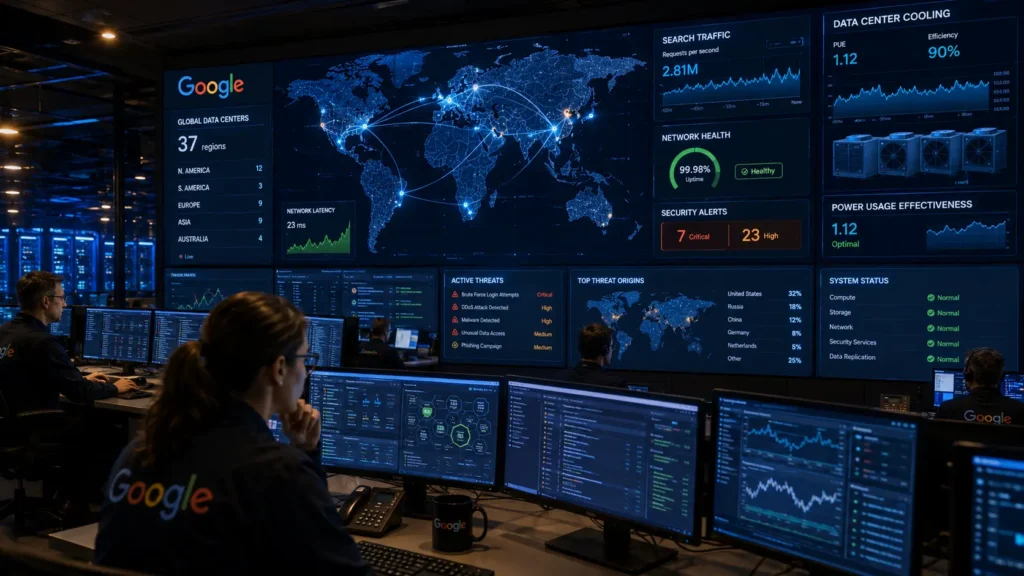
Engineers continuously monitor hardware performance, network traffic, storage systems, and power supplies.
If one server develops a problem, another immediately takes over its workload.
Multiple layers of redundancy help ensure that users rarely notice equipment failures.
This resilience is one reason Google services remain available even when individual hardware components stop working.
Security Is Built Into Every Step
Because Google’s infrastructure handles billions of searches, security plays a critical role.
Data traveling between your device and Google’s systems is encrypted.
Physical access to data centers is tightly controlled.
Specialized monitoring systems watch for unusual network activity.
Hardware, software, and operational procedures work together to protect the infrastructure supporting global search.
These protections are constantly updated as cybersecurity threats evolve.
The Invisible Machines Behind Every Search
Typing a question into Google feels effortless.
Behind that simple action, however, thousands of servers, advanced networking equipment, artificial intelligence models, and sophisticated ranking systems begin working together almost instantly.
Your search travels across global fiber networks, reaches powerful data centers, is divided into parallel tasks, compared against one of the world’s largest search indexes, and returned to your screen in less time than it takes to blink.
Most users never think about this invisible journey.
Yet every search depends on one of the most advanced computing infrastructures ever built.
The next time Google answers your question in a fraction of a second, remember that somewhere inside a massive data center, thousands of computers have quietly worked together to make that moment feel effortless.
Read Also
Read also: https://aiwalanews.com/how-to-check-if-your-data-has-already-been-leaked/
© AiwalaNews | Global Tech & Privacy Edition | April 2026
