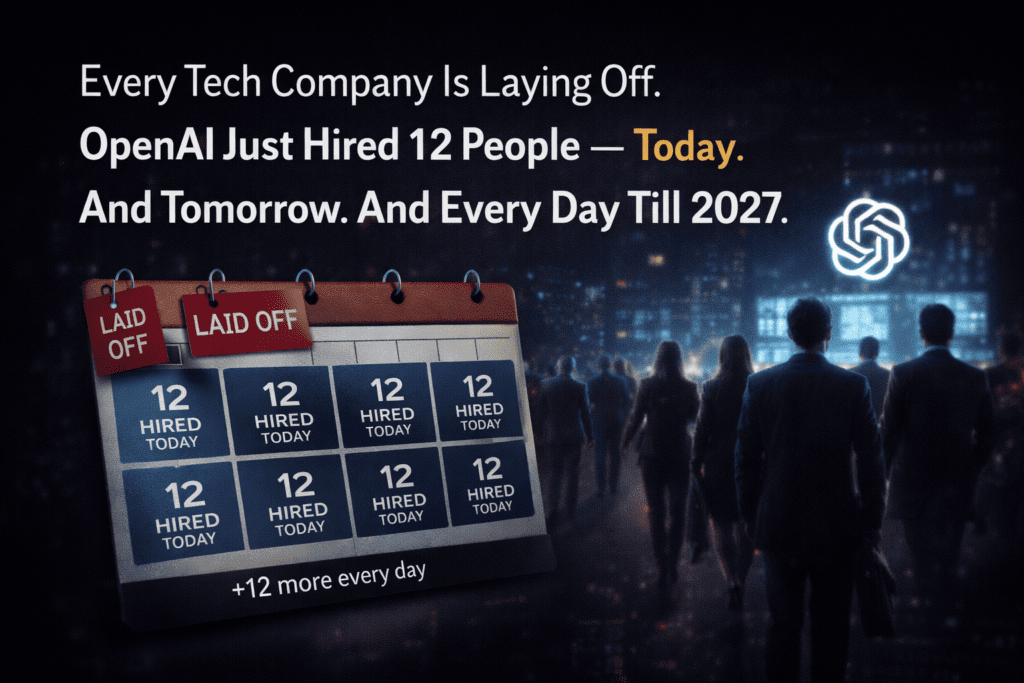
While the rest of Silicon Valley sends out pink slips, OpenAI is on the most aggressive hiring spree in AI history. 3,500 new jobs. One very uncomfortable reason why.
Let’s set the scene. It’s 2026. Meta, Google, and Amazon have all gone through rounds of layoffs. The tech job market has been brutal for two straight years. If you work in tech, you’ve either been let go or know someone who has.
And then there’s OpenAI – quietly signing a new office lease for over one million square feet in San Francisco, and planning to hire 12 new employees every single day for the rest of the year.
This isn’t a press release. It isn’t a promise. According to the Financial Times, this is already happening and the reason behind it is more telling than the number itself.
4,500 : Current OpenAI employees.
8,000 : Target headcount by end of 2026.
12/day : New hires needed every single day.
$840B : OpenAI’s current valuation.
So why is OpenAI suddenly in a panic?
One word: Anthropic.
By early 2026, Anthropic the company behind Claude had quietly reached $19 billion in annualized revenue, up from just $4 billion in mid-2025. Businesses that used to default to ChatGPT are switching. According to spending data from fintech firm Ramp, companies are now 70% more likely to choose Anthropic over OpenAI when buying enterprise AI for the first time.
That’s not a rounding error. That’s a warning signal. And internally, OpenAI’s CEO Sam Altman apparently agreed.
In December 2025, Altman issued an internal “code red” pausing all non-core projects and refocusing the entire company on one goal: winning enterprise. Reported by Financial Times, corroborated by multiple sources
Google’s Gemini 3 was also closing the gap fast. OpenAI, once untouchable, suddenly found itself in an actual race and realised it had been running lean for too long.

What 3,500 new jobs actually tells you
Here’s what most articles about this miss: OpenAI isn’t just hiring engineers. The breakdown of roles reveals exactly what kind of company it’s trying to become.
Where the 3,500 new hires are going
- Product development – building faster, shipping more, competing on features.
- Engineering & research – staying ahead of Gemini and Claude at the model level.
- Sales – converting free ChatGPT users into paying enterprise contracts.
- Technical ambassadors – a brand new role: humans who sit with businesses and help them actually use AI tools.
- Data centre & infrastructure – OpenAI is partnering with construction unions to hit 10 gigawatts of compute power by 2030.
That last role “technical ambassador” is the most interesting. It doesn’t exist yet at scale anywhere in the industry. OpenAI is essentially inventing a new job category: part consultant, part AI trainer, part sales engineer. And once OpenAI validates it, every AI company will copy it.
What this means for you even if you don’t work in AI
When a company this size hires 3,500 people, the ripple effects spread far beyond San Francisco. Every person OpenAI poaches leaves a vacancy somewhere else. Every “technical ambassador” role they create signals to companies everywhere: you now need a person whose full-time job is helping your team use AI.
That’s a new job. At your company. Whether you’re in banking, healthcare, retail, or manufacturing the “AI integration specialist” role is coming to your industry in 2026. OpenAI just put a number on it.
The timeline of how we got here
Late 2022 : ChatGPT launches. OpenAI goes from research lab to global phenomenon overnight.
Mid 2025 : Anthropic hits $4B in revenue. Enterprise customers start quietly switching from ChatGPT to Claude.
December 2025 : Sam Altman issues internal “code red.” All non-essential projects paused. Focus shifts entirely to enterprise.
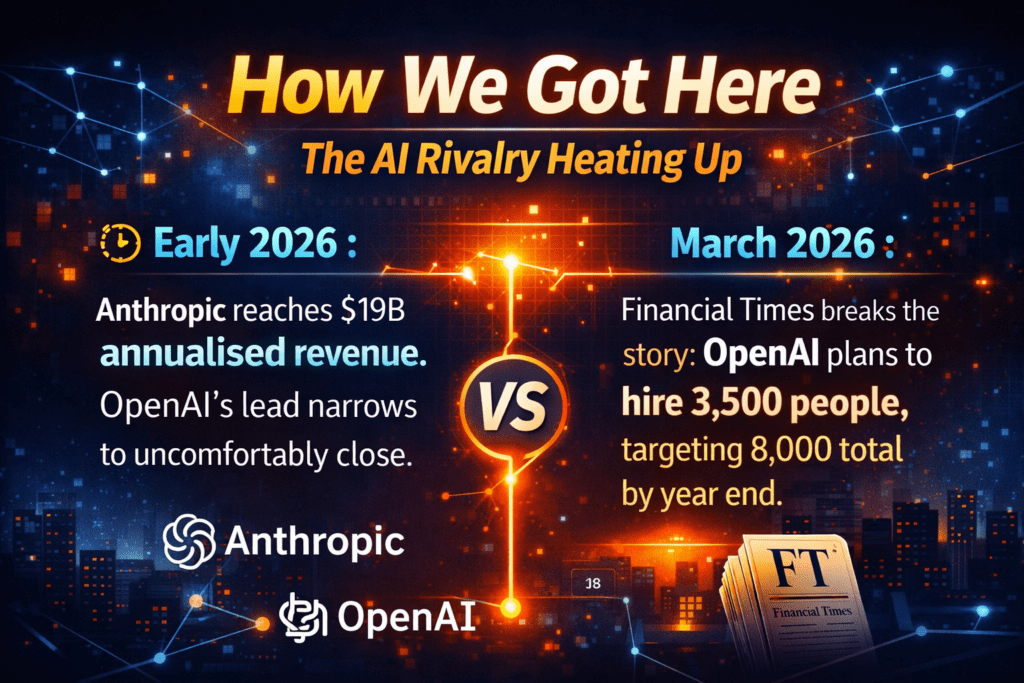
Early 2026 : Anthropic reaches $19B annualised revenue. OpenAI’s lead narrows to uncomfortably close.
March 2026 : Financial Times breaks the story: OpenAI plans to hire 3,500 people, targeting 8,000 total by year end.
The bigger picture no one is talking about
OpenAI is valued at $840 billion. It has Microsoft and SoftBank backing it. It invented the product category everyone is now chasing.
And it’s still scared enough to declare a code red, pause everything, and hire 12 people a day.
That tells you something important about where we are in the AI race. This isn’t a victory lap. This is a company that knows the gap between first and second place in AI can close faster than anyone thought possible and is doing everything in its power to make sure it doesn’t find out what second place feels like.
The AI war isn’t over. It’s just getting expensive.
