
A photo editor I know, who reviews user submitted images for a mid sized news outlet, told me about a picture that landed on her desk last year that looked completely convincing. Good lighting, natural expression, nothing obviously wrong. She almost cleared it. Then she ran it through a detection tool out of habit, and the software flagged it within seconds, pointing to something in the image she never would have caught on her own: a faint, mathematically consistent noise pattern that simply didn’t match how any real camera sensor behaves.
That gap, between what a trained human eye can catch and what a machine can catch, is the entire story of how fake photo detection actually works today.
Cameras Leave Fingerprints, AI Generators Don’t
Every real camera sensor produces a subtle form of electronic noise unique to that specific device, something researchers call Photo Response Non Uniformity, or PRNU for short. It’s essentially a tiny signature baked into every photo a real camera takes, invisible to the naked eye but statistically consistent and traceable. AI generated images almost never replicate this correctly. They either produce no meaningful sensor noise at all, or they produce noise that follows a completely different mathematical pattern than an actual camera would ever create. Detection systems built around this idea don’t need to understand what’s in a photo at all, they just need to check whether the noise looks like it came from real hardware or from a generative model.
Related techniques push this further using frequency domain analysis, essentially examining an image’s underlying mathematical structure rather than its visible pixels. AI generated images tend to carry frequency patterns that behave differently from photographs, patterns invisible to a person scrolling past a photo on their phone, but glaringly obvious to a model trained specifically to look for them.
The Small Mistakes Generators Still Can’t Fully Hide
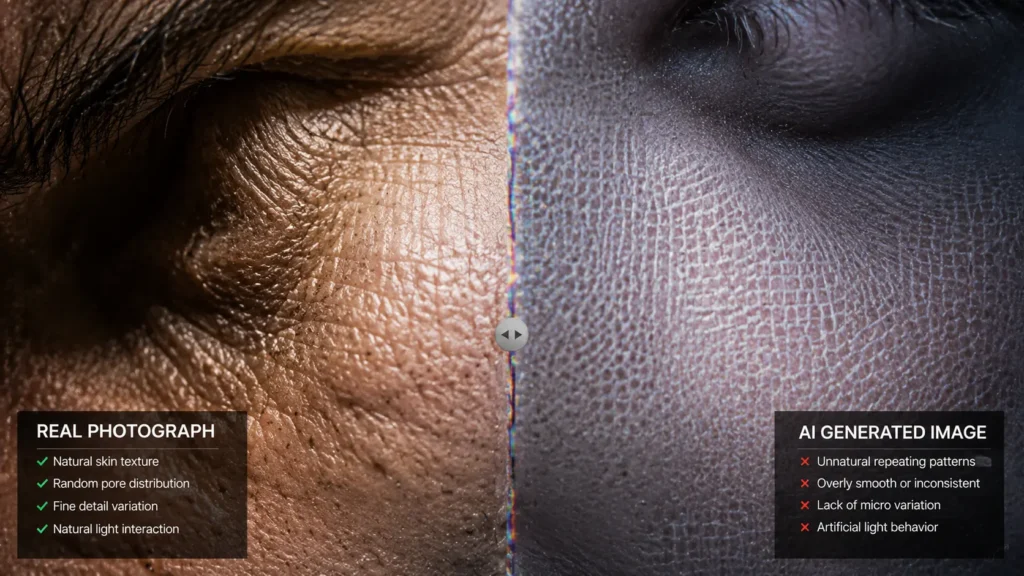
Beyond invisible statistical fingerprints, there’s a whole layer of detection built around visible errors that generative models still tend to make, just subtle enough that a casual viewer scrolls right past them. Detection research consistently points to the same recurring trouble spots: unnatural blinking patterns in video, distorted edges around hairlines and ears, lighting that doesn’t quite match across a face, and reflections that are physically impossible given the rest of the scene.
Images carry their own particular tells too. Mangled hands remain a famously persistent weakness, along with garbled text appearing on signs or clothing within a generated scene, small details a generator has to guess at without any real world reference to copy from.
Layered Detection, Not One Single Test
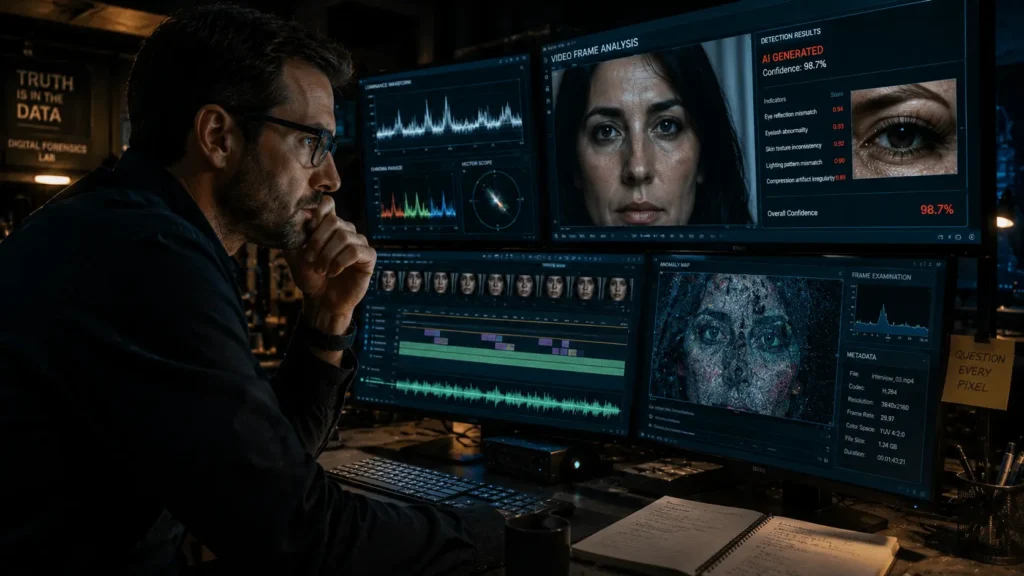
Modern detection tools rarely rely on just one method. According to security research published this year, serious detection platforms run through several analytical layers at once, starting with pixel level examination checking for blending boundaries and compression irregularities, then moving into deeper checks involving biological signals, spatial consistency, and in the case of video, whether motion and timing hold together believably across frames. Academic researchers describe this as a search for temporal inconsistencies, meaning things that look fine in a single frozen frame but fall apart the instant you watch how they move across time.
For audio and video together, cross checking has become especially important. Systems increasingly compare whether a person’s lip movements genuinely line up with the audio, since even highly convincing voice cloning tends to drift slightly out of sync with a fabricated video when examined closely enough.
The Fingerprint That Doesn’t Rely on Detection At All
There’s also a completely different approach gaining ground that doesn’t try to spot fakery after the fact, it tries to prove authenticity from the very beginning. The Coalition for Content Provenance and Authenticity, known as C2PA, has become a meaningful industry standard this year, attaching a cryptographic signature to genuine content the moment it’s captured, creating a verifiable chain of custody for that file going forward. Content missing that signature, or carrying one that’s been broken or altered, becomes an immediate red flag, arguably one of the fastest and most reliable checks currently available, since it sidesteps the constant arms race of spotting ever more convincing fakes.
Why This Still Isn’t a Solved Problem
I spoke with a digital forensics researcher who reviews synthetic media detection tools professionally (he asked not to be named since his lab has ongoing vendor evaluation agreements). His assessment matched what the published research shows plainly: detection accuracy on controlled benchmark datasets often climbs above 95 percent, but real world performance drops noticeably lower, dragged down by heavy compression, deliberate adversarial tricks, and generation models that keep improving month over month. “The tools genuinely work,” he told me, “but it’s a moving target, not a finished fortress. What catches a fake convincingly today might miss the next generation of models entirely.”
Why This Actually Matters Right Now
This isn’t a purely academic concern anymore. Financial institutions now screen video calls used for loan approvals against synthetic voice and face manipulation before processing sensitive requests. Newsrooms increasingly check source files and metadata before publishing sensitive images, precisely because fabricated visuals have real potential to influence public opinion during high stakes news cycles, including active discussion around upcoming election coverage.
The uncomfortable truth sitting underneath all of this is simple: a fake photo doesn’t need to fool an expert with a detection tool anymore. It just needs to fool you, scrolling past it in three seconds on your phone, before anyone with the right software ever gets the chance to check.
Read also this: The Hidden Sensors Inside Your Phone You Never Knew Existed | The Hidden Computers Sitting Inside Your Internet Provider
© AiwalaNews | Global Tech & Privacy Edition | April 2026
