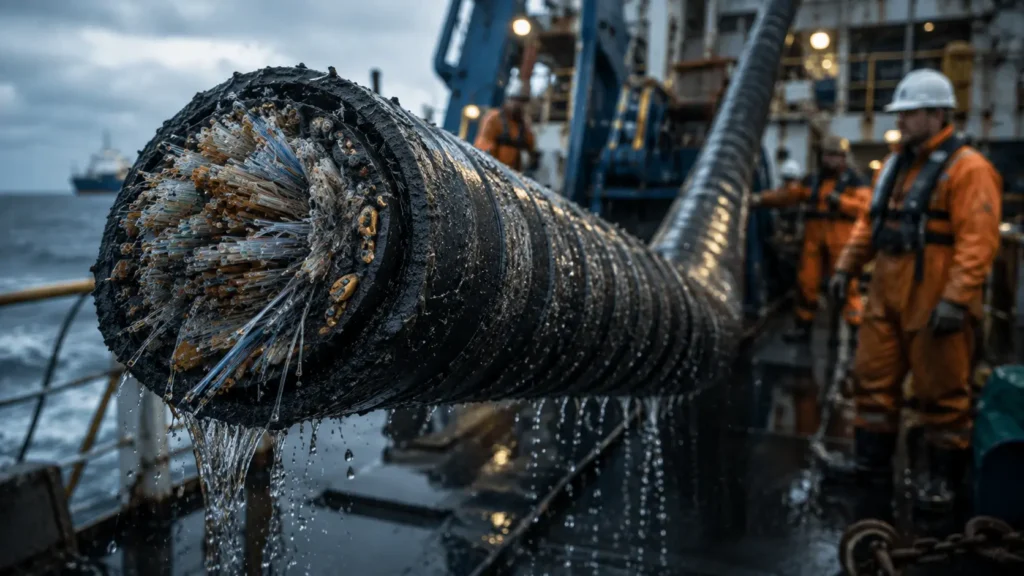
In January of last year, a storm battered the English Channel, and a ship called the King Arthur dragged its anchor across the seabed as it fought the weather. Nobody on board likely felt a thing. On the Channel Islands, three separate internet cables snapped in sequence over the course of about five hours, the first going at four in the afternoon, the last by nine that night. A telecom official there later put it plainly: broadband speeds would stay slower during peak hours until repairs finished, and repairing just the first cable alone was expected to take a full week.
That’s the strange reality of how a huge share of the world’s internet actually travels, through thin cables lying on the ocean floor, vulnerable to something as mundane as a ship anchor dragging in the wrong place at the wrong time.
Almost Everything You Do Online Runs Through the Ocean Floor
It’s easy to picture the internet as something beamed through satellites or floating invisibly overhead. In reality, the overwhelming majority of international internet traffic, nearly all of it, travels through physical fiber optic cables laid across the seafloor, connecting continents the same way old telegraph cables once did. These cables are remarkably thin given the job they do, often not much thicker than a garden hose despite carrying enormous volumes of data between entire countries.
And they get damaged more often than most people would guess. According to cable protection industry data, a vessel dragging its anchor across a cable, whether from a fishing boat or a commercial ship caught in bad weather, accounts for roughly a third of all cable faults worldwide in a typical year. Fishing gear adds to that same rough category, together making up close to three quarters of all reported incidents. Earthquakes, undersea landslides, and shifting seabed sediment cause most of the rest, with deliberate sabotage remaining genuinely rare despite how often it makes headlines.
How Engineers Find a Break They Can’t See
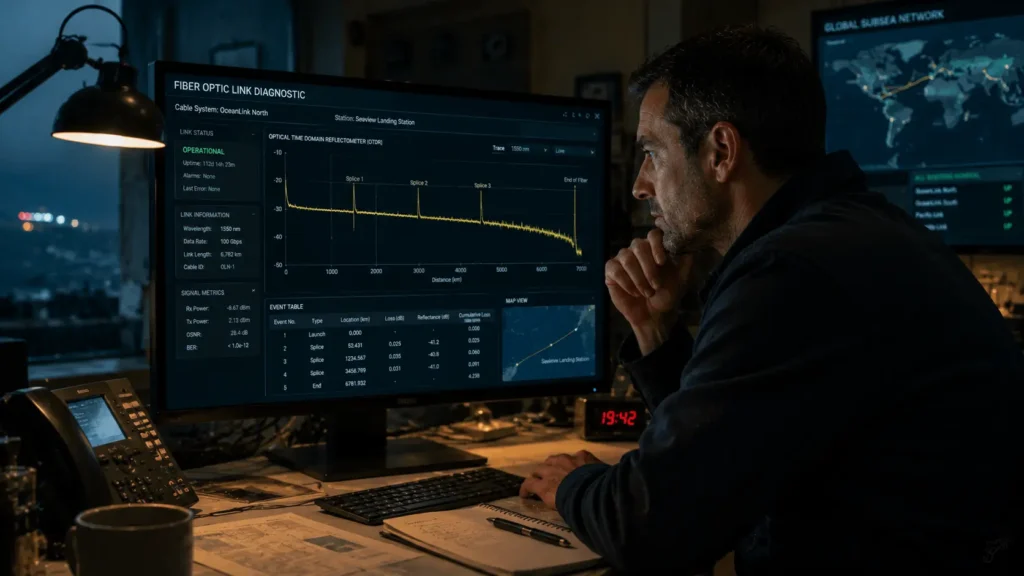
Here’s the part that genuinely surprised me. Engineers don’t need to send a ship out blindly searching the ocean floor to find a break. Using a technique called optical time domain reflectometry, teams working from shore landing stations send light pulses down the fiber itself. When that pulse hits the break, it reflects back, and the time it takes to bounce back tells engineers almost exactly where the damage sits, often narrowing the location down to within a few hundred meters, all without a single boat leaving the dock yet.
The Fix Nobody Sees Coming
Once the location is confirmed, a specialized cable repair ship gets dispatched, and this is where the scale of the problem becomes obvious. These ships aren’t sitting idle at every port, there are only a limited number stationed around the world, and getting to a damaged cable can genuinely take days. In one especially extreme case involving Tonga, a volcanic eruption severed the island nation’s only cable connection to the rest of the world, and the nearest available repair ship was nearly 4,800 kilometers away, forcing the country to rely on an emergency 2G signal for basic connectivity while repairs got underway.
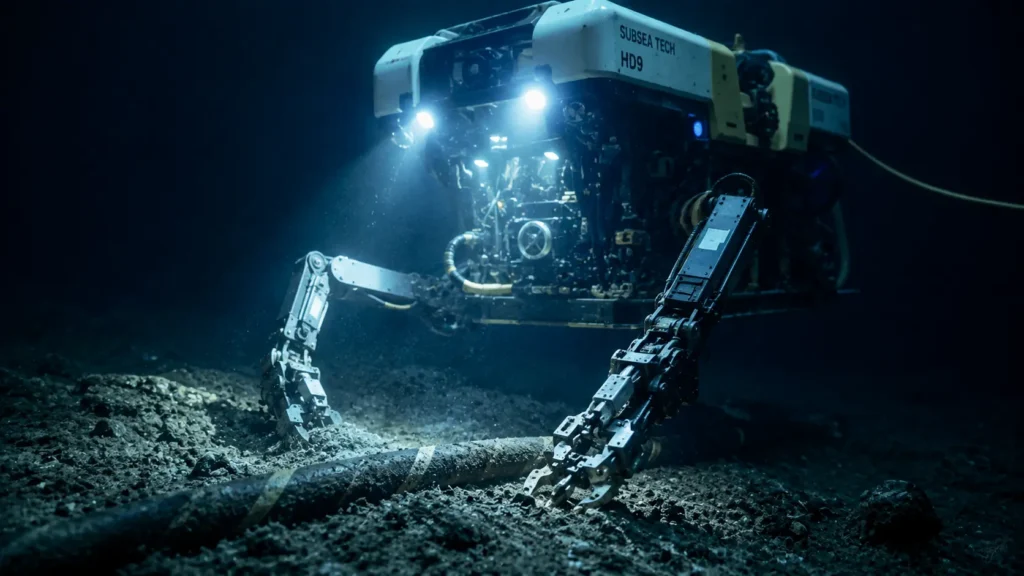
Once a repair vessel actually arrives, the process itself is almost old fashioned given how advanced the cable technology is. In shallow water, crews can grapple and physically lift the cable to the surface. In deeper water, sometimes down toward 2,000 meters, they send down a remotely operated submersible robot to locate, cut, and retrieve the damaged section instead. Either way, the ends get hauled onto the ship’s deck, spliced together with a fresh section of cable, carefully protected, and lowered back down in a loop specifically shaped to avoid kinking as it descends.
None of this is cheap. Keeping a repair ship active and ready costs many tens of thousands of dollars for every single day it’s at sea, whether or not it’s currently mid repair.
Why You Usually Never Notice
Given how often these cuts actually happen, you’d expect regular internet chaos. Mostly, you don’t get any, and that’s by careful design. The internet’s underlying structure was built specifically to survive exactly this kind of damage, with traffic capable of automatically rerouting itself through alternate cables the instant a break gets detected. When Red Sea cables were damaged last September, traffic connecting Europe, the Middle East, and Asia got rerouted through other available paths within hours, and most ordinary users never noticed more than mildly slower load times, if that.
It’s only when multiple cables fail at once, in the same region, without enough redundant paths left standing, that the public actually feels it. That’s exactly what happened off the coast of West Africa, when four separate cables broke within roughly a week of each other, leaving countries including Nigeria, Ghana, and Côte d’Ivoire scrambling with real, noticeable outages until repair ships and rerouted capacity slowly brought service back online.
A System Built to Fail Quietly
The next time your connection lags for no obvious reason, there’s a real chance the actual cause sits hundreds of miles offshore, at the bottom of an ocean, where a thin cable just took damage from something as unglamorous as a fishing net or a dragging anchor. An entire specialized industry exists solely to notice that break within seconds, reroute your traffic before you consciously register anything wrong, and then quietly send a ship out on what might be a ten day journey just to fix a cable most people will never know existed in the first place.
Read also this: The Hidden Computers Sitting Inside Your Internet Provider | How AI Detects Fake Photos Before Humans Notice
© AiwalaNews | Global Tech & Privacy Edition | April 2026
