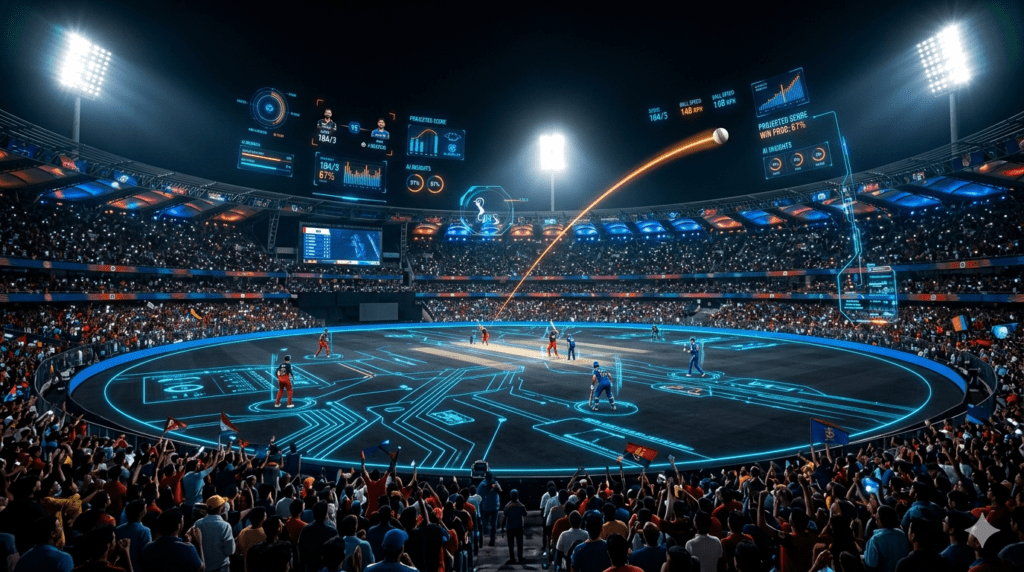
That run-out wasn’t decided by the third umpire. That LBW wasn’t called by a human. IPL 2026 is being run by machines – and not one fan in a thousand knows it.
You are watching IPL 2026 on your phone.
Virat Kohli edges one to the keeper. Umpire raises his finger OUT. RCB reviews. Two seconds later the screen fills with a glowing ball trajectory graphic. NOT OUT. Stadium explodes.
But nobody asks the real question in that moment.
Who actually made that decision?
Not the umpire. Not the BCCI. Not any human being standing on that field.
It was a machine. And that machine is just one of seven invisible technologies secretly running every single match of IPL 2026 – right now, tonight, as you watch.
The Military Tech Deciding Your LBW Reviews
HawkEye the system behind every DRS review in IPL 2026 — was originally built for British missile guidance systems. Military technology is now deciding cricket matches.
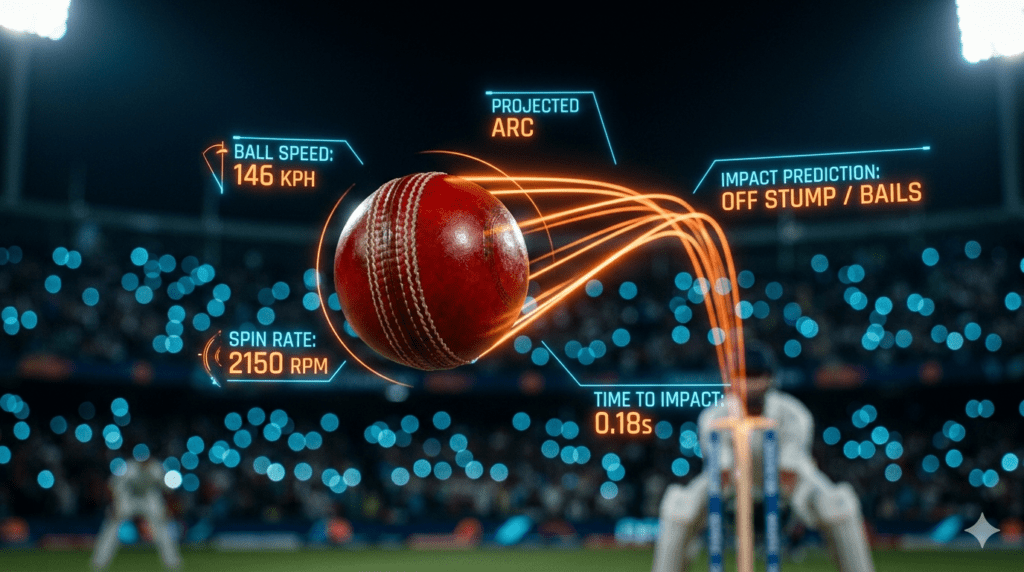
Here is what happens the moment a captain signals a review. Twelve high-speed cameras around the stadium lock onto the ball simultaneously. The system calculates its speed, spin, and trajectory 50 times per second. It then predicts exactly where the ball would have gone — within 2.5 millimetres of accuracy — and delivers the verdict in under 3 seconds.
In IPL 2026, HawkEye has been upgraded further. It now stores every batsman’s exact height in a database and automatically judges wide calls based on that specific measurement. The wide line for Virat Kohli is literally different from the wide line for Suryakumar Yadav.
The umpire raises his hand. But the decision was made by a missile system.
The Microphone That Hears the Unhearable
When a ball brushes a bat edge at 130 km/h, it creates a vibration lasting 0.001 seconds. No human ear on earth can detect it.
UltraEdge can.
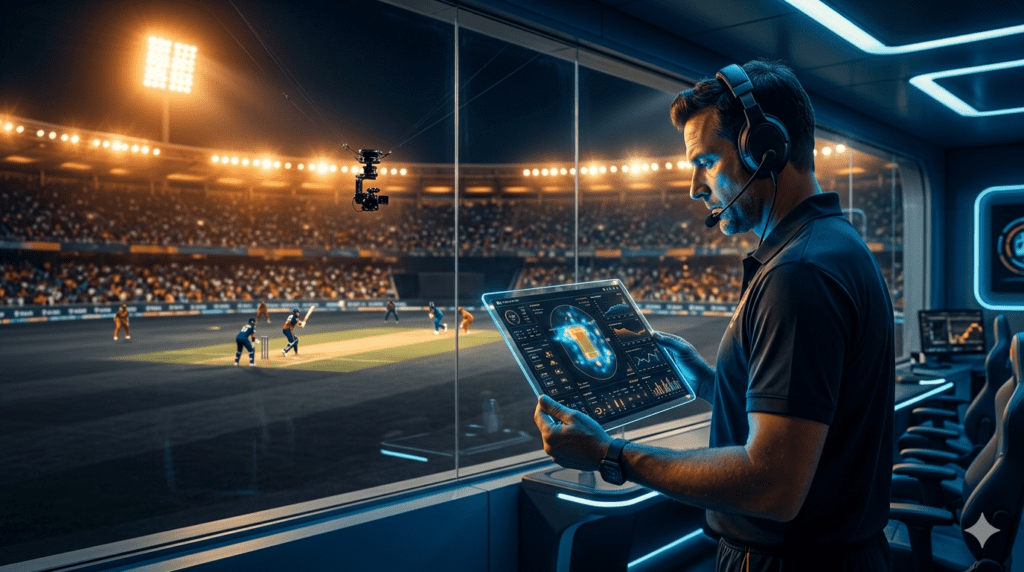
Ultra-sensitive microphones embedded near the stumps capture that sound, convert it into a waveform, and display it on the third umpire’s screen — showing the exact microsecond the ball made contact. In IPL 2026, the system has been upgraded with AI noise filtering that can distinguish between ball-on-bat, ball-on-pad, and even ball-on-clothing automatically.
That waveform graph the third umpire stares at? It is showing him a sound that nobody in that stadium — not the players, not the crowd, not the commentators – could ever hear.
The Stumps That Light Up Faster Than a Human Blink
Look closely the next time a wicket falls tonight. The bails glow for a fraction of a second.
Those are Zing Bails LED – embedded bails containing a circuit that lights up in 1/1000th of a second the moment they are dislodged. Human blink time is 150 milliseconds. Zing Bails react 150 times faster than that.
The system communicates wirelessly with the Smart Replay System and automatically triggers the best camera angle the moment a wicket breaks — before any human director has even reacted.
The Invisible Gadget Strapped to Every Player
Every IPL player this season is wearing a GPS and biometric sensor pod between their shoulder blades during warm-ups and training. The device is the size of a 50-rupee coin. What it sends back would shock you.
Sprint speed. Heart rate. Fatigue levels. Injury risk score. All of it transmitted 37 times per second to a tablet in the coach’s hands on the dugout bench.
If the AI detects that a fielder’s hamstring is under dangerous stress in the 15th over, the captain receives a quiet alert. The field placement changes. The player is protected – before they even feel the pain.
MS Dhoni once said he could read a player’s fitness by watching them walk to the boundary. IPL teams now have a machine that reads 37 data points about that same player every single second.
The AI That Planned the Match Before It Started
Before the toss even happens, every IPL franchise has already simulated today’s match thousands of times.
Mumbai Indians, CSK, and RCB all use AI analytics platforms that process ten years of ball-by-ball data in real time. The AI tells coaches which line and length dismisses a specific batsman most often. It suggests field placements for each bowler-batsman combination. It recalculates win probability after every single delivery and adjusts strategy recommendations live — while the match is happening.
When Rohit Sharma walks to the crease, the opposition’s AI has already studied his last 300 innings and identified the exact delivery most likely to get him out. IPL 2026 is not just cricket. It is a data war.
The Camera That Moves Before the Shot Is Played
IPL 2026 runs over 40 cameras in every stadium. Most of them are now controlled not by humans but by AI.
The system tracks the ball from the bowler’s hand, predicts its landing zone, and positions cameras including the Spidercam swooping overhead before the batsman has even played the shot. It then generates highlights automatically and pushes them to JioCinema and Instagram within 30 seconds of the moment happening.
The highlight you watched on Instagram just now? An AI created it, clipped it, and uploaded it. No human editor touched it.
This Is the IPL Nobody Sees
Every boundary. Every wicket. Every diving catch and dramatic run-out.
Behind all of it invisible, silent, and faster than any human machines are watching, deciding, analysing, and broadcasting. The umpires are still there. The coaches are still there. The players are still magnificent.
But IPL 2026 runs on technology that most fans will never know exists.
Now you do. Share this with every cricket fan who thinks IPL is just about sixes and celebrations.
