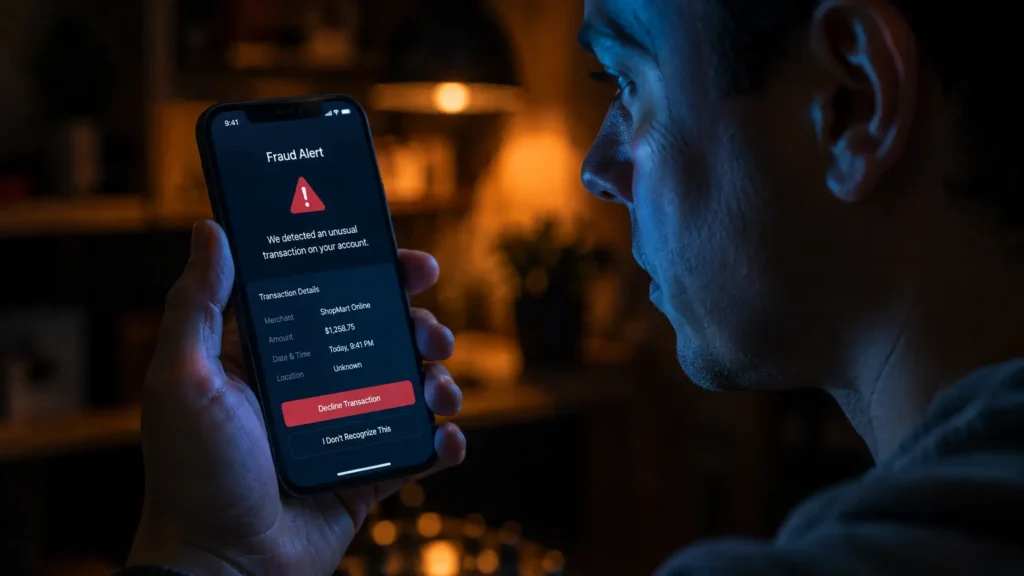
Your phone buzzes with a fraud alert before the receipt even prints. It feels like magic, but it’s actually a risk model comparing your purchase to millions of others in real time.

A former fraud analyst I once spoke with, someone who spent six years inside a major bank’s risk team, put it simply. “People think we’re watching their card,” she said, “but really, we’re watching patterns. Your card is just where the pattern shows up.” That single sentence explains almost everything about how banks catch a fraudulent purchase within seconds of it happening.
You swipe your card at a coffee shop in a city you don’t normally visit, and before the receipt even prints, your phone buzzes with a fraud alert. It feels almost psychic. It isn’t. Behind that near instant “is this really you?” text is a layered system that has been quietly evaluating your transaction since before your card finished processing.
The Transaction Never Really Just Happens
When you tap or swipe a card, the transaction doesn’t travel straight from the merchant to your bank account. It passes through several checkpoints, including a payment processor, a card network, and your issuing bank, and at nearly every stop, a piece of software is scoring the transaction for risk. All of this happens in the two or three seconds between your card touching the reader and the approved message appearing.
The bank isn’t reading your mind. It’s comparing this purchase against a profile of your normal behavior that has been quietly building for months or even years.
What The System Is Actually Looking At
Spending patterns. Every card carries a kind of behavioral fingerprint: typical purchase amounts, common merchant categories, usual times of day, and preferred payment methods. A four dollar coffee at eight in the morning on a weekday looks nothing like a six hundred dollar electronics purchase at two in the morning, and the system notices that mismatch instantly.
Location and velocity. If your card was used in Mumbai ten minutes ago and now shows an attempt in Delhi, that is a physical impossibility, and it gets flagged right away. Even without international travel, banks track velocity, meaning how many transactions occur in a short window. Five purchases in six minutes across different stores is a classic fraud signature, even when each individual purchase looks harmless on its own.
Merchant risk profiles. Certain merchant types, particularly ones tied to higher historical fraud rates, or ones your card has never interacted with before, automatically raise the risk score a little higher than a grocery store you visit every week.
Device and channel signals. For online purchases, banks look far beyond the card number itself. IP address, device fingerprint, browser type, and even typing rhythm during checkout all feed into the model. A purchase attempted from a device or location you’ve never used before adds risk, even when the amount involved is small.
A Real World Example
During a conversation about this exact topic, the analyst described a case involving a customer who had just landed in a new country. Within eleven minutes, the same card was used at an airport currency counter, a taxi kiosk, and a retail store two neighborhoods apart. The system didn’t block anything outright. Instead, it quietly raised the transaction’s risk score and queued a verification text, all before the customer had even unpacked their bag. That is the entire fraud detection process compressed into something almost invisible to the person carrying the card.
The Machine Learning Layer
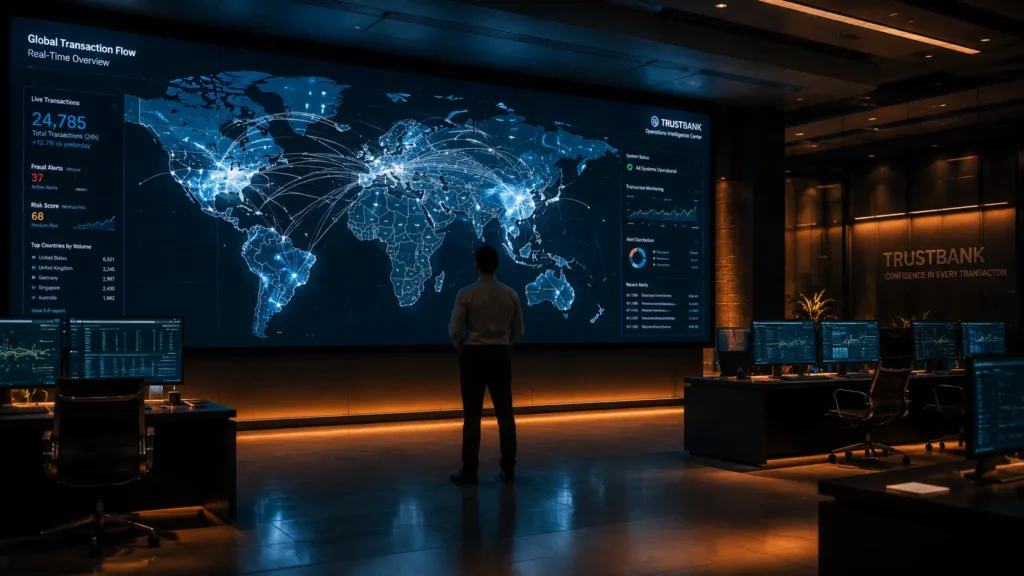
Older fraud systems relied heavily on fixed rules. If a transaction crossed a certain dollar threshold, or came from a blacklisted region, it got blocked automatically. Modern systems still use rules as a first filter, but the real power now comes from machine learning models trained on millions of past transactions, both fraudulent and legitimate.
These models don’t search for one obvious red flag. They weigh dozens of variables at once and output a risk score, something closer to a three percent chance of fraud versus a ninety two percent chance of fraud. A human reviewer isn’t approving or denying each individual purchase. The model makes that call in milliseconds, and only borderline or high risk scores ever get escalated for manual review or a temporary hold.
What makes these models genuinely effective is that they never stop learning. Every confirmed fraud case, and every false alarm a customer disputes, becomes new training data. A trick that fooled the system last year is far less likely to work today, because the model has effectively encountered that pattern before, across millions of unrelated accounts.
The Network Effect
One of the most underappreciated parts of fraud detection is that no bank works alone. Card networks like Visa and Mastercard sit above individual banks and see transaction data across their entire ecosystem. If a particular merchant terminal, card reader, or online store suddenly starts generating fraud reports across multiple unrelated banks, that signal spreads fast. A stolen card number showing suspicious activity at one bank can trigger heightened scrutiny for that same card at a completely different institution within minutes.
This is part of why a single data breach at one retailer can lead to a wave of blocked cards across many banks that had nothing to do with that retailer directly. The fraud signal travels through the shared network, not through any one bank’s internal system.
Why You Sometimes Get A False Alarm
The tradeoff in all of this is that a system tuned to catch fraud in real time will occasionally flag something that is genuinely you. Buying furniture while traveling, making an unusually large purchase, or using your card in a new country for the first time can all trip the same alarms. Banks accept a certain rate of these false positives because the cost of missing real fraud is far higher than the mild annoyance of a legitimate purchase being held for a quick text confirmation.
That is also why the fraud alert usually arrives as a simple yes or no question rather than an automatic block. The system found something unusual, but it isn’t confident enough to decide entirely on its own, so it hands the final call back to you.
The Real Takeaway
The speed feels almost magical, but it is really just layers of comparison happening faster than any human ever could manage. Your history gets compared against this purchase, this purchase gets compared against a global fraud model, and this transaction gets compared against millions of others happening at that exact same moment across the network. By the time you’ve finished tapping your card, that entire comparison has already run its course.
Read also: Why Your Phone Overheats While Charging, Explained Simply and How Two Factor Authentication Actually Stops Hackers
© AiwalaNews | Global Tech & Privacy Edition | April 2026
