
I still remember the first time I actually paid attention to what happens after hitting “Report Spam.” A colleague of mine, who spent years working on email deliverability for a mid sized marketing firm, once told me something that stuck with me. She said, “People think reporting spam just deletes an email. In reality, you just voted in an election that decides whether an entire company’s emails get blocked forever.”
That single sentence changed how I look at that tiny button sitting quietly in Gmail, Outlook, and every other inbox.
It Is Not Just a Delete Button
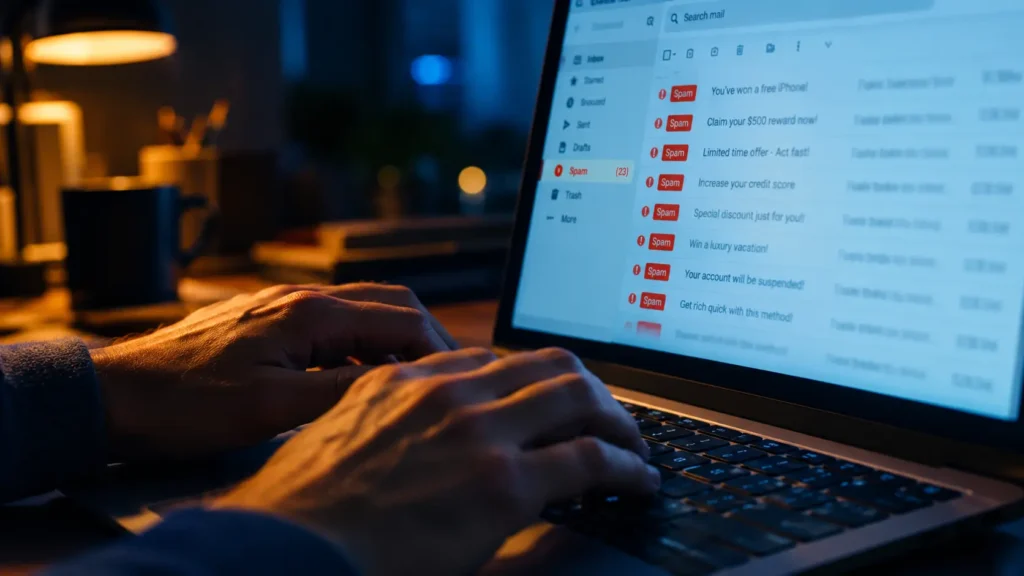
When you report an email as spam, the message does not simply vanish. Behind the scenes, your email provider logs several data points, the sender’s IP address, the domain it came from, the content structure, any embedded links, and even how many other users reported the same message around the same time.
This is where the real mechanics kick in. Providers like Gmail, Outlook, and Yahoo Mail use this data to build what is essentially a reputation score for every sending domain and IP address on the internet. Think of it like a credit score, but instead of tracking loan repayments, it tracks how trustworthy an email source behaves.
I once spoke with a small business owner in Jaipur who ran an email newsletter for his handmade furniture store. His open rates dropped from 40 percent to almost nothing within two weeks. When he investigated, he discovered a batch of subscribers had marked his emails as spam after he changed his sending frequency from monthly to daily without warning. That single behavioral shift triggered enough spam reports to tank his domain reputation, and it took him nearly three months of clean sending behavior to recover.

The Algorithm Behind the Curtain
Major email providers run sophisticated machine learning models that constantly analyze reported spam. These systems look far beyond just the report itself. They examine patterns like sending volume spikes, whether links point to newly registered domains, how many recipients open versus immediately delete, and whether the email authentication protocols, specifically SPF, DKIM, and DMARC, are properly configured.
If you have ever wondered why some phishing emails still slip through while a legitimate business newsletter lands in spam, this is usually why. Scammers often rotate through disposable domains faster than reputation systems can blacklist them, while legitimate senders build a long, stable history that occasionally gets disrupted by a wave of complaints, sometimes unfairly.
What Happens to the Sender
Here is the part most people never think about. Once enough reports accumulate against a sender, several consequences can follow.
First, the sender’s emails may start landing directly in spam folders for all recipients, not just the ones who reported it. Second, in more severe cases, the sending domain or IP gets added to blocklists maintained by organizations like Spamhaus or SORBS, which many email providers consult before even delivering a message. Third, and this surprises people, legitimate businesses can get caught in this net entirely by accident.
A friend who manages email operations for an ecommerce brand told me about a scenario where a competitor’s bot network mass reported their promotional emails as spam in a coordinated attempt to damage their sender reputation. It took direct intervention with Google’s postmaster tools and weeks of clean sending practices to restore their deliverability. This kind of retaliation, while against platform policies, does happen more often than most business owners realize.
Why Reporting Actually Matters for Everyone
Every time you report spam, you are contributing training data to a system that protects millions of other inboxes. This is genuinely one of the more effective examples of crowdsourced security working at scale. Individual reports feed into pattern recognition that eventually blocks entire spam campaigns before they reach anyone else.
However, there is a nuance worth understanding. Reporting an email as spam is different from simply unsubscribing. If a legitimate company sends you emails you no longer want, clicking unsubscribe is the correct action. Reporting spam should be reserved for genuinely unwanted, unsolicited, or malicious content. Misusing the spam button on legitimate senders contributes to false positives in the system, occasionally hurting small businesses that never intended to spam anyone.
A Quick Reality Check From Someone Who Has Seen Both Sides
I spoke with an email security consultant who put it simply. He said most people either overuse the spam button out of laziness instead of unsubscribing, or underuse it by simply deleting phishing emails without reporting them at all. Both habits weaken the overall system. The button works best when used precisely, for actual spam or phishing attempts, not general inbox annoyance.
The Bigger Privacy Angle
There is also a quieter privacy dimension here. When you report spam, some providers share aggregated threat intelligence data with third party security firms and industry coalitions working to fight phishing and malware distribution. Your individual report typically stays anonymized, but it becomes part of a larger dataset used to protect the broader internet ecosystem.
So the next time that spam button feels like a small, throwaway click, remember it is actually a small act of digital governance, one that shapes reputation scores, protects other users, and occasionally decides whether a business survives its own email mistakes.
Read also this: https://aiwalanews.com/
Read also this: https://aiwalanews.com/
© AiwalaNews | Global Tech & Privacy Edition | April 2026
