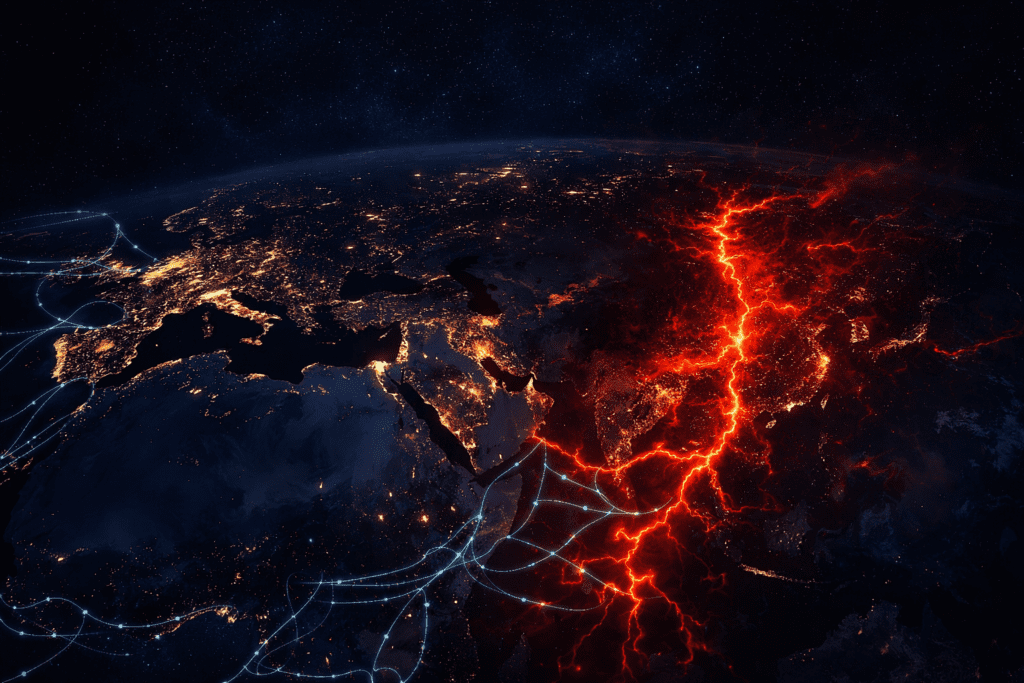
97% of the world’s internet travels through cables lying silently on the ocean floor. They are thinner than a garden hose. And right now, in two of the world’s most dangerous war zones, they are being cut, threatened, and left unrepaired. Here’s what happens to your internet – and your country – when the cables go dark.
Picture this. You wake up tomorrow morning and your internet is slow. Not dead just painfully, frustratingly slow. Your UPI payment times out. Your office video call drops every 30 seconds. Netflix buffers. Your bank’s app won’t load. You restart your router three times and assume it’s your service provider’s problem.
It isn’t. The problem is 3,000 metres below the surface of the Arabian Sea where a fiber-optic cable the width of a garden hose, carrying a significant chunk of India’s internet traffic, has been severed. And no repair ship can reach it. Because there’s a war above it.
This isn’t a hypothetical. It is already happening. And most people have no idea.
97% : of all global internet traffic travels through undersea cables.
500+ : submarine cables currently active worldwide.
$9T : worth of daily trade supported by this infrastructure.
5 months : time taken to repair Red Sea cables cut in 2024.
The internet has a physical body and it’s shockingly fragile
Most people think of the internet as wireless, cloud-based, invisible. It isn’t. Beneath the surface of every ocean lies a web of fiber-optic cables stretching 1.7 million kilometres – long enough to wrap around the Earth 42 times. These cables carry everything: your emails, your Zoom calls, your stock trades, your government communications, your Netflix queue.
As the UN’s International Telecommunication Union put it: “About 99% of international internet traffic goes through submarine cables. Even the conversation you and I are having right now is carried through these cables.”
And they are not protected by anything. No armour. No military guard. Just the depth of the ocean which, in the most strategically important places, isn’t even that deep.
“Undersea cable routes are geographically constrained with fewer options for physical bypasses. U.S. government and industry leaders have prioritized expansion over kinetic risk mitigation.” Security analyst quoted by Rest of World, March 2026
Two chokepoints – Both on fire. Right now.
The world’s internet has two critical bottlenecks two narrow passages where almost every cable connecting Europe, Asia, Africa, and the Middle East must pass through. The Red Sea and the Strait of Hormuz. In early 2026, for the first time in history, both are simultaneously in active conflict zones.
The Red Sea has been under Houthi attack since 2024. The Strait of Hormuz was declared shut by Iran’s Revolutionary Guard in March 2026. With roughly 150 ships stranded near the strait and repair vessels unable to operate safely, any cable damaged right now simply stays damaged potentially for the entire duration of the conflict.
Meta’s 2Africa Pearls project a 45,000 km cable system that would have connected India, Pakistan, the UAE, Saudi Arabia and more has been indefinitely suspended. The French company contracted to lay it has halted operations entirely. The internet expansion the world was counting on is on hold, indefinitely.
Key cables currently at risk
- SMW5 (SeaMeWe-5) connects Singapore to France via the Middle East, passing through both chokepoints
- EPEG (Europe-Persia Express Gateway) 25,000 km cable connecting Europe to India via the Persian Gulf
- 2Africa Pearls Meta-led project connecting India, Gulf states and Africa; construction suspended
- AAE-1 one of the longest cables in the world, running from Asia to Europe via the Red Sea
- C-Lion1, BCS East-West – Baltic Sea cables mysteriously severed in late 2024, suspected Russian sabotage

Why India gets hit first – and hardest
India is the world’s most internet-dependent large economy when it comes to undersea cable reliance. Nearly all of India’s international internet traffic every international bank transfer, every outsourced IT call, every global software deployment, every overseas remittance flows through cables that pass through either the Red Sea or the Strait of Hormuz.
In 2025, when cables were cut in the Red Sea, internet speeds slowed noticeably across India, the UAE, Saudi Arabia, and Kuwait within hours. Financial trading platforms lagged. Call centres dropped calls. Cloud services based in Europe became sluggish for Indian users.
India’s $250 billion IT export industry runs almost entirely on these cables. A sustained disruption doesn’t just slow your Instagram feed it threatens the backbone of the economy that employs millions.
India :IT exports, banking, UPI international payments, and BPO operations all depend on Red Sea and Hormuz cable routes.
United States : 80% of US military communications travel through undersea cables. Wall Street, cloud giants AWS and Azure, all exposed.
United Kingdom :London’s financial markets process trillions daily through cable-dependent systems. UK is also a major cable landing hub for Europe.
Global : $9 trillion in daily trade. Cloud services in Frankfurt, Singapore, and Dubai. All connected by the same fragile cables.
This isn’t new – it’s been quietly escalating for years
September 2022 : Nord Stream pipelines blown up in the Baltic Sea. First major act of undersea infrastructure sabotage in the modern era.
February 2024 : Three Red Sea cables cut when a Houthi-struck cargo ship drags its anchor across the seabed. Asia-Europe internet disrupted. Repair takes five months.
November–December 2024 : Baltic Sea cables C-Lion1 and BCS East-West mysteriously severed. Finland mobilises the military. Russia suspected.
January 2025 : Taiwan’s largest telecom reports undersea cable damage. China suspected. NATO deploys frigates and naval drones to the Baltic.
2025 : Internet speeds slow across India, UAE, Kuwait and Saudi Arabia as Red Sea cables take further damage from ongoing conflict.
March 2026 : Iran closes the Strait of Hormuz. Both critical chokepoints now in active war zones simultaneously – a first in history. Repair ships stand down.
