Right now, somewhere in the world, a recruiter at a company you have been dreaming about just visited your LinkedIn profile. They scrolled for a few seconds. They closed the tab. They moved on to the next candidate.
You never got a notification. You never knew. And just like that, the job was gone.
This is not a hypothetical. This is happening to millions of professionals in the US, UK, India, and across the globe every single day and almost none of them realize it.
LinkedIn now has over 1 billion users worldwide. Every single one of them believes their profile is “good enough.” Very few of them are right. The brutal truth is that most LinkedIn profiles are not just weak.
The Numbers That Should Terrify You
| Stat | What It Means For You |
|---|---|
| 7 seconds | Time a recruiter spends on your profile before deciding |
| 87% of recruiters | Use LinkedIn as their primary hiring tool |
| 40× more likely | To get opportunities with a fully optimised profile |
| 21× fewer views | Profiles with no photo receive compared to those with one |
The Silent Rejection Machine Nobody Warned You About
LinkedIn is not just a digital resume. It is an algorithm-powered gatekeeping system that decides who gets seen and who gets buried.
When a recruiter at Google, Deloitte, HSBC, or any fast-growing startup searches for candidates, LinkedIn’s algorithm determines whose profile appears in their results. If your profile is missing critical signals the right keywords, the right structure, the right engagement you simply do not exist in their search.
This is happening to recent graduates in Mumbai applying to global remote jobs. It is happening to experienced professionals in London who wonder why their inbox is silent. It is happening to ambitious mid-career managers in New York who cannot figure out why the calls stopped coming.
The profile you set up three years ago and never touched again is not a neutral presence online. It is a liability.
Every day you wait is another day recruiters are finding your competitors instead of you. The next 10 minutes could change your career trajectory permanently.

❶ Your Headline Is the First Thing Killing Your Chances
If your LinkedIn headline simply says your job title “Marketing Manager” or “Software Engineer” you have already lost the battle before it even began.
Your headline is the single most important piece of real estate on your entire profile. It is what recruiters read in those critical first 7 seconds. It is what LinkedIn’s algorithm indexes to match you to search queries. And for most people, it is completely wasted.
Think about what a recruiter actually searches for. They do not type “Marketing Manager” into LinkedIn. They type things like “B2B SaaS marketing manager demand generation US” or “digital marketing lead fintech London.” If those words are not in your headline, you are invisible to the searches that matter most.
✦ Fix This Tonight: Rewrite your headline using this formula: What you do + Who you help + One measurable result or specialisation. Example: “Product Marketing Manager | Helping SaaS Brands Drive Pipeline, 3× Revenue Growth at Series B Startups.” Do this tonight, not tomorrow.
❷ Your “About” Section Reads Like a Job Description Nobody Asked For
Open your About section right now. Does it start with “I am a results-driven professional with X years of experience”? If yes, you are one of millions of people writing the exact same thing, saying absolutely nothing.
Recruiters read hundreds of profiles every week. The ones that stop them cold are the ones that open with a story, a bold statement, or a specific problem they solve — not a corporate biography that could belong to anyone.
Your About section is your 30-second pitch to every single person who lands on your profile — a recruiter in San Francisco, a hiring manager in Manchester, a potential client in Singapore. You have roughly 300 characters visible before they click “see more.” If those 300 characters do not create urgency to keep reading, they will not click. They will leave.
✦ Fix This Tonight: Start your About section with a one-sentence hook that names a specific problem you solve or a specific result you have achieved. Make it impossible to ignore. End with a clear call to action stating what you are open to and how to reach you.
❸ You Have No Profile Photo or the Wrong One
Profiles without a photo receive up to 21 times fewer profile views. This is not an opinion. This is data from LinkedIn itself.
But having any photo is not enough. Having the wrong photo is almost as damaging as having no photo at all.
A blurry selfie, a group photo where people cannot tell which person you are, a photo from five years and two haircuts ago, all of these send a signal that you are not serious about your professional presence.
In a world where US tech companies are hiring remotely across continents, UK firms are sourcing global talent, and Indian professionals are competing for international remote roles, your photo is often the very first human impression you make. It either builds instant trust or quietly triggers doubt.
✦ Fix This Tonight: Use a clear, recent, professionally framed headshot where your face takes up at least 60% of the frame. Natural light near a window and a clean background on any modern smartphone is more than enough.
❹ Your Experience Section Has Zero Numbers in It
Read through your experience section right now. How many numbers do you see? How many percentages, revenue figures, team sizes, or timelines?
If your bullet points say things like “managed a team” or “responsible for social media” with no numbers attached, you are describing activity — not achievement. Recruiters and hiring managers do not hire activity. They hire results.
A candidate who writes “Led a team of 12 engineers to deliver a product that generated £2.4M in new ARR in 8 months” will always beat the candidate who writes “Led engineering team.” Every single time. In every country. At every level.
✦ Fix This Tonight: Go back through every role in your experience section. For each bullet point, ask yourself: “How much? How many? How fast? What changed because of what I did?” Add real numbers wherever you can.
❺ You Are Missing the Keywords That Make You Findable
LinkedIn’s search algorithm relies heavily on the skills and keywords present in your profile. If the terms recruiters are typing are not anywhere on your page, you will never appear in their search results no matter how qualified you actually are.
This is especially critical for professionals trying to attract global opportunities. A developer in Bengaluru landing a remote role with a US startup needs the same keyword vocabulary that a recruiter in Austin is typing. A finance professional in Birmingham needs the specific certifications and software names that a London headhunter is filtering for.
✦ Fix This Tonight: Go to five to ten job descriptions for roles you want. Highlight every skill, tool, software, and methodology that appears repeatedly. Now check how many of those words appear in your LinkedIn profile. Add the missing ones to your skills section, your headline, your About, and your experience bullet points. This single change can transform your search visibility within 48 hours.
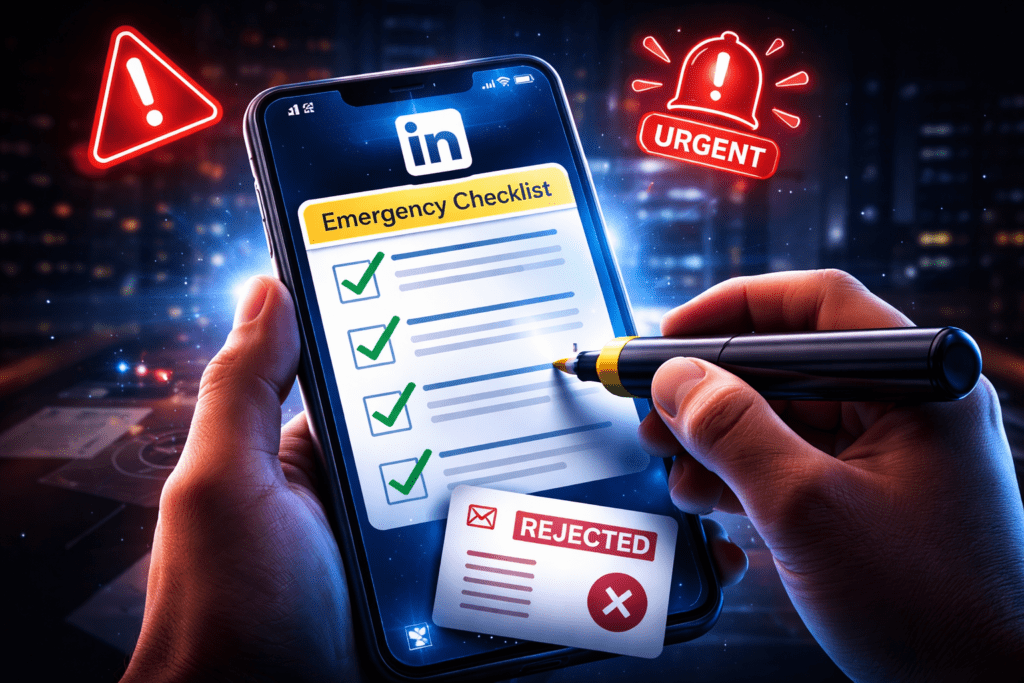
Your LinkedIn Emergency Checklist Do This Tonight
- ✅ Rewrite your headline with keywords, value, and specialisation
- ✅ Open your About section with a bold hook, not a job title summary
- ✅ Upload a clear, recent, well-lit professional headshot
- ✅ Add real numbers to every single bullet point in your experience section
- ✅ Research job descriptions and add missing keywords to your skills section
- ✅ Turn on “Open to Work” if you are actively looking
- ✅ Request at least two fresh recommendations from past managers or colleagues
- ✅ Post one piece of original insight in your niche this week
The Window Is Smaller Than You Think
There is a recruiter right now, at this very moment, searching LinkedIn for someone exactly like you. They are typing in keywords that match your experience. They are filtering by location, by industry, by skills. They are going to click on a profile in the next few minutes and potentially change that person’s career forever.
The only question is whether that profile is going to be yours or someone else’s. And that answer depends entirely on what you do in the next hour.
The people landing great opportunities in 2026 are not always the most talented. They are the most visible, the most credible, and the most optimised. They did the work most people kept putting off.
“Your next opportunity is already searching for you. Make sure it can find you.”
Share this with one person in your network whose LinkedIn profile urgently needs attention. You might just change their career tonight.
