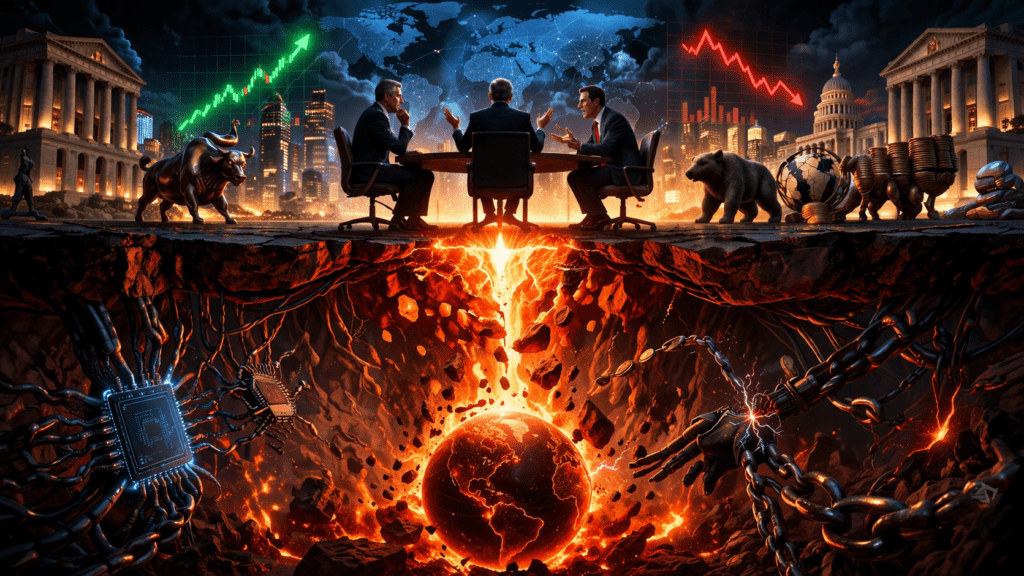
Everyone is watching the wrong thing.
While economists track interest rates, politicians argue over trade deficits, and news channels debate inflation numbers the real economic earthquake is already building underground. It has no central bank. No government policy can stop it. And by the time the majority of people understand what hit them, it will already be too late to prepare.
The next global recession will not come from Wall Street greed, a housing bubble, or a pandemic. It will come from Artificial Intelligence and the clock is already ticking louder than most people realise.
The Warning That Went Viral And Was Immediately Ignored
In February 2026, a research memo quietly published online was read by millions within days. Released on February 22, 2026, the Citrini Research “2028 Global Intelligence Crisis” report painted a stark picture of an AI-driven economic collapse, projecting a 10.2% unemployment rate and a 38% S&P 500 drawdown by June 2028.
Let those numbers sink in for a moment.
A 38% collapse in the stock market. Unemployment levels not seen since the Great Depression. And the trigger is not a war, not a virus, not a banking collapse. The trigger is a technology shift that is happening right now, in offices and server rooms across the US, UK, India, and every major economy on the planet.
The memo argued that AI, as a rapidly improving substitute for human intelligence, is fundamentally repricing the value of human work leading to a collapse in white-collar hiring rather than a mere shift in roles, through what it called a “self-disruption cycle.”
Most people scrolled past it. Most people always do right up until the moment they cannot afford to anymore.
This Is Not a Theory. It Is Already Happening.
You do not need to read research memos to see the signs. You just need to look at what is happening to industries, right now, in real time.
In early 2026, roughly $1 trillion in market value was wiped out as fears spread that AI tools could effectively replace parts of the software sector with major companies like Microsoft down 13% and Adobe down 19% in a single month.
This was not a random market correction. This was the financial world beginning to price in something that ordinary people have not yet fully grasped that entire industries can be rendered obsolete not over decades, but over months.
A viral essay viewed 85 million times compared the current moment to February 2020 when the pandemic was approaching and a widely unprepared public had no idea what was coming. The message was direct: white-collar workers should be afraid.
The people who prepared in February 2020 survived what came next far better than those who waited. The same principle applies right now.
The Mechanics of an AI-Triggered Recession
Here is how it actually unfolds and why it is more dangerous than any recession that came before it.
The widespread use of AI could turn an ordinary downturn into a deep and prolonged economic crisis by causing large scale disruptions simultaneously across labor markets, financial markets, and supply chains.
Previous recessions followed a pattern people understood. Lose a job, find another job. Factories close, new factories open. Demand drops, demand recovers. People knew the playbook.
This recession will have no playbook.
The CEO of one of the world’s largest AI companies has stated that 50% of entry-level white-collar jobs will be disrupted within five years pointing to the potential for an unemployment spike as high as 20%, a figure that surpasses the Great Financial Crisis of 2009 and approaches the peak of the Great Depression.
And here is the part that should terrify every working person in the US, UK, India, and beyond displacement from the AI revolution means the unemployment rate, in theory, could spike and plateau there unlike previous recessions where the uncertainty was when a new job would arrive, not if.
The jobs do not come back. Not the same ones. Not quickly. And not for everyone.

The “Ghost GDP” Problem Nobody Is Talking About
There is a concept emerging in economic circles that perfectly captures why this recession will feel different from every one before it. It is called “Ghost GDP.”
According to the viral Citrini research scenario, AI creates economic output that shows up in GDP numbers and corporate profits but never circulates through the real economy a negative feedback loop where AI capabilities improve, companies need fewer workers, displaced workers spend less, margin pressure pushes firms to invest more in AI, and the cycle continues with no natural brake.
Think about what that means for a family in Birmingham, Bengaluru, or Baltimore. The economy looks fine on paper. Stock markets may even be rising. But real people have less money, fewer jobs, and no safety net while the productivity gains flow entirely to corporations and shareholders.
This is not science fiction. Customer service, office support, and media roles already face the highest disruption risk because their tasks are repetitive, text-based, or rules-driven and these are precisely the jobs that tens of millions of middle-class families in every country depend on.
The Window to Act Is Narrow – And Closing Fast
Here is the part of this conversation that turns fear into action.
By 2030, AI could automate 30 to 60% of tasks across sectors, per McKinsey’s Global AI Survey with the period from 2026 to 2030 representing the critical “transition phase” where agentic AI shifts from pilots to mainstream.
That transition phase is right now. Not in five years. Not in ten. Now.
The people who will come out of this shift financially intact are not necessarily the most educated or the most experienced. They are the ones who understood what was coming and repositioned themselves before the crowd did.
That means learning which skills AI cannot replace. It means understanding where the new jobs and new wealth will actually be created. It means treating this moment with the same urgency you would treat a fire alarm in your building because the fire is real, it is already inside, and the exits are still open.
For now.
What You Must Do Before This Changes Everything
The question is not whether this technology shift will reshape the global economy. Experts warn that AI’s widespread adoption could turn a regular recession into a deep and prolonged economic catastrophe with devastating consequences for labor markets, financial systems, and global supply chains and that policymakers need to act now before the window closes.
If governments and policymakers need to act now, so do you.
Start by auditing your own career. Ask honestly: how many of my daily tasks could an AI system do tomorrow? If the answer is more than half, you are already in the danger zone. The solution is not panic it is purposeful repositioning toward skills, roles, and industries where human judgment, creativity, and emotional intelligence remain irreplaceable.
The last recession wiped out savings accounts, mortgages, and retirement funds of millions of ordinary families who had no idea it was coming.
This one is coming with a warning label.
The warning is on the front page. The data is publicly available. The trajectory is clear.
The only remaining question is whether you will act on it or whether you will be one of the people who later says they never saw it coming.
The shift is already underway. The recession clock is ticking. And the window to prepare is still just barely open.
