
We tap, swipe, and stream without a second thought, trusting that the internet will simply be there. But the network underpinning modern civilization from hospitals to stock exchanges, power grids to payment systems is far more brittle than it appears. Security researchers and intelligence agencies have spent years warning about systemic vulnerabilities baked into the internet’s core. Most of the world isn’t listening.
Below are seven deeply concerning cyber threats that don’t always make front-page news, yet carry the potential to cause overnight disruption at a civilizational scale. Understanding them is not paranoia it’s preparation.
Threat 01 : BGP Hijacking -The Silent Rerouting of the Internet’s Traffic.
The Border Gateway Protocol (BGP) is the postal system of the internet it decides which route your data takes across the globe. Shockingly, it was designed in an era of trust, with almost no built-in authentication. A malicious actor or even a misconfigured router can announce false routes and siphon enormous chunks of global traffic in minutes. In 2010, China Telecom briefly rerouted 15% of the world’s internet traffic through its servers. In 2022, similar incidents struck major cloud providers. The threat is persistent, stealthy, and largely unmitigated across thousands of autonomous networks worldwide.
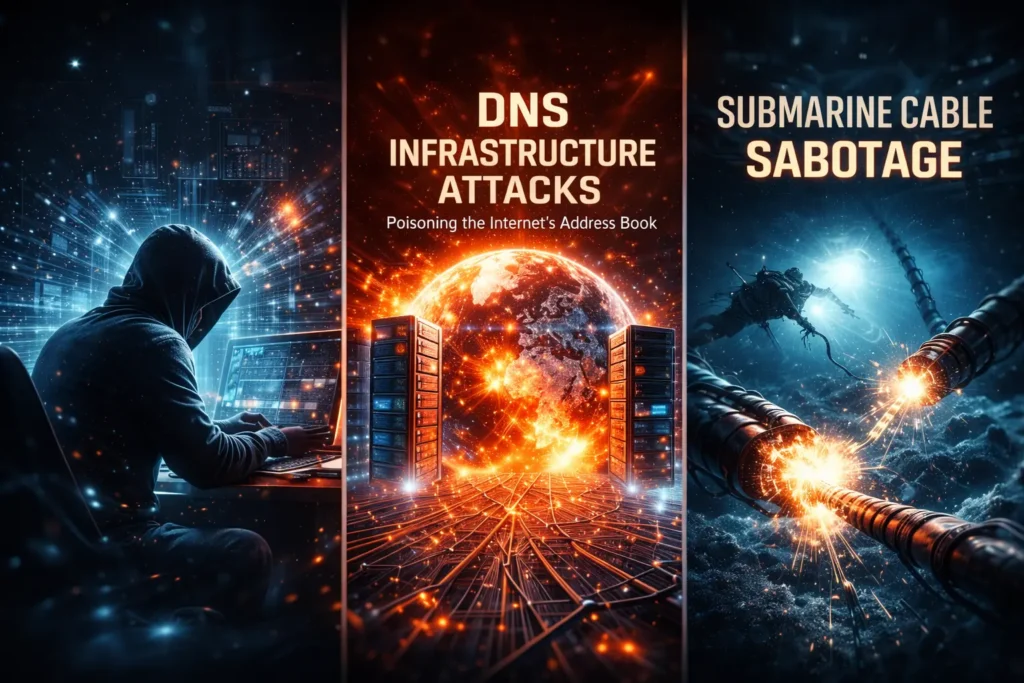
Threat 02 : DNS Infrastructure Attacks Poisoning the Internet’s Address Book.
The Domain Name System translates human-readable URLs into IP addresses. It is, essentially, the internet’s phonebook and it is under constant siege. DNS cache poisoning, DDoS attacks on root servers, and DNS tunneling can render entire regions of the internet unreachable or redirect users silently to malicious destinations. A coordinated attack on even a handful of root DNS servers could trigger widespread outages. In 2016, a single DDoS attack on DNS provider Dyn took down Twitter, Netflix, and Reddit across the eastern United States for hours.
Threat 03 : Submarine Cable Sabotage Where the Internet Lives Underwater
Over 95% of international internet traffic travels through a network of undersea fiber-optic cables thin, largely unprotected, and traversing some of the world’s most contested geopolitical waters. In early 2024, cables in the Red Sea were severed, disrupting roughly 25% of traffic flowing between Europe and Asia. Intelligence agencies have documented increased reconnaissance activity by state-sponsored submarines near critical cable landing stations. A targeted, multi-cable disruption campaign could isolate entire continents digitally and repairs can take months.
Threat 04 : Supply Chain Compromise The Enemy Hidden Inside Your Software.
The SolarWinds attack of 2020 rewrote the rules of cyber warfare. By inserting malicious code into a trusted software update, attackers infiltrated over 18,000 organizations including multiple U.S. government agencies without triggering a single alarm. Supply chain attacks are terrifying because trust itself becomes the attack vector. When your firewall, your antivirus, or your operating system becomes the threat, conventional defenses are useless. Open-source libraries, third-party APIs, and even hardware firmware are now active battlegrounds that most organizations aren’t equipped to monitor.
Threat 05 : AI-Powered Zero-Day Exploitationm – Attacks That Outpace Human Response.
Historically, zero-day vulnerabilities flaws unknown to software vendors required skilled human researchers to discover and weaponize. That bottleneck is disappearing. AI models are now being used to autonomously discover, validate, and exploit vulnerabilities at machine speed. What once took a nation-state team weeks can now potentially be accomplished in hours. Security teams simply cannot patch at the rate AI can probe. This asymmetry is growing and it represents one of the most urgent structural shifts in the threat landscape.
Threat 06 : Critical Infrastructure Targeting – Power, Water, and the Internet Intertwined.
The internet doesn’t exist in isolation. Power grids, water treatment facilities, financial clearinghouses, and hospital networks are all deeply dependent on internet-connected control systems many running outdated industrial software never designed for connectivity. The Volt Typhoon campaign, attributed to Chinese state actors, was found to have silently embedded itself inside U.S. critical infrastructure networks for years, lying dormant, waiting. A coordinated strike targeting power and internet infrastructure simultaneously could create cascading failures with no clear ceiling on damage.
Threat 07 : Quantum Decryption – The Coming Collapse of Today’s Encryption.
This threat operates on a longer but irreversible timeline. Most encryption protecting internet communications today from banking to messaging to government systems relies on mathematical problems that classical computers cannot solve in any practical timeframe. Sufficiently powerful quantum computers will break this protection entirely. State actors are already harvesting encrypted data today through a strategy called “harvest now, decrypt later” storing intercepted communications until quantum capability matures. Once that threshold is crossed, decades of sensitive data become readable. The window to transition to quantum-resistant cryptography is narrowing faster than most institutions are moving.

None of these threats require a science-fiction scenario to activate. They exist inside the systems running right now, in the protocols designed before security was a priority, in the geopolitical tensions already reshaping digital infrastructure. The internet is a miracle of human engineering and a monument to accumulated technical debt.
The institutions, companies, and individuals who treat cybersecurity as a cost center rather than a strategic imperative will discover, often too late, that resilience must be built before the disruption, not scrambled for during it. The time to pay attention is now not after the lights go out.
Take action before it’s too late. Share this article with your IT teams, policy makers, and the people who run the systems you rely on. An informed network is the first layer of defense.
The 7 threats covered:
- BGP Hijacking – silent traffic rerouting
- DNS Infrastructure Attacks – poisoning the address book
- Submarine Cable Sabotage – the physical internet
- Supply Chain Compromise – trust as a weapon
- AI-Powered Zero-Day Exploitation – machine-speed attacks
- Critical Infrastructure Targeting – Volt Typhoon-style dormancy
- Quantum Decryption – the “harvest now, decrypt later” threat
