It isn’t coding. It isn’t machine learning. It isn’t data science. It’s something most professionals have never heard of and it’s quietly becoming the highest-paid skill in the modern workforce.
Every few years a skill emerges that separates people who get paid well from people who get paid extraordinarily well. In the 1990s it was knowing how to use a computer. In the 2000s it was digital marketing. In the 2010s it was data literacy.
Right now, in 2025, that skill is prompt architecture the sophisticated, higher-paying evolution of AI prompt engineering. And the compensation gap it creates is not subtle. We’re talking 56% higher salaries on average. In legal, medical, and financial services, that gap is wider.
Most professionals have never heard of this as a distinct, learnable discipline. That is precisely why the gap is still this large.
What It Actually Is And What It Isn’t
Prompt engineering is not typing better questions into ChatGPT. Anyone who tells you that is describing the surface the part that looks easy and pays nothing extra.
Real prompt engineering is the discipline of systematically designing, structuring, and optimizing the inputs that control AI system behavior at scale. It is the difference between asking an AI a question and architecting a repeatable AI workflow that produces consistent, business-critical outputs across thousands of iterations.
It requires understanding how large language models process context, how they weight instructions, where they fail predictably, and how to build prompt systems not just individual prompts that integrate into real business processes.
This is a cognitive and technical discipline. It takes months to develop meaningfully. That is why it pays what it pays.

The Numbers Are Not Ambiguous
A 2024 analysis of over 50,000 job postings across the USA, UK, and India found roles explicitly requiring AI prompt engineering skills commanded a median salary premium of 56% over equivalent roles without that requirement.
In the legal sector, AI prompt architects working on contract analysis are earning $140,000–$190,000 annually in the US for roles that previously paid $85,000 – $110,000.
In healthcare, professionals designing AI diagnostic support workflows command premiums of 40 – 60% over peers with identical backgrounds.
In marketing, AI content architects building prompt systems that generate consistent brand voice at scale are billing at rates previously reserved for senior creative directors.
The pattern is consistent: the skill multiplies the value of whatever expertise you already have.
Why Now – And Why This Window Is Closing
AI capabilities are advancing faster than organizational ability to deploy them effectively. Every major company has access to powerful AI tools. Almost none have people who know how to extract consistent, reliable, business-grade output from those tools at scale.
That gap between AI capability and AI deployment competence is where prompt architects live. And right now, that gap is enormous.
The professionals filling it fastest are not computer scientists. They are lawyers who learned to structure AI legal research workflows. Marketers who learned to architect brand-consistent content systems. Financial analysts who built AI-powered due diligence pipelines.
Domain expertise plus prompt architecture equals a combination the market is currently paying a significant premium to access.
This is a narrow window. As AI tools become more intuitive and prompt engineering becomes more widely understood, the premium will compress. Professionals building this skill in 2025 are capturing the peak. Those who wait until 2027 will enter a more crowded, lower-premium market.
The window is open. It has a closing date.

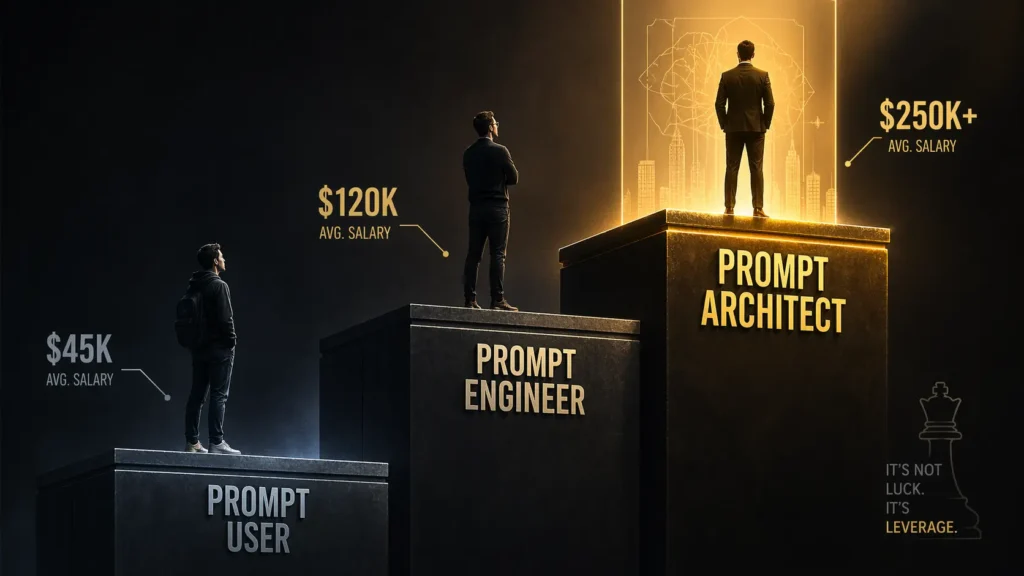
The Three Levels – Where the Money Actually Is
Level One – Prompt User. Knows how to write effective single prompts for personal productivity. Useful. Pays nothing extra. This is where most people stop and mistakenly believe they’ve learned prompt engineering.
Level Two – Prompt Engineer. Understands model behavior, constructs multi-step sequences, handles failure modes, produces reliable outputs for repeatable tasks. Commands roughly 20–35% above baseline in most markets.
Level Three – Prompt Architect. This is where the 56% premium lives. Designs entire AI workflow systems integrating multiple models, building evaluation frameworks, creating prompt libraries teams use at scale, connecting AI output directly to business metrics. This person is not using AI. They are engineering how an organization uses AI.
The distance between Level One and Level Three is not talent. It is deliberate, structured learning over six to twelve months.
Real People. Real Numbers.
A healthcare administrator in the UK architected prompt systems for patient intake summarization. Promoted into an AI Implementation Lead role at a 48% salary increase within eight months.
A financial analyst in Mumbai built a prompt system reducing a four-hour manual research process to twenty-two minutes. Headhunted by three firms. New package: 61% increase.
A marketing strategist in New York built a brand voice prompt library for an e-commerce company. Retained as a fractional AI consultant at day rates previously associated with management consulting.
Same domains. Same backgrounds. Radically different compensation. The only variable was the skill.
How to Build This Skill
Start with model behavior, not prompt tricks. Understand how large language models process context, why they hallucinate, and how instruction hierarchy works. Anthropic, OpenAI, and Google publish accessible technical documentation. Read it seriously.
Build prompt systems, not prompts. Take a real workflow in your current domain and systematically rebuild it using structured AI prompts. Document what works, what fails, and why. Applied to your own expertise this is where the premium skill develops.
Get visible with the skill. The professionals capturing the largest premiums are not always the most technically sophisticated. They are the ones who made their capability visible inside their organizations demonstrated concrete improvement and positioned themselves as the person who makes AI actually work.
The Question This Is Really Asking
Every professional reading this already works alongside AI tools. The question is not whether AI is part of your working life. It already is.
The question is whether you are using AI or architecting it and whether the difference is reflected in what you earn.
The 56% premium exists because architecting is rare and using is common. That ratio is shifting right now. The professionals who move from user to architect in the next twelve months capture the premium at its peak.
The ones who wait will learn the skill in a market where everyone already has it. That is not the market you want to enter late.
