
You are sitting with a friend, casually talking about a restaurant you want to try. You never searched for it. You never typed it. Yet within the hour, your phone is showing you ads for that exact restaurant. You brush it off. Probably a coincidence. But it keeps happening again and again, with different conversations, different topics, different rooms.
At some point, coincidence stops being a satisfying explanation.
In 2026, the question of whether smartphones secretly record their users has moved from conspiracy theory into mainstream legal, regulatory, and cybersecurity debate. The truth is layered, uncomfortable and entirely worth understanding before you have another private conversation near a device that has a microphone, a camera, and a permanent internet connection.
What Is Actually Happening Inside Your Phone
The short answer is that your phone is not secretly recording every conversation but it is always listening for activation commands like “Hey Siri” or “OK Google.” Modern smartphones use passive wake-word detection to enable voice assistants, meaning the microphone remains locally active so it can recognise specific trigger phrases.
But passive listening is only the beginning of the story. False positives can activate the assistant and unintentionally record your conversations and those clips may then be uploaded to the provider’s cloud servers for processing and, in some cases, reviewed by real human analysts.
Beyond voice assistants, the risk runs deeper. Apps installed on your phone can request microphone access, and some untrustworthy apps may request it unnecessarily and listen in the background especially if granted permission to run while not in use. That flashlight app you installed three years ago. That free game you downloaded once. Each one potentially holds a key to your microphone and you handed it over without reading the fine print.

The Warning Signs Your Phone May Be Compromised
Before running any technical checks, your own phone’s behaviour is the first and most powerful indicator. Frequent overheating when you are not actively using your device, unexpected reboots, strange background noises during calls, or your screen lighting up randomly could all indicate background recording activity.
If your phone experiences delays when shutting down or refuses to turn off properly, hidden spyware could be secretly completing data transfers before powering off and this is especially suspicious if it happens immediately after a call or text conversation.
Other red flags include apps opening and closing on their own, excessive notifications from unrecognised apps, and voicemail boxes that are unexpectedly full or empty without explanation.None of these alone confirms surveillance. All of them together demand immediate investigation.
How to Check Step by Step
Watch the Dots
Both Android and iOS now require apps to trigger visible indicators when they access sensitive hardware. A green dot usually means the camera is active. An orange dot means the microphone is in use. If the green dot appears on your iPhone without a camera app in use, it indicates that something is secretly recording you. This is your fastest, most reliable first check.
Audit Your App Permissions
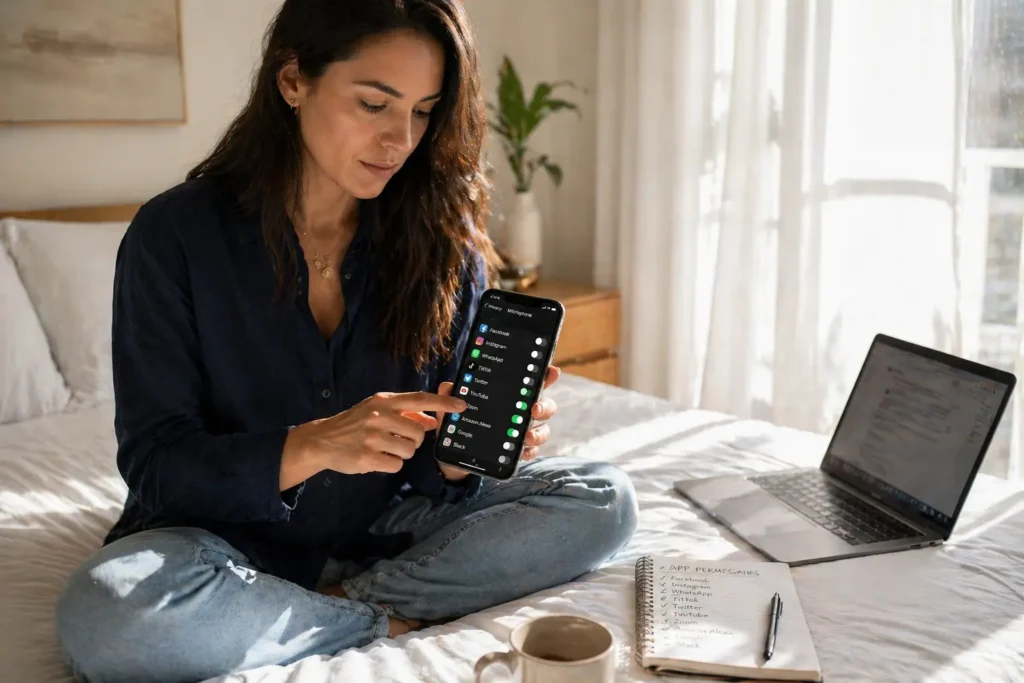
Go to Settings, then Privacy, then Microphone and Camera. Review which apps have access. If an app like a calculator, flashlight, or weather tool has microphone permissions — that is a red flag. Revoke access immediately.
Check Background App Activity
On Android, go to Settings, then Developer Options, then Running Services. Look for unfamiliar processes consuming microphone or camera resources. On iOS, check the App Privacy Report under Settings to see exactly how apps are using the permissions you have granted including data and sensor access, app network activity, and most contacted domains.
Monitor Battery and Data Usage
Unexplained battery drain or sudden spikes in data usage can be a sign that something is recording or uploading in the background. Run a deep scan with a trusted security tool such as Malwarebytes or Certo these tools detect hidden processes that standard app lists miss.
The Legal Reality in 2026
The law is catching up but slowly. By 2026, smartphone privacy regulations are converging globally. Twenty US states now align consent rules with Global Privacy Control standards, while EU GDPR streamlines opt-outs. California’s CCPA bans cross-context behavioural advertising from voice data without explicit opt-in, and Indiana, Kentucky, and Rhode Island enforce 45-day deletion timelines for audio logs with fines of $7,500 per violation.
The EU AI Act classifies emotion recognition from audio as high-risk, requiring assessments before deployment. The UK’s Data Use Act allows non-sensitive audio use but guarantees user contest rights.
Strong laws. But privacy protections in practice depend entirely on users actively managing their settings something most people never do. The law can protect you in court. It cannot protect you if you never check your permissions.
How to Stop It – Right Now
The fixes are simple, fast, and completely free. Disable microphone and camera access for every app that has no legitimate reason to need it. Turn off voice assistants entirely, or set them to activate only on-screen press rather than wake word. Review microphone permissions granted across all your applications and delete your voice request history to ensure no memory bank of your conversations exists.
Keep your operating system updated without delay. For maximum protection, consider using a secondary phone for sensitive discussions, or disabling microphone access globally when it is not needed. Privacy is not a one-time fix it is maintained through consistent habits.
For those handling genuinely sensitive information journalists, lawyers, activists devices like the Purism Librem 5 include physical switches that disconnect the camera and microphone at the hardware level, making software-based surveillance technically impossible.
The Uncomfortable Truth
Your smartphone is the most intimate device ever built. It knows your location, your relationships, your health concerns, your financial worries, and your private conversations. Whether a corporation, a hacker, or a compromised app is listening the result is the same. Your most private moments become data. And data, in 2026, is the most valuable commodity on Earth.
The question was never really whether your phone could listen. It always could. The question is whether you are going to let it.
Check your permissions tonight. Not tomorrow. Tonight.
📖 Read Also:
- How Scammers Are Using AI to Fake Your Family Member’s Voice
- Warning: This New Ransomware Attack Is Targeting Hospitals Globally
© AiwalaNews | Global Tech & Privacy Edition | April 2026
