
You wake up tomorrow morning and reach for your phone.
No signal. No WhatsApp. No news. No Google. You assume it is your network. You restart your phone. Nothing. You check your WiFi. Nothing. You walk outside and ask your neighbour. They have no internet either.
Then your phone buzzes one last SMS from your bank before the networks fully collapse.
“Due to global connectivity failure, all digital transactions are temporarily suspended.”
Your money is still in your account. You just cannot touch it.
This is not a movie. This is not a drill. This is the scenario that governments, military strategists and tech executives have been quietly simulating for years and the results have left every single expert who has seen them genuinely shaken.
Minute 0 – The Moment Everything Stops
At the exact second the global internet fails, approximately 5.4 billion people lose access to the infrastructure that runs their entire lives without even realising how completely dependent they are on it.
Stock markets in Tokyo, London, Mumbai and New York freeze mid-transaction. Trillions of dollars in trades hang in digital limbo – neither completed nor cancelled. Automated trading systems that execute millions of orders per second go silent. The financial world, which moves entirely on real-time data, goes blind.
Airports enter emergency protocol. Modern aircraft navigation systems rely on internet-connected ground infrastructure. Hundreds of flights in the air at that exact moment switch to backup systems. No new flights take off. Air traffic controllers worldwide are suddenly managing existing traffic with degraded communication systems.
In hospitals across every continent, cloud-connected medical equipment begins throwing errors. Patient monitoring systems that send data to central servers lose their connection. Electronic health records become temporarily inaccessible. Doctors are suddenly working with paper and memory.

Minute 30 – The Panic Begins
Half an hour in, the realisation hits the general public simultaneously and globally.
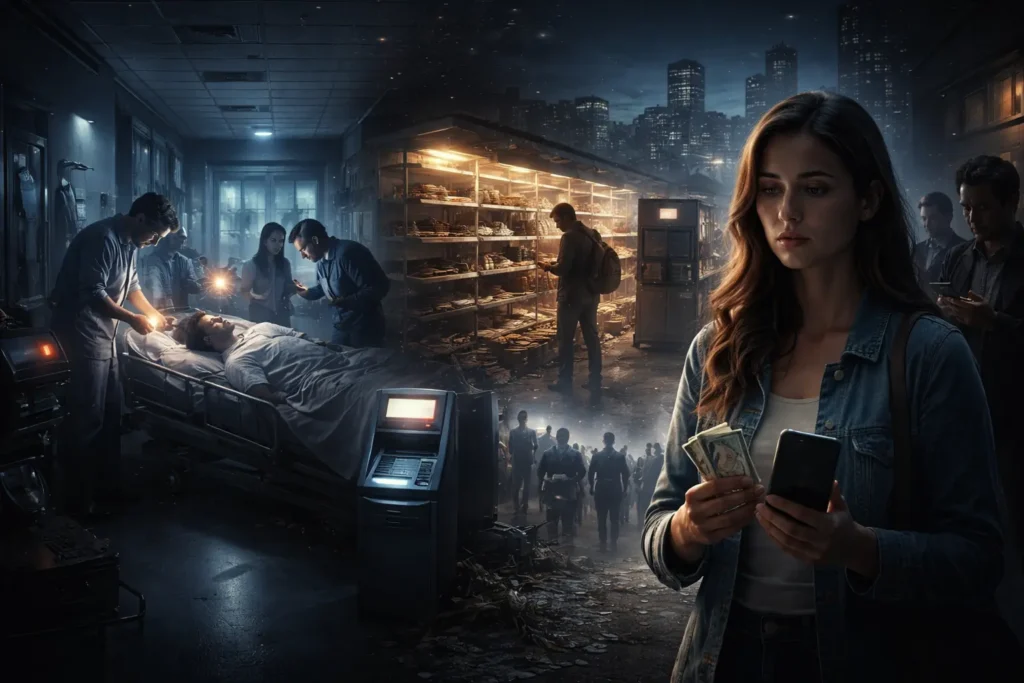
ATMs stop dispensing cash. Not because the banks have failed but because every ATM on Earth requires an internet connection to verify your account before releasing money. You can have one million dollars in your account and walk away from an ATM with nothing.
In India alone, 400 million UPI transactions that would normally process in this 30-minute window simply do not happen. Shops cannot accept digital payments. Street vendors cannot receive GPay. Petrol stations cannot process card payments. The world’s most advanced digital payment ecosystem — built over a decade — becomes completely useless in under 30 minutes.
In the UK and US, contactless payments, Apple Pay, Google Pay and every card terminal that requires online verification goes dark. People who have not carried physical cash in years which is most people suddenly cannot buy food, fuel or medicine.
The only people who can transact are the ones holding physical cash. And almost nobody is.
Hour 2 Supply Chains Begin Fracturing
By the second hour, the global supply chain the invisible system that puts food on your shelf, fuel in your car and medicine in your pharmacy starts breaking down.
Every major logistics company on Earth operates on real-time internet-connected tracking systems. FedEx, Amazon, DHL, Indian Railways freight, UK Royal Mail — none of their routing systems function without live connectivity. Warehouses do not know what to dispatch. Drivers do not know where to go. Ports do not know which containers to unload.
Supermarkets in London, Mumbai and New York that operate on “just in time” inventory meaning they carry only 2 to 3 days of stock at any given moment — begin running low on fresh produce within hours because their automated reorder systems cannot communicate with suppliers.
Fuel distribution networks that rely on digital dispatch systems slow to a crawl. Power grids in several countries that depend on internet-connected load balancing software begin experiencing localised failures.
Hour 6 – Governments Declare Emergencies
Six hours into a global internet blackout, every major government on Earth has declared a national emergency.
The United States activates FEMA protocols designed for infrastructure collapse. The UK government convenes COBRA its emergency committee for only the fourth time in modern history. India’s National Disaster Management Authority deploys across all major cities.
Military communication systems, which operate on separate secured networks, remain functional. But civilian infrastructure the power, the water treatment, the traffic management, the healthcare coordination is operating at a fraction of normal capacity and degrading further by the hour.
Financial markets have now been frozen for six hours. The last estimate before communication between exchanges failed put the unrealised losses at over $4 trillion and climbing.
Hour 12 – The Human Cost Becomes Real
This is the moment the situation transforms from a crisis into a catastrophe.
Hospitals that exhausted their backup generator fuel are now operating on skeleton systems. Patients dependent on remotely monitored equipment are being manually checked by nurses who are stretched beyond capacity. Surgeries that require real-time imaging systems connected to hospital networks are being postponed. People are dying not because medicine failed but because the internet that medicine now depends on is gone.
In every major city on Earth, grocery stores have been stripped of their physical cash inventory within hours of the blackout. The people with cash bought everything. The people without it the majority are going home empty-handed.
Social order, which depends on the perception that systems are functioning, begins visibly fraying in dense urban centres.
Hour 24 – The Damage That Cannot Be Undone
When the internet finally returns after 24 hours, the world that reconnects is not the same world that went dark.
The total economic damage from a single 24-hour global internet outage is estimated by cybersecurity researchers and economic analysts at between $8 trillion and $10 trillion. That is more than the entire annual GDP of Japan destroyed in a single day.
Thousands of people have died not from violence, not from disease, but from the quiet collapse of the digital infrastructure that modern medicine, modern food distribution and modern emergency services are built entirely upon.
Financial markets, when they reopen, experience the single largest sell-off in recorded history as every institution simultaneously attempts to process 24 hours of suspended transactions.
And the most terrifying part of all of this?
It does not require a world war to trigger it. It does not require a nuclear weapon. A coordinated cyberattack on the thirteen root DNS servers that form the backbone of the entire global internet or a single large solar storm could make everything above happen before breakfast tomorrow morning.
This Is Not Science Fiction
In 2021, Facebook, Instagram and WhatsApp went offline for six hours. A single misconfiguration in their DNS settings took down platforms used by 3.5 billion people. Facebook lost $60 million in revenue in those six hours. Its stock dropped 5% before the platforms came back online.
That was six hours. One company. One mistake.
Scale that to the entire global internet. Scale it to 24 hours. The number stops being a number and starts being a civilisational event.
What You Can Do Right Now
The experts who run these simulations do not share their findings to cause panic. They share them because the gap between “this could happen” and “this is happening” is narrower than at any point in human history.
Keep physical cash accessible at all times enough for at least 72 hours of essential expenses. Store offline copies of critical documents, medical records and emergency contacts. Know where your nearest physical bank branch is and how to access it without digital assistance.
The internet is the most important infrastructure human civilisation has ever built. It is also the most fragile.