You have heard the name a hundred times.
In news reports about drug markets. In headlines about stolen data. In government warnings about cybercrime. In movies where hackers type furiously in dark rooms surrounded by green text.
Every single one of those portrayals got it wrong. Or at least, dangerously incomplete.
Because the dark web is not what most people think it is. And that misunderstanding that comfortable distance most people maintain from it is precisely why your personal data is almost certainly already there right now, and you have no idea.
First – The Internet You Do Not See
Before understanding the dark web, you need to understand that the internet you use every day is only a fraction of what actually exists.
The internet has three layers.
The Surface Web is everything Google can find and index websites, news articles, social media, YouTube videos. This is what most people mean when they say “the internet.” It represents less than 5% of all data online.
The Deep Web is everything that exists online but is not indexed by search engines your bank account portal, your email inbox, your Netflix account, hospital databases, government records, corporate intranets. This is not sinister. It is simply private. The deep web represents approximately 95% of all internet content.
The Dark Web is a small, intentionally hidden section of the deep web that requires specific software to access most commonly a browser called Tor. It is not indexed. It is not accessible through Chrome, Safari or any standard browser. It was originally built not by criminals but by the United States Naval Research Laboratory to allow intelligence agents to communicate anonymously.
What Is Actually on the Dark Web
Here is the honest answer that most articles refuse to give you.
The dark web contains both legitimate and deeply criminal content simultaneously and the distinction matters enormously for understanding why it affects you personally.
On the legitimate side, the dark web is used by journalists in authoritarian countries to communicate without government surveillance. It is used by whistleblowers to share information with media organisations safely. It is used by political dissidents in countries like China, Iran and Russia where surface web access is heavily censored. Facebook, the BBC and The New York Times all operate official dark web versions of their sites specifically to reach users in countries where those platforms are blocked.
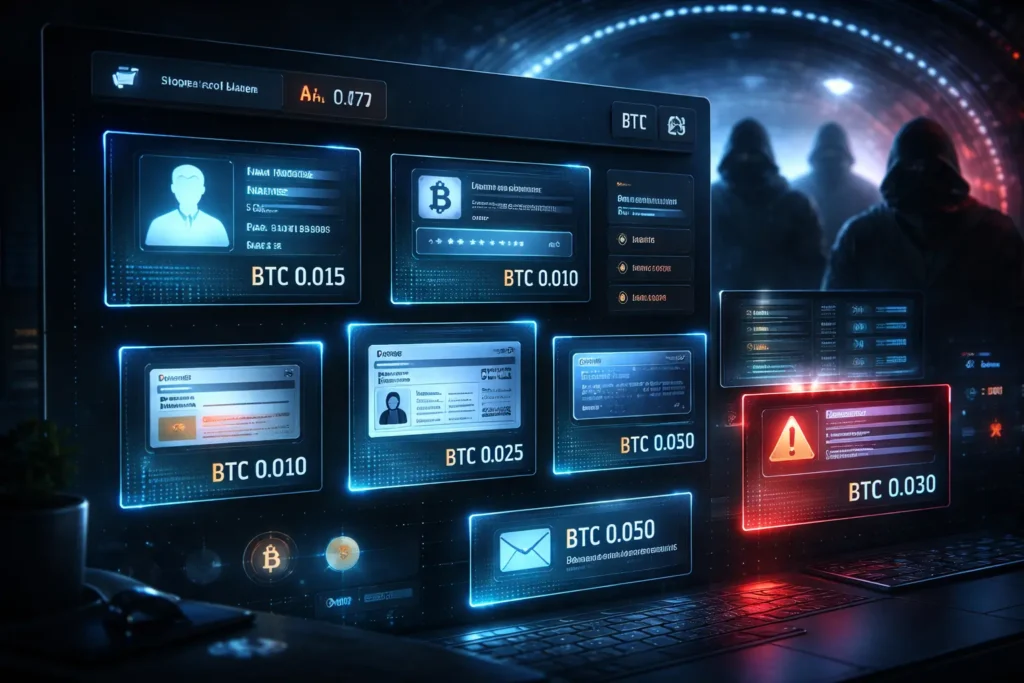
On the criminal side and this is where it directly affects you the dark web hosts some of the most active marketplaces for stolen personal data on Earth.
Your email address. Your password. Your Aadhaar number. Your Social Security number. Your credit card details. Your home address. If any of the services you use have ever suffered a data breach and statistically, several of them have your personal information is almost certainly listed for sale on a dark web marketplace right now.
In 2024 alone, over 1.7 billion personal records were listed for sale across dark web data markets. Indian Aadhaar data, UK NHS patient records, US Social Security numbers, banking credentials from every major economy all of it available to anyone with a Tor browser and cryptocurrency, for prices starting at under $5 per identity.
Why This Matters Directly to You
The dark web is not an abstract threat. It is the warehouse where the consequences of every data breach you were never notified about are being actively monetised.
When criminals buy your credentials from a dark web marketplace, the attacks that follow are not random. They are targeted, personalised and devastatingly effective because they use your real name, your actual bank’s branding and sometimes your genuine account details.
The phishing email that knew your full name and your bank. The call from someone who knew your date of birth and last four digits. The fraudulent loan application made in your name. All of it traces back to data that was purchased on the dark web often months or years after the original breach that nobody told you about.
In the US, identity theft enabled by dark web data purchases cost Americans $10.3 billion in 2023. In India, cybercrime losses linked to stolen credential markets crossed ₹11,000 crore in the same year. In the UK, fraud enabled by purchased personal data costs the economy £2.5 billion annually.
How to Check If Your Data Is Already There
You do not need to access the dark web to find out if your data is on it.
Go to haveibeenpwned.com right now and enter every email address you have ever used. This free, legitimate service run by a respected cybersecurity researcher cross-references your email against known breach databases and dark web data dumps and tells you exactly which breaches your information appeared in.
Google One’s dark web monitoring scans for your email, phone number, name and address across known dark web markets and alerts you if your information appears. It is available free to any Google account holder.
If either tool returns results and for most people reading this, they will do not panic. Panic is the enemy of protection. Follow these immediate steps.
Change the password on every account associated with the exposed email, starting with your primary email account. Use a password manager like Bitwarden free, trusted and used by security professionals globally to generate unique passwords for every account.
Enable authenticator-based two-factor authentication on your email and banking apps immediately. Not SMS-based authenticator app based. This closes the most common attack vector that dark web credential purchases enable.
The One Thing Most People Get Wrong
The biggest misconception about the dark web is that it only matters to people who use it.
You have almost certainly never opened a Tor browser. You have almost certainly never visited a dark web marketplace. And your data is almost certainly there anyway placed there by criminals who bought it from a breach of a service you trusted with your information years ago.
The dark web does not require your participation. It only requires that you exist online.
And in 2026, every person reading this article in the US, UK, India or anywhere else on Earth exists online deeply enough for their data to be valuable to someone who knows where to sell it.
What to Do Starting Today
Check haveibeenpwned.com for every email you own.
Enable Google One dark web monitoring on your primary Google account.
Switch to encrypted DNS (1.1.1.1) to prevent your browsing from being logged at the ISP level.
Install uBlock Origin to block the tracking scripts that feed data brokers who sometimes supply dark web markets.
Use a password manager. Enable authenticator two-factor authentication. Treat your personal data like the valuable asset it is – because on the dark web, it already has a price tag.