On September 6, 2025, something happened in the Red Sea that most people never read about but felt immediately.
Two submarine cables SMW4 and IMEWE, part of the critical data corridor connecting Asia, Europe, and the Middle East were severed near Jeddah, Saudi Arabia. Within hours, internet users in India, Pakistan, the UAE, and Saudi Arabia reported slower speeds and intermittent connections. Microsoft Azure issued a status alert: the Middle East “may experience increased latency due to undersea fiber cuts in the Red Sea.” Emergency traffic rerouting stabilised cloud services by the following day.
The physical cable repairs were expected to take weeks. Possibly months.
Nobody had been told that their video call, their bank transfer, their streaming service, their government’s classified communications, all ran through two cables lying on the floor of a contested sea. They found out when the cables stopped working.
This is the infrastructure story of the modern world and almost nobody knows it exists.
The Scale Nobody Visualises Correctly
There are 570 active submarine cable systems as of 2025, with another 81 planned or under construction. Combined, they stretch approximately 1.7 million kilometres enough to wrap around Earth more than forty times.
They carry 97 to 99% of all international internet traffic. Not “a lot.” Nearly all of it. Every intercontinental email, every international financial transaction, every cross-border video call, every piece of cloud data stored in a foreign country it travels as pulses of light through glass fibres lying on the ocean floor.
Satellites — which most people assume carry most data are slower, more expensive, and handle a fraction of global capacity. Starlink and its competitors are genuinely impressive technologies. They carry roughly 1 to 3% of international data. The cables carry the rest.
The total investment into new submarine cable projects between 2025 and 2027 is expected to reach $13 billion nearly double the amount spent from 2022 to 2024. The acceleration is being driven almost entirely by AI. Tech giants Meta, Google, Amazon, and Microsoft are investing in their own dedicated private cable systems, separate from the shared consortium cables that have served the industry for decades, to connect their AI data centres across continents with guaranteed dedicated capacity.

What the Cable Actually Is
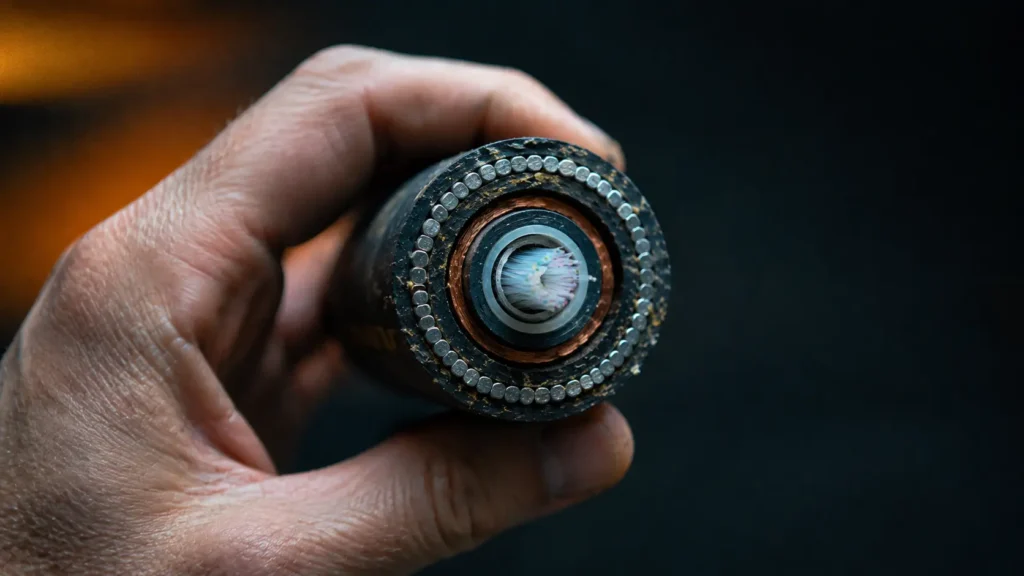
Pick up a garden hose. That is approximately the diameter of a submarine internet cable for most of its transoceanic journey 17 to 25 millimetres.
Inside that hose: at the core, glass optical fibres, each no thicker than a human hair. These are not ordinary glass. They are ultra-pure silica fibres engineered specifically for submarine applications, using a grade called G.654 that minimises signal loss over very long distances.
Data travels through these fibres as pulses of light fired by lasers at one end, received by detectors at the other. Light travels at approximately 200,000 kilometres per second through glass slightly slower than through a vacuum meaning a signal crosses the Atlantic in roughly 60 milliseconds.
The volume of data carried through a single fibre would be incomprehensible if stated in familiar terms. Engineers use a technique called Dense Wavelength Division Multiplexing (DWDM), which fires dozens sometimes hundreds of different wavelengths of light down the same fibre simultaneously. Each wavelength carries its own independent data stream. A single fibre pair on a modern cable can carry hundreds of terabits per second. A modern cable contains multiple fibre pairs, running in parallel.
One problem: light weakens over distance. A signal cannot travel 10,000 kilometres unaided. The solution is repeaters cylindrical devices roughly the size of a large fire extinguisher, installed along the cable approximately every 70 kilometres. Each repeater contains erbium-doped fibre amplifiers (EDFAs) devices that boost the optical signal directly as light, without converting it to electricity. A cable spanning the Atlantic carries dozens of these repeaters. A transpacific cable carries over one hundred. Every repeater is powered by electrical current sent down a copper conductor running alongside the optical fibres, supplied from shore stations at each end of the cable.
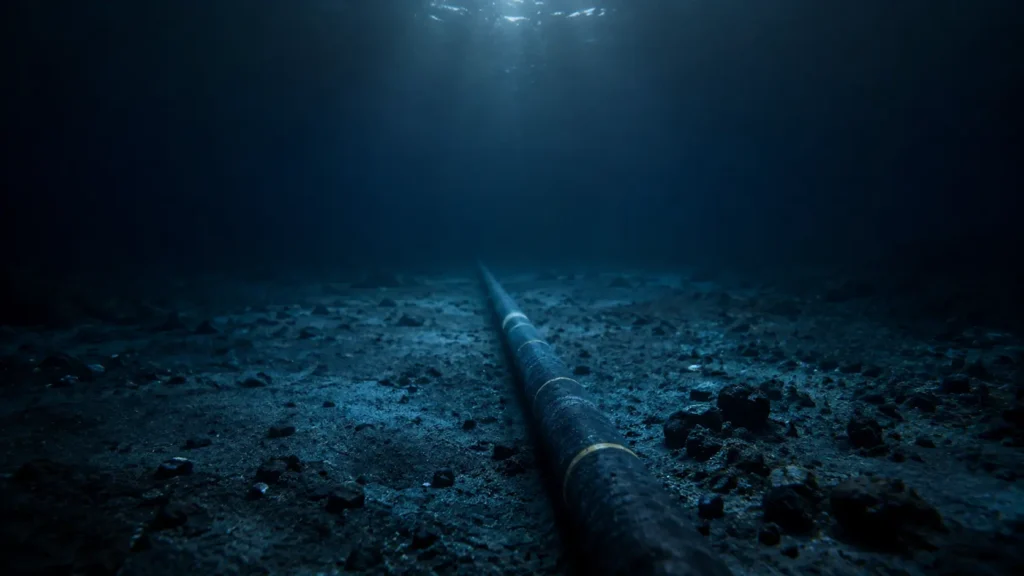
Near the shoreline where the cable is most vulnerable to ship anchors, fishing trawlers, and undersea landslides it is armoured with steel wire wrapping and buried beneath the seabed. In the deep ocean, where pressures exceed 800 atmospheres and human access is essentially impossible, the cable relies on its insulating jacket alone. It has no armour. It does not need it out there. What it needs, out there, is simply to not be disturbed.
The Vulnerability Nobody Planned For
Cables break. They have always broken. The causes are mundane with remarkable regularity: fishing trawlers dragging anchors across the seabed account for the majority of shallow-water cable cuts. Submarine landslides triggered by earthquakes including the 2006 Taiwan earthquake that severed nine cables simultaneously and disrupted internet across Southeast Asia account for most deep-water incidents.
Between 2024 and mid-2025, the Insikt Group recorded 44 cable damage events across 32 locations globally. Three factors consistently increase the likelihood of significant outages: lack of redundancy in cable networks, lack of diversity of cable routes, and limited global repair capacity worldwide.
That last point is underappreciated. There are only approximately 60 cable repair ships operating globally. Each costs $30,000 or more per day to operate. Repairs in shallow water take days. Deep-water repairs take weeks. Repairs in conflict zones where the ship needs government permits to enter national waters — can take months.
The Red Sea has become the defining case study. In February 2024, a UK-owned vessel struck by a Houthi-fired missile sank, its dragging anchor damaging four major cable systems simultaneously SEA-ME-WE 4, IMEWE, EIG, and SEACOM disrupting 25% of all traffic between Asia, Europe, and the Middle East. Repair ships required permits from a government that barely controlled its own capital. The cables waited.
The September 2025 cuts were the third major incident in the same corridor in eighteen months. Seventeen submarine cables pass through the Red Sea. At the Bab-el-Mandeb Strait between Yemen and Djibouti, many of them pass within kilometres of each other a geographic chokepoint where a single incident can simultaneously affect a significant fraction of intercontinental internet capacity.
In March 2024, multiple cable cuts off the coast of West Africa caused massive service disruptions in Côte d’Ivoire, Liberia, Ghana, and neighbouring countries. The pattern is consistent: the world’s internet routes through geographic chokepoints, and those chokepoints are more fragile than any government or technology company has publicly acknowledged.
Who Actually Owns the Cables
For most of submarine cable history, the cables were owned by consortia groups of telecommunications companies that jointly financed and shared capacity on a cable route. A cable linking the US to Europe might be jointly owned by fifteen carriers from twelve countries.
That model is changing rapidly. Tech giants are now building private dedicated cables for their own exclusive use. Google’s Firmina cable the longest subsea cable to use a single power feed, stretching from the US East Coast to Las Toninas in Argentina became fully operational in 2024. Meta’s 2Africa cable, encircling the entire African continent and connecting to Europe and Asia, represents the longest submarine cable ever deployed. Microsoft and Meta announced a joint investment in a new private cable in 2025.
The implications are significant. When a private cable owned entirely by Google fails, Google’s traffic reroutes across its other private cables and its capacity purchases on consortium cables. When a consortium cable serving small island nations or developing economies fails, there may be no alternative. The redundancy the tech giants are building is redundancy for themselves not for the global internet equally.
The Infrastructure You Rely On Without Knowing It
The next time you send an international wire transfer, your bank’s instruction travels as light through a glass fibre thinner than a human hair, bounced through amplifiers on the ocean floor, across thousands of kilometres of crushing darkness, to emerge at a cable landing station on a foreign beach in under a second.
The next time a regional conflict disrupts internet for hundreds of millions of people, you are watching what happens when someone cuts a garden hose.
The capacity of these optical cables has been increasing by 40% yearly for the last four decades. The internet’s exponential growth has been matched, almost exactly, by the cables beneath the ocean that no one thinks about until something goes wrong.
Ninety-nine per cent of global data. One point seven million kilometres of glass fibre. Sixty repair ships. And a world that has no idea any of this exists until it doesn’t.
📌 Read Also:
- How GPS Works When You’re in the Middle of Nowhere
- How Cloudflare Stops Millions of Hackers Every Day
© AiwalaNews | Global Tech & Privacy Edition | April 2026
