
You spent hours tailoring your resume. You met every requirement listed in the job posting. And yet silence. No rejection email, no feedback, nothing. What actually happened is more mechanical, and more unsettling, than most applicants realize: an AI system decided you weren’t worth a human’s time often before anyone ever opened your file.
This isn’t a rare exception anymore. It’s how most hiring now works.
The Scale: How Common Is This Really?
The numbers here are almost hard to believe for anyone who hasn’t job-hunted recently.
Ninety percent of U.S. employers use AI screening tools to sort and rank job seekers, with most relying on the same few third-party vendors. In 2026, 82% of companies deploy AI specifically for resume screening making it the single most common use of artificial intelligence in hiring.
And the rejection rate from these systems is staggering: AI-powered Applicant Tracking Systems reject about 75% of resumes within 5 seconds.
Worse, most of this happens without anyone checking the AI’s work. Fifty percent of companies use AI exclusively for initial screening rejections with no human oversight, and an additional 21% allow AI to reject candidates at all stages without review only 29% maintain full human oversight on AI rejection decisions.
Step 1: Can the AI Even Read Your Resume?
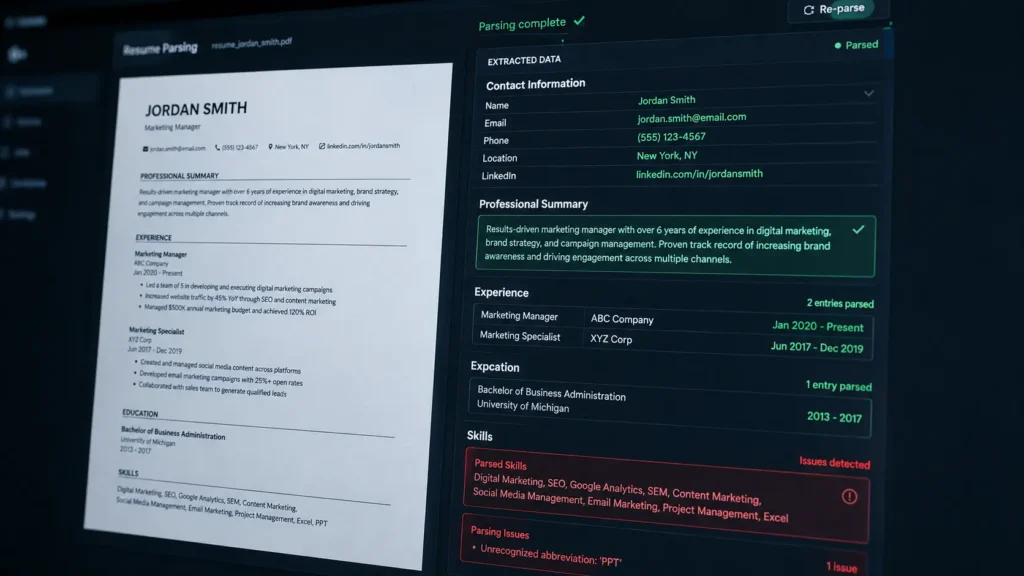
Before any actual evaluation happens, your resume has to survive something much simpler getting parsed into text the computer can understand.
The ATS receives your file and attempts to extract text. A PDF with selectable text gets parsed successfully 95% of the time, but an image-based PDF a scanned document results in complete failure, with 0% content extracted. If the parser can’t read your resume, you’re rejected before the AI even starts scoring.
Multi-column layouts, tables, graphics, and non-standard fonts account for 42% of parsing errors.
That means a beautifully designed resume with columns, icons, or a creative layout can get rejected purely because the software literally cannot read it. Multi-column layouts and generic summaries are among the five most common automatic rejection triggers.
Step 2: Keyword and Skills Matching
Once your resume is successfully parsed into clean text, the AI moves on to matching it against the job description.
AI resume screening uses algorithms from keyword matching to machine learning to filter, rank, and score resumes before a human ever sees them. Your resume gets parsed into structured data, matched against job requirements, scored for fit, and queued in a shortlist all before any recruiter opens it.
The AI extracts keywords from the job description required skills, tools, certifications, experience levels and resumes matching 60%+ of keywords pass screening 90% of the time.
This is exactly where qualified people get rejected for trivial reasons. If a job description asks for “Project Management Professional” and you only write “PMP,” some older systems may fail to make the connection.
Newer systems are smarter, but not perfect. Instead of asking “Does this resume contain the word ‘project management’?”, a more advanced AI model asks “does this candidate’s experience demonstrate project management capability?” parsing career trajectories and inferring transferable skills.
Step 3: The “Knockout Question” The Silent Rejection
This is the single biggest rejection mechanism most applicants never even notice.
Automated rejections are almost entirely driven by binary knockout questions built into application forms “Do you require visa sponsorship?” or “Do you hold a valid RN license?”
AI scores typically prioritize and sort candidates; they don’t usually eliminate them outright meaning the scoring system alone rarely kills your application completely. It’s the yes/no checkbox questions buried in the application form that do the real damage, instantly and silently, regardless of how strong your resume is.

Where the System Genuinely Fails Good Candidates
This is the part that should concern every job seeker and every employer.
A 2024 Harvard Business School and Accenture study on “Hidden Workers” found that 88% of employers acknowledge their automated filters reject qualified candidates.
In one documented case, a legacy ATS keyword filter rejected 68% of applicants on first pass. But when the talent acquisition team audited a sample of rejected candidates, they found that 40% had relevant transferable skills the system had simply missed.
And there’s a deeper, more troubling problem hiding underneath the surface: bias. Algorithmic bias is a documented problem in these systems ML models trained on historical hiring data can absorb past biases and reproduce them at scale. A 2024 study found that LLMs favored white-associated names in 85.1% of cases and male-associated names in 88.9% of cases, with resumes carrying Black male-associated names disadvantaged in up to 100% of test cases.
If a model was trained on data where previous hires came from certain schools or career patterns, it may penalize candidates who don’t match those patterns regardless of their actual qualifications.
The Regulations Catching Up Slowly
Lawmakers are finally starting to respond to how opaque these systems have become.
The Colorado AI Act, effective June 30, 2026, requires risk assessments and transparency notices for “high-risk” AI systems, including hiring tools. The Illinois AI Employment Prevention Act, effective January 1, 2026, prohibits discriminatory effects and mandates applicant notification. The EU AI Act, fully applicable August 2, 2026, classifies recruitment AI as “high-risk,” requiring strict data governance and human oversight.
These laws are early steps, not full solutions but they signal that regulators have noticed what job seekers have suspected for years: this system needed guardrails.
What You Can Actually Do About It
You can’t control whether a company uses AI to screen you — but you can control whether your application survives it.
1. Use a simple, single-column format.
Stick to a clean, single-column layout, and use standard headers like “Work Experience” instead of creative ones like “My Journey.”
2. Always submit a text-based PDF, never a scanned image.
A PDF with selectable text parses successfully 95% of the time a scanned image fails completely.
3. Spell out both the acronym and the full term.
Use both the acronym and the full title for certifications and tools mentioned in the job description, since older systems may not connect the two automatically.
4. Tailor every resume to the specific job.
The same resume won’t score well across different job postings each job has different keywords and requirements.
5. Answer knockout questions honestly, but strategically.
Since these binary screening questions silently eliminate candidates, read every application question carefully a vague or incorrect answer can disqualify you instantly, regardless of your actual resume.
The Bottom Line
The rejection email you never received wasn’t necessarily a judgment on your career. A resume that passes these automated checks is no longer competing with the 75% of applicants who don’t understand how automated screening works it’s competing in the top 25%, the pool from which hiring managers actually make their shortlist.
Understanding how the system filters you isn’t about gaming it dishonestly it’s about making sure your real qualifications actually reach a human being who can recognize them.
Read Also:
- 🔗 The Dark Technology Behind Every “Recommended for You” — How Big Tech Controls What You See
- 🔗 AI Is Replacing These 11 White-Collar Jobs in 2026 — Is Yours on the List?
© AiwalaNews | Global Tech & Privacy Edition | June 2026
