Every day, millions of iPhone users simply look at their phone and watch it unlock almost instantly. No password. No fingerprint. Just a glance.
To most people, it feels effortless.
But behind that fraction of a second is an extraordinary combination of artificial intelligence, infrared imaging, depth sensing, and a dedicated security processor working together to answer one critical question:
Is this really you?
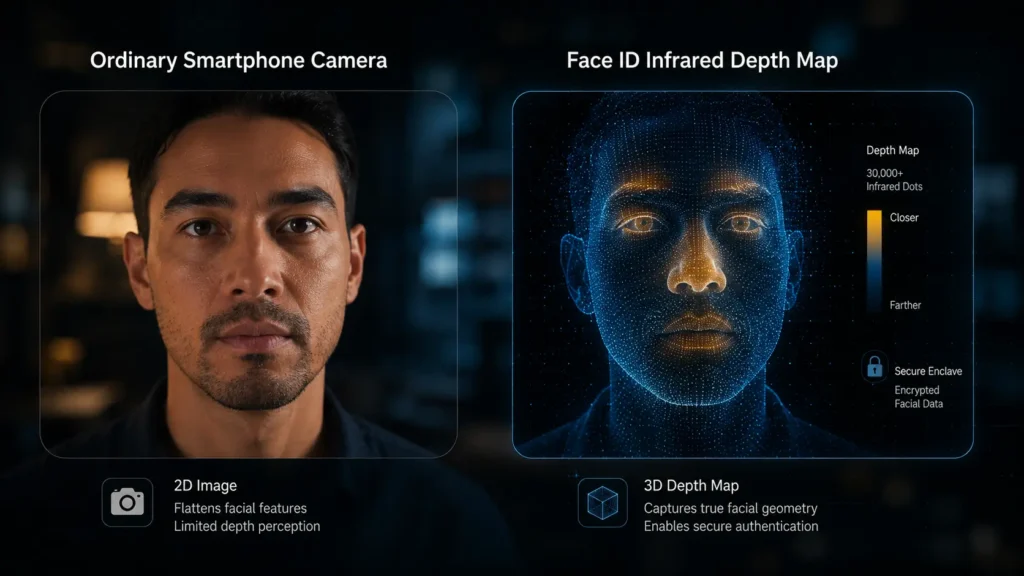
Unlike a traditional camera that captures a flat image, Apple’s Face ID creates a sophisticated three dimensional map of your face, allowing it to recognize you even if you’ve changed your hairstyle, grown a beard, or started wearing glasses.
Here’s how one of the world’s most advanced consumer security systems actually works.
Face ID Does Not Simply Take Your Picture
One of the biggest misconceptions is that Face ID works like taking a selfie.
It doesn’t.
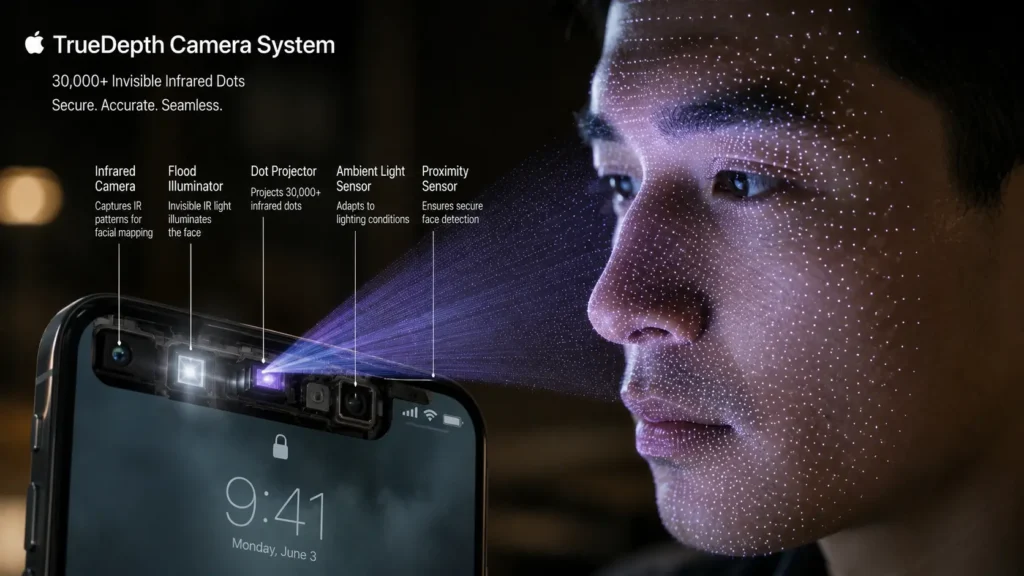
When you raise your iPhone, several specialized sensors activate almost simultaneously.
These include:
- An infrared camera
- A dot projector
- A flood illuminator
- The Apple Neural Engine
Together they form Apple’s TrueDepth Camera System.
Instead of recording colors like an ordinary camera, this system analyzes the shape and depth of your face.
That makes it significantly harder to fool than ordinary facial recognition systems.
More Than 30,000 Invisible Dots
The magic begins with the Dot Projector.
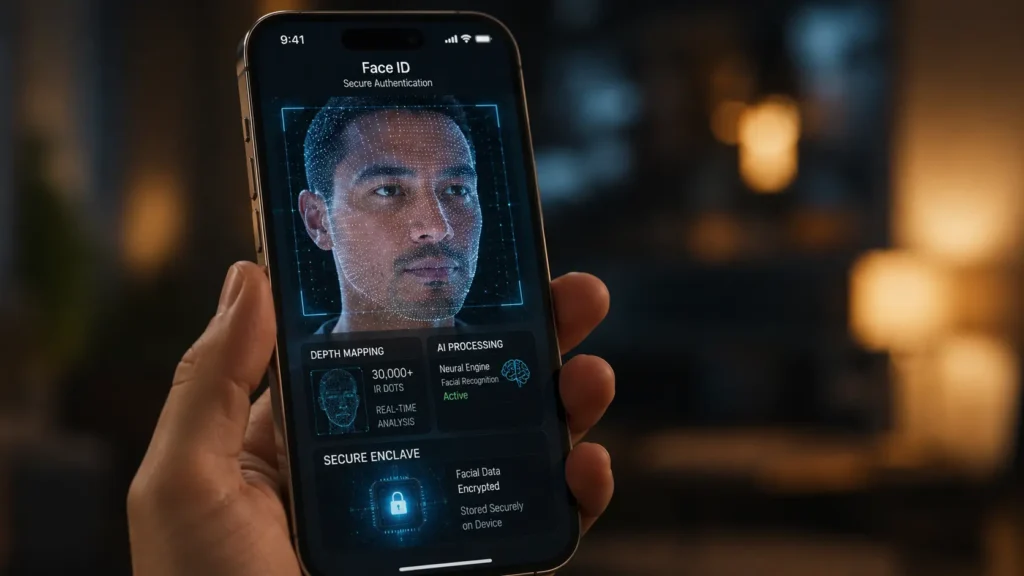
This tiny component projects more than 30,000 invisible infrared dots onto your face.
These dots cannot be seen by human eyes.
The infrared camera then measures exactly how those dots land across your facial features.
Because every face has different contours, the resulting depth map becomes highly unique.
The system captures details such as:
- Eye position
- Nose shape
- Jawline
- Forehead contours
- Distance between facial features
This three dimensional model becomes the basis for recognition.
It Works Even in Complete Darkness
Many users wonder why Face ID unlocks their phone at night.
The answer is the Flood Illuminator.
Instead of relying on sunlight or room lighting, it emits invisible infrared light that evenly illuminates your face.
Because infrared works in darkness, Face ID performs almost identically whether you’re outdoors, inside your home, or lying in bed with the lights off.
This is one reason Face ID remains reliable in environments where ordinary cameras struggle.
Artificial Intelligence Does the Real Work
Collecting facial information is only the first step.
Next comes the role of Artificial Intelligence.
Apple’s Neural Engine analyzes the captured depth information in milliseconds.
Rather than comparing a photograph, the AI evaluates hundreds of mathematical relationships between different parts of your face.
The system also adapts over time.
If you:
- Grow a beard
- Wear makeup
- Change hairstyles
- Put on prescription glasses
- Wear a hat
Face ID gradually learns these natural changes while still rejecting unfamiliar faces.
This continuous learning improves convenience without sacrificing security.
Your Face Never Leaves Your iPhone
One of Apple’s biggest privacy features is where your biometric information is stored.
Your facial data is not uploaded to Apple’s servers for authentication.
Instead, Face ID creates a mathematical representation of your face and stores it securely inside the Secure Enclave, a dedicated security processor built into the iPhone.
According to Apple, this information remains encrypted and isolated from the rest of the operating system.
Even Apple cannot access your Face ID template.
This design reduces the risk associated with cloud based biometric storage.
Can Someone Unlock Your Phone With a Photo?
The short answer is no in normal circumstances.
Because Face ID relies heavily on depth information rather than a flat image, an ordinary photograph cannot reproduce the three dimensional facial structure required for authentication.
The system also checks for attention awareness by default.
This means your eyes generally need to be open and looking toward the device before it unlocks.
These additional checks make spoofing significantly more difficult.
How Accurate Is Face ID?
Apple states that the probability of a random person unlocking your device with Face ID is approximately 1 in 1,000,000 under normal conditions.
For comparison, Apple previously estimated the probability for Touch ID at roughly 1 in 50,000.
While no biometric system is perfect, Face ID represents a substantial improvement in resistance to random unauthorized access.
However, Apple notes that identical twins and some siblings with very similar facial features may have a higher chance of successful authentication.
Why Face ID Sometimes Fails
Even advanced technology has limitations.
Face ID may struggle when:
- Your face is heavily covered.
- You wear certain masks without compatible settings.
- The camera is blocked.
- Bright objects interfere with the sensors.
- The phone is held at an unusual angle.
When recognition confidence drops below Apple’s security threshold, the device simply requests your passcode instead.
This conservative approach helps protect sensitive data.
The Future of Facial Recognition
Biometric technology continues improving every year.
Researchers are exploring:
- Faster Neural Engines
- Better infrared sensors
- Improved anti spoofing techniques
- More accurate depth mapping
- AI powered adaptive recognition
Future devices may authenticate users even faster while consuming less power and improving accessibility.
At the same time, privacy protections will remain essential as biometric technology becomes more widespread.
The Bottom Line
Unlocking your iPhone with Face ID may feel effortless, but behind that quick glance is a sophisticated system of infrared sensors, 30,000 invisible dots, Artificial Intelligence, and the Secure Enclave working together in less than a second.
Rather than storing a simple photograph, Face ID creates an encrypted mathematical model of your face and compares it using advanced machine learning. It is one of the clearest examples of hidden technology quietly protecting millions of people every day, proving that some of the most impressive innovations are the ones we barely notice.
Read Also
➡️ The AI Inside Your Phone That Listens Even When It’s “Off”
https://aiwalanews.com/the-ai-inside-your-phone-that-listens-even-when-its-off/
➡️ Why Deleting an App Doesn’t Actually Delete Your Data
https://aiwalanews.com/why-deleting-an-app-doesnt-actually-delete-your-data/
© AiwalaNews | Global Tech & Privacy Edition | April 2026
