
Have you ever mentioned a product in conversation, only to see an ad for it later? It’s a common experience that leads many people to ask the same unsettling question:
“Is my phone listening to me all the time?”
The short answer is more nuanced than many headlines suggest.
Modern smartphones do contain artificial intelligence (AI) systems that continuously monitor audio but that doesn’t necessarily mean they’re recording or sending everything you say to remote servers. Instead, most major smartphone platforms rely on on-device AI that listens locally for specific wake phrases such as “Hey Siri,” “OK Google,” or “Alexa.”
Understanding how these systems work can help separate real privacy concerns from popular myths.
Your Phone Is Always “Listening”But Mostly On the Device
The microphones in many smartphones remain powered at a very low level so they can detect a predefined wake word.
This process is handled by a dedicated low-power AI processor or digital signal processor (DSP) designed specifically for continuous audio analysis without draining the battery.
Importantly, in most modern devices, this audio processing happens locally on the phone, not in the cloud.
Until the wake word is detected, the incoming sound is typically analyzed and discarded within seconds rather than permanently stored.
That means your phone is generally listening for a pattern not recording every conversation.
How Wake Word Detection Works
Voice assistants rely on machine learning models trained to recognize a very small set of trigger phrases.
The AI compares incoming audio with the stored wake-word model.
If no match is found, the audio is discarded almost immediately.
Only after the wake phrase is detected does the phone activate the full voice assistant and begin processing your spoken request.
For many commands, modern smartphones continue to process requests directly on the device, improving both speed and privacy.
Why It Feels Like Your Phone Knows Everything
Many people assume targeted ads prove their microphone is secretly recording conversations.
In reality, advertising platforms often build detailed profiles using other information, including:
- Browsing history
- Search activity
- App usage
- Purchase behavior
- Approximate location
- Device identifiers
- Interests inferred through machine learning
Combined, these signals allow recommendation systems to predict what users may be interested in sometimes so accurately that it feels as though the phone was listening.
While this can create a strong perception of surveillance, targeted advertising is generally driven more by behavioral data than by continuous microphone recordings.
On-Device AI Is Becoming More Powerful
Recent smartphones include specialized AI hardware capable of running increasingly sophisticated models without sending data to external servers.
Features such as:
- Live language translation
- Voice transcription
- Noise cancellation
- Smart photo editing
- Call summarization
- Voice isolation
can now operate largely on-device.
Processing data locally reduces latency while limiting the amount of personal information transmitted over the internet.
This shift toward edge AI is becoming a major privacy trend across the technology industry.
When Audio May Leave Your Phone
There are situations where voice recordings can be transmitted beyond your device.
Examples include:
- Sending a voice command to a cloud-based assistant.
- Dictating messages using online speech recognition.
- Using AI-powered transcription services.
- Enabling optional diagnostic or voice improvement programs.
Many smartphone manufacturers provide privacy settings that allow users to review or delete stored voice activity.
Checking these settings periodically is a good privacy habit.

Common Privacy Myths
Several misconceptions continue circulating online.
Myth: Your phone records every conversation 24/7.
Reality: Current evidence does not support widespread continuous recording by mainstream smartphone operating systems.
Myth: Every advertisement comes from microphone recordings.
Reality: Most targeted advertising relies on browsing behavior, search history, app activity, and predictive algorithms rather than secret audio recordings.
Myth: Turning off the screen disables AI listening.
Reality: Wake-word detection often continues while the device is locked because the AI processor remains active to detect voice commands.
How to Protect Your Privacy
Although on-device AI is generally designed with privacy in mind, users can still reduce unnecessary data collection.
Simple steps include:
- Disable voice assistants if you never use them.
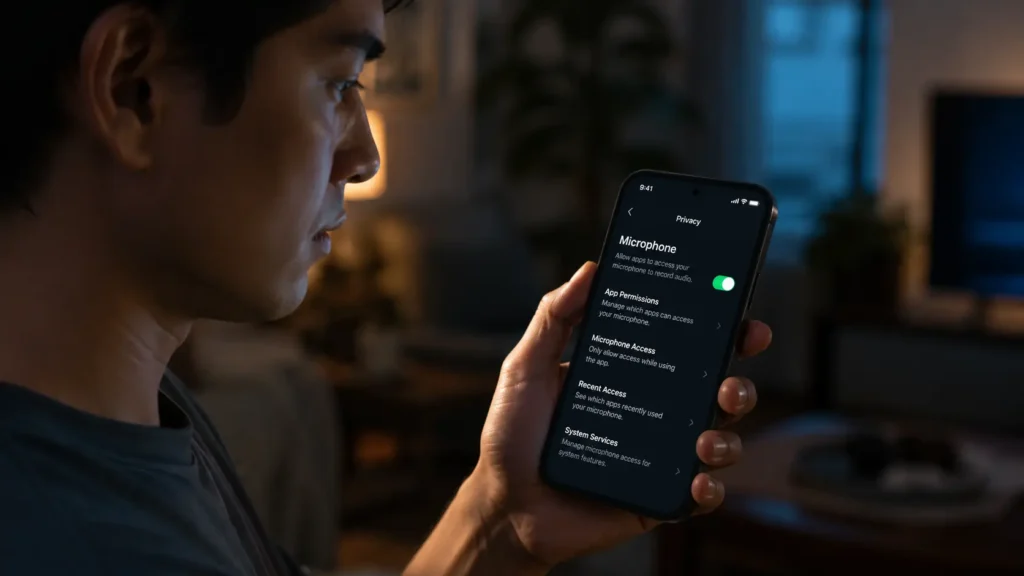
- Review microphone permissions regularly.
- Delete stored voice history.
- Update your phone with the latest security patches.
- Limit unnecessary app permissions.
- Use privacy dashboards available in Android and iOS.
These measures provide greater transparency over how apps access sensitive information.
The Future of AI on Smartphones
As smartphones become more capable, more AI features will run directly on the device instead of remote cloud servers.
This shift offers two important advantages:
- Better privacy through local processing.
- Faster responses with reduced internet dependence.
However, users should remember that privacy also depends on how apps, services, and permissions are configured.
Understanding how on-device AI works is one of the best ways to make informed decisions about digital privacy.
Final Thoughts
The idea that smartphones are secretly recording every conversation makes for attention grabbing headlines, but the reality is more technical.
Today’s phones continuously analyze sound for wake words using low-power AI, yet this process usually occurs locally without permanently storing or transmitting every conversation.
That doesn’t mean there are no privacy risks. Voice assistants, app permissions, cloud services, and behavioral tracking all deserve careful attention.
Knowing how these technologies actually operate empowers users to take practical privacy steps without falling for myths or unnecessary fear.
Read Also
👉 https://aiwalanews.com/how-to-know-if-your-phone-is-being-monitored-the-7-signs/
👉 https://aiwalanews.com/youtube-records-you-every-time-you-skip-an-ad-and-its-darker-than-you-think/
© AiwalaNews | Global Tech & Privacy Edition | April 2026
