Every night, millions of people plug in their phone, dim the lights, and assume the device goes quiet too. It does not. Independent academic investigations, including work from IMDEA Networks Institute and partner European universities, found that certain Android devices kept transmitting tracking data linked to major companies like Meta and Yandex, even after users had actively tried to limit that tracking. The phone on your nightstand is, in a very real sense, still working while you rest.
The Numbers Behind the Headline
The figure of 1,400 companies is not a scare tactic. It comes from how modern apps are actually built. A single weather app, a shopping app, or a simple game often bundles code from five, ten, sometimes twenty different advertising and analytics partners, each one collecting and forwarding data independently. Multiply that across the twenty five or thirty apps sitting on the average phone, and the number of companies quietly receiving fragments of your data climbs into the thousands within weeks, not years.
This is not a rumor circulating on forums. Fox News, TechAdvisor, and CyberGuy have all separately reported on the same underlying research, confirming that smartphones routinely transmit location signals, device identifiers, advertising IDs, and usage patterns long after the screen goes dark.
Why Nighttime Is the Perfect Window
There is a simple, unglamorous reason your phone is busiest overnight. A charging device connected to home Wifi, sitting completely still for six or seven hours, is the easiest possible subject to track with precision. There is no walking, no signal jumping between cell towers, no ambiguity about where you are. For a data collector, a sleeping person with a plugged in phone is close to a perfect data source.
It also means almost nobody notices. During the day, your attention is split between calls, messages, and apps you are actively using. At 3am, network requests slip out completely uncontested, with no notification and no visible sign that anything happened at all.
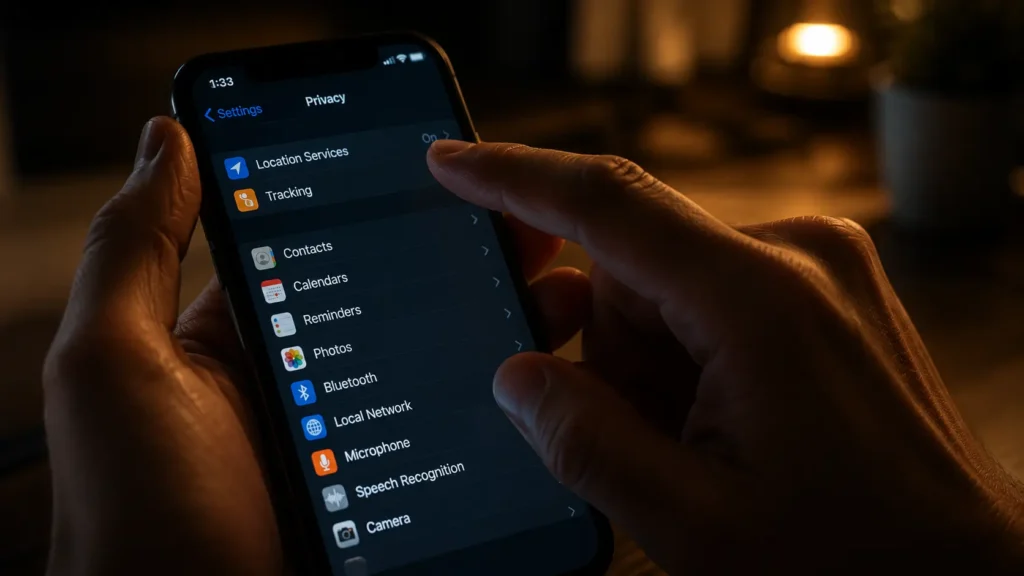
What Is Actually Leaving Your Device
Some background activity is genuinely necessary. Security patches, clock syncing, and essential app updates fall into this category. But researchers have repeatedly flagged a second layer of traffic that goes well beyond maintenance. This includes your approximate or exact location, a list of installed apps, battery status, screen on time, and unique identifiers that let separate companies quietly connect your activity across different apps without ever asking you directly.
According to the CyberGuy investigation, this blurred line between diagnostics and commercial tracking is exactly what makes the issue difficult for average users to detect or challenge. You technically agreed to something, buried inside a privacy policy you tapped past in three seconds, but you almost certainly did not agree to this specific outcome.
Why This Keeps Happening
None of this is accidental. Location history, app usage patterns, and device fingerprints are genuinely valuable. They get sold, licensed, and merged into detailed profiles used for targeted advertising, credit modeling experiments, insurance risk scoring, and in some documented cases, law enforcement requests. A single data point about you means very little on its own. A year of nightly data points becomes something companies are willing to pay for.
What You Can Do Tonight
The encouraging part is that you are not powerless here, and none of the fixes require deep technical knowledge.
Open your phone settings and review which apps have location access when not actively in use. Most people are shocked to find a dozen apps with permissions they never consciously granted.
Turn off background app refresh for anything that does not genuinely need it. A recipe app or a flashlight app has no real reason to sync data at 4am.
Reset your advertising ID periodically, or limit ad tracking entirely through your phone’s privacy settings. This single step breaks a major thread that lets companies link your behavior across different apps.
Consider a privacy focused DNS or firewall tool. These can block known tracker domains before they ever leave your device, cutting a large share of nighttime traffic without breaking the apps you rely on daily.
Finally, be deliberate about what you install. Every new app is another potential doorway for third party code you never chose and cannot easily see once it is running.
The Bigger Picture
None of this makes your phone the enemy. It simply reflects how the modern mobile economy actually works, quietly powered by data moving in the background long after most of us stopped paying attention. Awareness here is not paranoia, it is catching up to reality.
Tonight, when you plug your phone in and close your eyes, it will still be busy. That will not change on its own. But a few deliberate settings, checked once, put a meaningful amount of that control back where it always belonged, with you.
Read also: How Data Brokers Build a Complete Profile of You
Read also: Simple Privacy Settings Every Smartphone User Should Check
© AiwalaNews | Global Tech & Privacy Edition | April 2026
