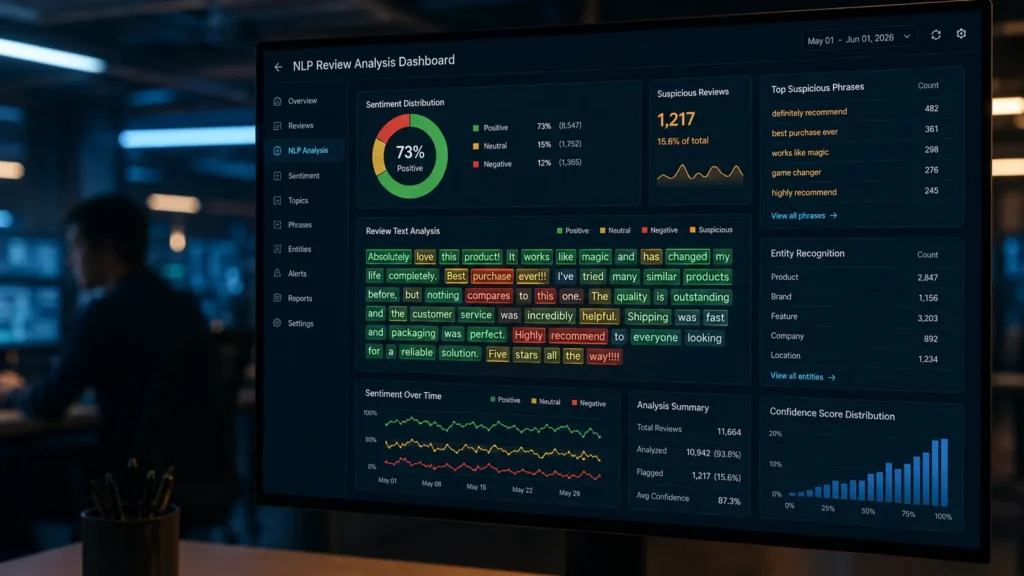
Before you buy almost anything online, you read the reviews. A product with 4.8 stars and 3,000 reviews feels safe. It feels verified. It feels like evidence. But the reviews shaping billions of purchasing decisions every year are increasingly contaminated by fabricated content and the only system capable of catching that contamination at scale is artificial intelligence.
Amazon alone blocked over 200 million suspected fake reviews in a single year. The problem is not a minor platform hygiene issue. It is a systemic threat to consumer trust, and in 2026, the battle against it is being fought entirely by machines.
The Scale of the Problem Nobody Talks About
The financial stakes are enormous, and the deception is more organized than most shoppers realize.
Recent data indicates that even brief exposure to deceptive reviews can cause a 26% drop in trust and a 20.5% reduction in purchase intent. That erosion of trust compounds: when people think a business is using fake reviews, they also start to doubt its genuine five star reviews, making all positive customer feedback less valuable.
Fake reviews are not just individual bad actors posting from their couch. They are coordinated operations networks of paid accounts, AI generated text, and organized review farms operating at industrial scale across Amazon, Yelp, Google, and TripAdvisor simultaneously.
AI fake review detection systems achieve 85 to 98% accuracy far surpassing the 57% accuracy of human detection. Humans, in other words, are essentially guessing when they try to spot a fake review manually. The AI is not.
Layer 1: Natural Language Processing Reading Between the Lines
The first and most fundamental layer of detection examines the text itself, but at a depth no human reader could replicate.
AI fake review detection works by combining Natural Language Processing, Machine Learning, and Behavioral Analysis to identify patterns that distinguish authentic customer feedback from manipulated or bot generated content.
Natural Language Processing helps machines understand and interpret human language the way humans use it in real life. When detecting fake reviews, NLP analyzes the text for factors like grammar, syntax, tone, and even emotional content.
The linguistic signals the system looks for are consistent across platforms. Paid and bot generated reviews often have a different texture because they are meant to change how people feel rather than show what really happened. Overly generic language words like “Great product!” “Excellent service!” or “Highly recommend!” could be used to describe almost any item without going into detail about its features. Repetitive phrasing appears across multiple accounts using the same sentence structures. Extreme sentiment is another signal: when reviews are either all good or all bad, there is no balance, whereas most real reviews mention at least one minor problem.
Real reviews have texture. Fake reviews have polish and that distinction, invisible to the casual reader, is statistically detectable at scale.
Layer 2: The Hybrid Model That Changed Everything
For years, text analysis alone was enough. Then fake reviewers got smarter.
Most existing fake review detection systems focus on the text of a review. That approach worked for a while, but fake reviewers have gotten smarter. They now pair carefully written text with misleading images to make their reviews look authentic. Text only tools struggle to catch this, and that is a real problem for shoppers and honest sellers alike.
The response from researchers was a multi signal approach. Researchers addressed this by building a system that looks at multiple signals at once. It analyzes the review text using two different methods a text convolutional neural network and pre trained language models to capture both surface level and deeper meaning in the words.
The results of this hybrid architecture are measurable and significant. A hybrid AI model combining language analysis and behavioral cues identified fake reviews with 93% accuracy on Amazon and 91% accuracy on Yelp, surpassing traditional detection methods. The system analyzes review context, emotional tone, and behavioral patterns to distinguish genuine from deceptive content.
The researchers, from the Royal Docks School of Business and Law, say this approach gives the model a fuller picture of whether a review is genuine or deceptive.

Layer 3: Behavioral Analysis Watching the Reviewer, Not Just the Review
The most sophisticated detection layer doesn’t analyze the review text at all. It analyzes the person who wrote it.
Machine learning looks at real and fake reviews to learn the differences. Over time, machine learning techniques allow AI to become more accurate at identifying fake reviews from unusual reviewer behavior to accounts that only post five star ratings with generic comments.
The behavioral signals are extensive: how long the reviewer spent on the product page before writing, whether the account was created shortly before the review was posted, whether the same device was used to post multiple reviews across different accounts, how the reviewer’s activity compares to verified purchaser patterns, and whether the timing of multiple reviews clusters around suspicious windows rather than arriving organically over time.
AI fake review detection uses machine learning to identify fraudulent reviews by analyzing text, user behavior, and network connections. That network connection analysis is particularly powerful — a single fake review looks difficult to distinguish from a real one, but a network of 500 fake reviews posted from overlapping devices, IP addresses, and account creation dates reveals the coordinated infrastructure underneath.
The Arms Race: AI Generating Fakes vs. AI Catching Them
Here is the uncomfortable truth sitting at the center of this entire system.
Sophisticated AI like ChatGPT can produce incredibly human like text, creating an arms race between AI powered generation and detection. Current AI fake review detection systems are improving, but it is a difficult task. Research is focused on identifying subtle linguistic fingerprints that betray AI authorship, even when the text seems natural. While detectors struggle, they still outperform humans, who are essentially guessing randomly.
The fake review problem is, in 2026, primarily an AI versus AI conflict with the consumer caught in between. The same technology that powers the generation of convincing fake reviews is being deployed to detect them. The question of which side is winning depends entirely on which platform you are looking at and how aggressively they have invested in detection infrastructure.
What Regulators Are Doing About It
The legal landscape is finally catching up with the technical reality.
The Federal Trade Commission updated its rules on endorsements and testimonials in 2024, making it explicitly illegal to buy, sell, or host fake reviews with penalties applying to platforms that knowingly allow them. The UK’s Digital Markets, Competition and Consumers Act brought similar provisions into force in 2025, requiring platforms to take reasonable steps to prevent fake review publication.
Researchers say future work will focus on training detection systems with larger and more diverse datasets and testing newer AI technologies. They hope the tool could eventually work in real time on large online shopping platforms. If successful, the technology could help make online reviews more trustworthy and help shoppers avoid wasting money on poor quality or unsafe products.

How to Protect Yourself Right Now
Until detection systems reach the point where they catch everything in real time, shoppers have practical tools available.
Look for reviews that include specific product details model numbers, color variants, sizing notes, use cases rather than generic praise. Check the reviewer’s account history: an account with dozens of five star reviews posted across unrelated products within a short window is a red flag. Filter specifically for three star reviews, since these are statistically the least likely to be fabricated. Use browser extensions like Fakespot or ReviewMeta that run their own AI detection on Amazon and other platforms automatically.
And perhaps most importantly: treat a perfect five star average with the same skepticism you would treat a product with no reviews at all.
The Bottom Line
The review you trusted enough to spend money on was evaluated by an AI before it ever appeared on the page. Whether that evaluation was rigorous enough depends entirely on the platform and the sophistication of the system behind it.
By leveraging technology and promoting transparency, we can build a digital marketplace where authentic customer feedback drives decisions, honest businesses thrive, and consumers can make choices with confidence.
That future exists. Getting there requires winning an arms race that, for now, neither side has definitively won.
Read Also:
🔗 The Invisible Companies Buying and Selling Your Data Every Day
🔗 How AI Decides Which Job Applicants Get Rejected
© AiwalaNews | Global Tech & Privacy Edition | April 2026
