
Look closely at almost any modern banknote and somewhere in the design sits a scatter of tiny dots that seem like decoration. They are not. That cluster is a deliberate security signal, and it has a name most people have never heard, the EURion constellation.
A Discovery Made By Accident
The pattern was not revealed by a central bank press release. It was found in 2002 by security researcher Markus Kuhn, who uncovered the pattern on the ten euro banknote while experimenting with a Xerox color photocopier that refused to reproduce the note. Kuhn noticed the arrangement resembled a familiar shape in the night sky, and the name became a portmanteau of Orion, the constellation it resembles, and EUR, the euro’s official currency code.
What he had actually found was a repeating pattern of five small yellow, green, or orange circles, printed across the note at different orientations. In some circles of engineers and researchers, it also goes by a quieter, more industrial name, Omron rings, a nod to the Japanese company widely credited with developing the earliest version of the detection technology.
How Something This Small Stops a Machine
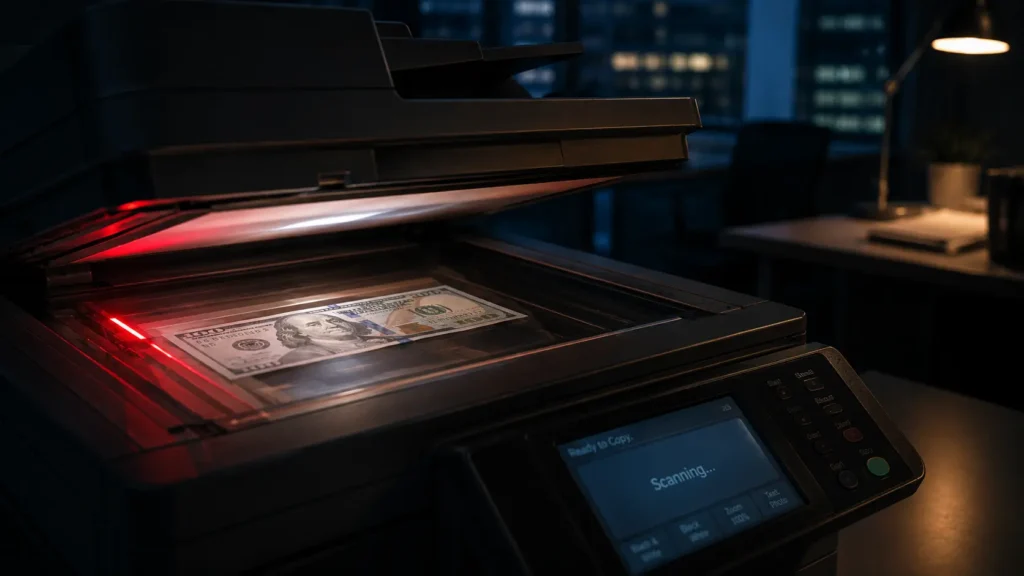
The genius of the system is how little it actually needs. Kuhn found that the mere presence of five of these circles on a page was enough for some color photocopiers to refuse the job outright. A separate technical study testing the threshold directly found the same result under controlled conditions. Researchers attempting to reproduce a banknote quickly discovered that even a single detected constellation was enough to halt the reproduction process entirely.
Later analysis dug into why the pattern works so reliably as a machine readable signal. Researcher Andrew Steer observed that there are simple integer ratios between the squared distances separating nearby circles, a detail that gives image processing software an efficient mathematical shortcut for recognizing the pattern. In other words, the circles are not just present, their spacing is mathematically tuned to be instantly recognizable.
Not Just Photocopiers
The reach of this system extends well past office copy machines. The pattern is typically printed in yellow, green, or orange ink specifically because those colors stand out clearly in the blue channel of a color image, which happens to be exactly how many detection algorithms are built to scan for it.
Consumer software has run into the same wall. Recent versions of image editing programs including Adobe Photoshop and Paint Shop Pro were found to refuse processing images containing banknotes. Investigations into this behavior traced it to something separate but related, a system called the Counterfeit Deterrence System, or CDS. According to reporting cited in later research, the CDS is a software based technology that prevents image editing programs like Adobe Photoshop from opening or processing high resolution images of banknotes. Interestingly, deeper testing by researcher Steven Murdoch and colleagues found that this particular banknote detection code inside consumer software does not actually rely on the EURion pattern itself, suggesting two separate detection systems have been quietly running in parallel for years.

A Global, Coordinated Effort
This was never a single company’s side project. The effort gained formal structure through the Central Bank Counterfeit Deterrence Group, established in 2000 at the request of G10 central bank governors specifically to coordinate global strategies against digital counterfeiting. That group eventually grew to include over 30 central banks and note printing authorities working together on the problem.
The scale of adoption is what makes this genuinely remarkable. Variants of the constellation now appear on banknotes from the Chilean peso, Mexican peso, Canadian dollar, Australian dollar, US dollar, British pound sterling, Swedish krona, and Japanese yen. Some sources place the true count even higher, noting the pattern appears in some form across more than 50 different currencies worldwide, each roughly a single millimeter in diameter, small enough to blend seamlessly into decorative background art.
The Secrecy Around It
What makes the story stranger is how quiet officials have stayed about it. Despite its widespread use, central banks have remained notably secretive about the EURion constellation, with some even denying its existence outright. No banknote ships with a label pointing to the feature. It was reverse engineered by outside researchers poking at photocopiers, not disclosed by the institutions that designed it.
Detection is also not perfectly consistent everywhere. While the system is known to work across many machines, its detection can be inconsistent, some printers and scanners block the copy attempt while others allow it through without any warning at all. That inconsistency is part of why the system stays effective against casual attempts while remaining far from a total defense against determined counterfeiters using specialized equipment.
Why It Still Matters
The EURion constellation was never meant to stop sophisticated criminal operations. Its entire purpose is aimed lower, at the ordinary person tempted to run a bill through a home scanner or office copier out of curiosity or opportunity. In that narrow but common scenario, it works remarkably well, quietly, invisibly, and without a single warning label anywhere on the note itself.
Next time you hold a banknote up to the light, look past the watermark and the security thread. Somewhere in that busy background pattern, five small circles are doing a job you were never meant to notice.
Read also: The Hidden Setting That Stops Your TV From Watching You Watch It
Read also: Your Phone Sends Data to 1,400 Companies While You Sleep
© AiwalaNews | Global Tech & Security Edition | April 2026
