
You settle in, turn on the television, and press play. What you probably do not realize is that the television is doing something too. It is watching the screen, matching what it sees against a massive content library, and quietly sending that information off to servers you will never see. This is not a rumor or a conspiracy theory. It is a documented feature called Automatic Content Recognition, or ACR, and researchers have now measured exactly how aggressive it really is.
What ACR Actually Does
A 2024 study from University College London, presented at the ACM Internet Measurement Conference, connected brand new Samsung and LG smart TVs to a controlled internet hub and captured every packet leaving each device. The results were blunt. Researchers found that LG televisions sent digital fingerprints of on screen content roughly every 15 seconds, while Samsung devices transmitted similar data about once every minute. This happened continuously, in the background, without any visible indication on screen.
The technology works a bit like Shazam for your living room. It periodically captures a snapshot of whatever is displayed and compares it against a reference library to identify the exact show, channel, or advertisement being viewed. Samsung markets its version under the name Viewing Information Services, while LG calls its system Live Plus, promising in return personalized recommendations and targeted advertising.
It Watches More Than Just Your Smart TV Apps
Here is the part that catches most people off guard. The UCL researchers confirmed that ACR continues operating even when the television is being used purely as an external monitor, connected to a laptop, gaming console, or cable box through HDMI. In other words, plugging in an unrelated device does not switch the tracking off. The TV keeps identifying and logging whatever appears on its own screen, regardless of the source.
Dr. Anna Mandalari, one of the study’s authors, explained that the average viewer has little awareness that this system exists at all, let alone that they have the option to disable it. The study also found a curious regional difference. In the United Kingdom, ACR pauses while a user streams through recognized apps such as Netflix or YouTube. In the United States, however, ACR often remains fully active even during that same streaming activity, collecting data regardless of which platform is on screen.
Why This Has Become a Legal Problem
This is no longer just an academic concern. In late 2025, the Texas Attorney General filed lawsuits against five major manufacturers, including Samsung, LG, Sony, Hisense, and TCL, over exactly these tracking practices. That legal pressure led to a landmark settlement with Samsung in February 2026, one of the clearest signs yet that regulators now view undisclosed ACR tracking as more than a privacy inconvenience.
Privacy researchers have also pointed out a subtler issue. Since ACR captures anything displayed on the screen, it can theoretically fingerprint copyrighted material, confidential work documents shared during a video call, or personal photos viewed through a connected device. What was designed as an advertising tool ends up brushing against far more sensitive territory than most buyers ever consider at checkout.

The One Setting That Actually Works
The encouraging discovery buried inside the UCL research is this. Opting out genuinely works. When researchers disabled ACR through the television’s settings, network traffic to ACR related servers stopped entirely. No workaround, no hidden backup channel. A real, complete stop.
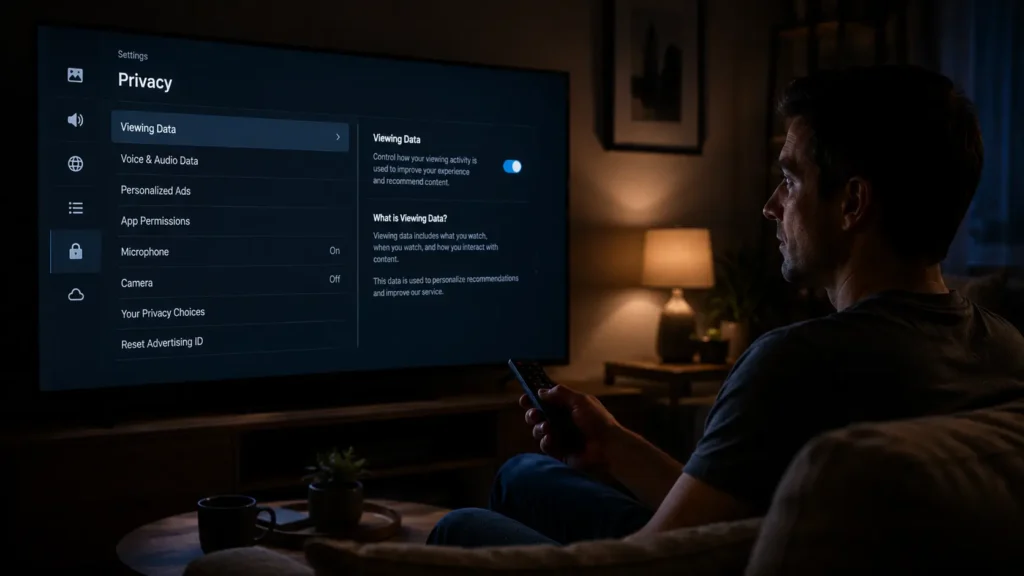
The setting itself is usually named something vague and easy to miss, phrases like Viewing Information Services, Live Plus, Interest Based Advertising, or simply ACR, tucked several menus deep inside general or privacy settings. Manufacturers rarely walk new owners through it during setup, and the default position on nearly every major brand is enabled, not disabled.
Turning it off typically takes less than a minute once you find the right screen. Look under general settings, then privacy or terms and policies, and search specifically for wording related to viewing data, interest based advertising, or content recognition. Toggle it off, and according to the same peer reviewed research, the tracking traffic simply disappears.
Why Most People Never Bother
Part of the reason this setting stays buried is structural, not accidental. ACR data is valuable. It feeds targeted advertising, audience measurement, and licensing deals between manufacturers and third party data buyers. A setting that is easy to find and easy to disable works against that business model, so it rarely gets highlighted during setup or in the on screen welcome tour.
The Bigger Takeaway
None of this means smart TVs are secretly malicious. It means the convenience of modern television comes bundled with a data relationship most buyers never explicitly agreed to in any meaningful sense. The good news, confirmed by real peer reviewed testing rather than speculation, is that the fix is simple, free, and already sitting inside every one of these televisions.
Somewhere in your settings menu, three or four taps deep, there is a switch that changes what your television actually does while you watch it. Most people never find it. Now you know exactly where to look.
Read also: How Smart Home Devices Quietly Collect More Than You Think
Read also: The Privacy Settings Every New Device Owner Should Check First
© AiwalaNews | Global Tech & Privacy Edition | April 2026
