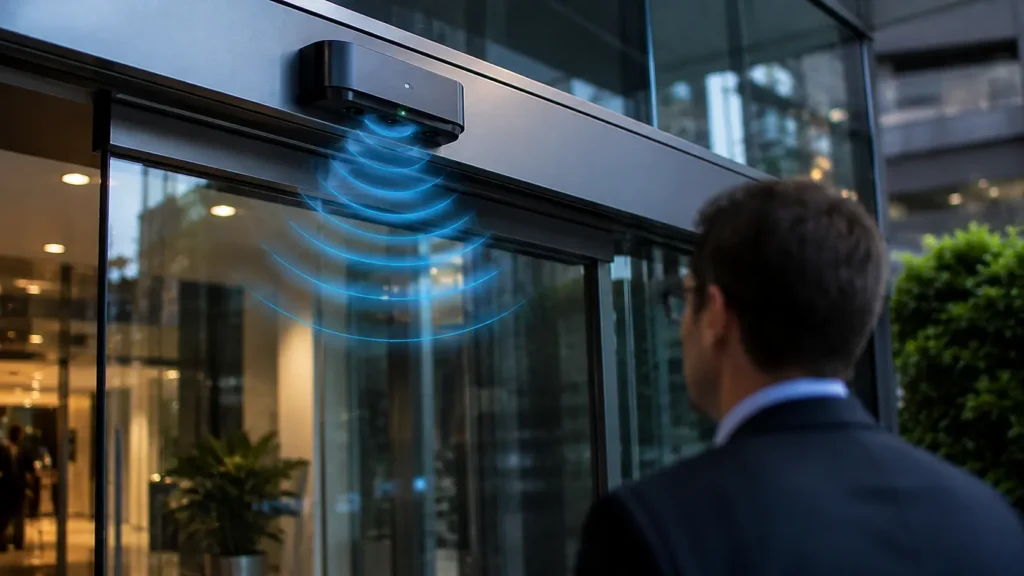
Walk toward the entrance of a supermarket, hospital, airport, or office building, and something almost magical happens. The doors slide open before your hand reaches the sensor, often before you even notice where the sensor is located.
It feels effortless. Many people assume the door reacts the moment they step onto a hidden pressure pad or wave directly in front of a detector.
The reality is far more fascinating.
Modern automatic door systems are constantly scanning the space in front of them, predicting movement and identifying approaching people before they ever reach the entrance. In many cases, the system begins making decisions in just a fraction of a second, creating the smooth experience we barely notice every day.
Behind those few seconds of convenience lies decades of engineering focused on one goal.
Making every entrance safer, faster, and smarter.
The Door Is Already Watching Before You Arrive
Contrary to popular belief, most modern automatic doors do not wait for physical contact.
Instead, they continuously monitor an invisible area extending several feet in front of the entrance.
This monitoring happens every second, whether anyone is nearby or not.
The sensors create an invisible detection zone that allows the system to recognize movement long before someone reaches the doorway.
As soon as a person enters that zone, the door’s controller analyzes the incoming signal and decides whether the movement is approaching the entrance or simply passing by.
If the movement is directed toward the door, the opening process begins almost immediately.
That is why the doors often seem to anticipate your arrival.

The Invisible Technology Above Your Head
Look above most automatic sliding doors and you will usually find a small black or dark colored device mounted over the entrance.
Inside that compact housing are highly advanced sensors.
The most common technologies include microwave radar sensors, infrared sensors, and increasingly LiDAR based detection systems in premium installations.
Each works differently, but they all serve the same purpose.
Detect people before they reach the door.
Microwave radar sensors emit harmless radio waves that bounce off moving objects.
When those reflected waves change, the system instantly knows something is approaching.
Infrared sensors detect changes in heat and movement.
Newer LiDAR systems create detailed three dimensional maps of the entrance area using pulses of light, allowing them to distinguish people from shopping carts, bicycles, or other objects with remarkable accuracy.
It Is Not Just Detecting You. It Is Predicting Your Movement
One of the smartest features of modern automatic door technology is that it does not simply detect motion.
It evaluates direction.
Imagine someone walking along the sidewalk in front of a store.
If every passing pedestrian triggered the doors, they would constantly open and close all day, wasting energy and increasing wear.
Instead, the controller studies movement patterns.
If someone is moving toward the entrance, the door prepares to open.
If they continue walking parallel to the building, the system ignores them.
This predictive capability makes automatic entrances feel surprisingly intelligent, even though they rely on sophisticated mathematics rather than artificial intelligence.
A Busy Airport Shows Why Speed Matters
Picture a crowded international airport during the morning rush.
Hundreds of travelers roll luggage toward the terminal every few minutes.
Families push strollers.
Airport staff transport equipment.
Passengers carrying heavy bags cannot easily stop to push open large glass doors.
Automatic entrances remove that obstacle.
As each traveler approaches, sensors recognize their movement and activate the doors before they arrive, allowing a continuous flow of people without unnecessary delays.
Without this technology, entrances would quickly become bottlenecks during peak travel hours.

Safety Is More Important Than Convenience
Opening the door is only part of the job.
Closing it safely is often even more important.
Modern systems use additional presence sensors that monitor the doorway while it remains open.
If someone pauses in the entrance, bends to pick up a dropped item, or a child suddenly runs back through the doorway, these sensors immediately detect the obstacle.
Instead of closing, the doors remain open until the path is completely clear.
This significantly reduces the risk of injuries and protects wheelchairs, shopping carts, luggage, and pets from becoming trapped.
In hospitals and care facilities, where patients may move slowly, these safety features are especially important.
Why Automatic Doors Rarely Open for Birds or Falling Leaves
Have you ever wondered why a bird flying nearby or leaves blowing across the entrance usually do not trigger the doors?
Modern controllers use filtering algorithms to reduce false activations.
They consider factors such as object size, movement speed, travel direction, and how long something remains inside the detection zone.
A small leaf moving randomly in the wind behaves very differently from a person walking steadily toward the entrance.
By filtering out irrelevant movement, the system improves both efficiency and reliability.
This also helps reduce unnecessary heating or cooling losses inside buildings because the doors only open when genuinely needed.
The Technology Keeps Improving Every Year
Automatic entrances today are far more advanced than those installed decades ago.
Many premium systems now adjust their opening speed based on pedestrian traffic.
Some communicate with building management systems to improve energy efficiency.
Others integrate with access control, allowing authorized employees to enter restricted areas while keeping unauthorized visitors outside.
Artificial intelligence is also beginning to assist certain high end commercial entrances by improving object recognition and adapting sensor sensitivity based on changing environmental conditions.
Even so, the core principle remains unchanged.
Detect approaching people early enough to create a seamless experience.
Can Automatic Doors Ever Fail
Like any technology, automatic doors are not perfect.
Heavy rain, accumulated dirt, damaged sensors, electrical faults, or poor maintenance can affect performance.
That is why commercial entrances undergo regular inspections and safety testing.
Many countries require automatic door systems in public buildings to comply with strict safety standards, ensuring sensors, controllers, and emergency mechanisms continue operating correctly.
These inspections help ensure the doors remain dependable even after millions of opening and closing cycles.
The Everyday Technology Most People Never Notice
Automatic doors have become so common that we rarely think about the engineering behind them.
Yet every smooth opening represents an invisible conversation between advanced sensors, intelligent controllers, precision motors, and carefully designed safety systems.
They quietly monitor movement, predict human behavior, protect vulnerable pedestrians, and keep busy buildings operating efficiently.
The next time a door opens before you even reach it, remember that it was not reading your mind.
It was reading your movement.
In just a fraction of a second, modern automatic door systems analyze your approach, predict your destination, and make thousands of tiny calculations so your journey continues without interruption.
Sometimes the smartest technology is the one we stop noticing altogether.
Read Also
Read also: https://aiwalanews.com/how-to-check-if-your-data-has-already-been-leaked/
