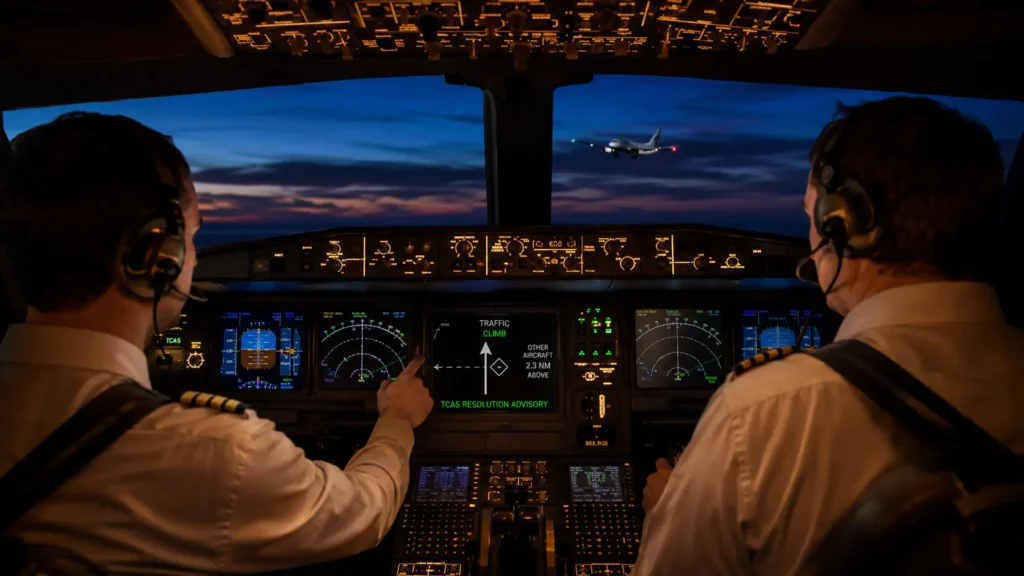
If you have ever looked out of an airplane window and noticed another aircraft far in the distance, you have probably wondered just how crowded the skies really are.
The answer is surprising. On any normal day, tens of thousands of commercial flights are moving across continents, oceans, and busy air corridors at speeds approaching 900 kilometers per hour. Despite this extraordinary traffic, the chances of two passenger aircraft colliding remain exceptionally small.
That level of safety is not simply the result of skilled pilots or experienced air traffic controllers. One of the biggest reasons is an onboard system known as Traffic Collision Avoidance System, more commonly called TCAS. It is designed to detect potential conflicts long before pilots can see another aircraft and can calculate a coordinated escape maneuver in roughly 0.35 seconds.
Most passengers never know it exists, yet it quietly stands guard throughout every flight.
Why Human Eyes Are Not Enough
Imagine two modern passenger jets flying above thick cloud layers at an altitude of nearly 37,000 feet. Both aircraft are moving at cruising speed, and neither crew can visually identify the other because they are still many kilometers apart.
Even with perfect weather, relying on human vision would simply be too slow.
Aircraft travel so quickly that every second matters. If two jets are approaching each other, their combined closing speed can exceed 1,700 kilometers per hour. At that rate, valuable separation disappears almost instantly.
This is where TCAS becomes one of the most important safety systems ever installed on commercial aircraft.
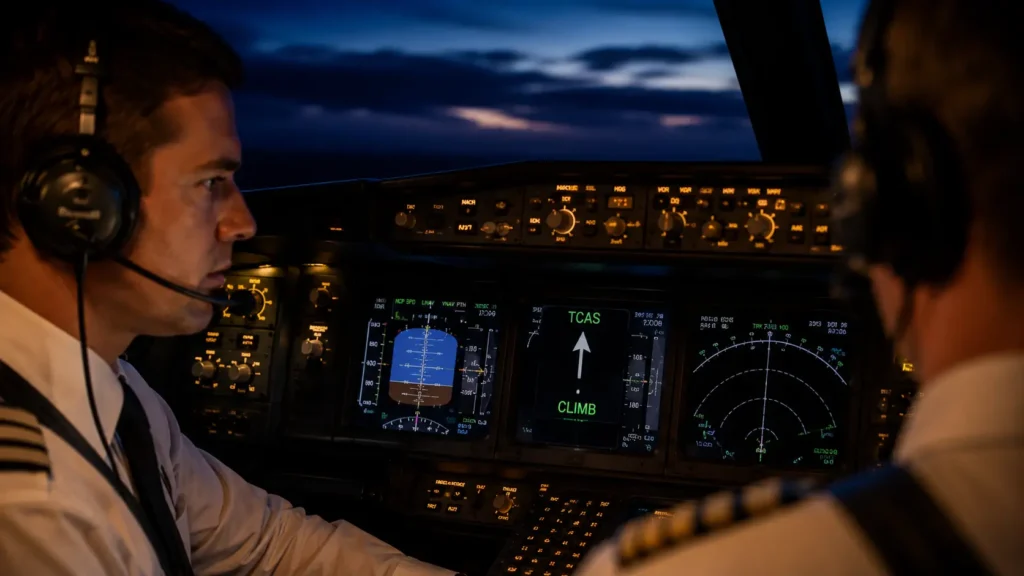
How TCAS Constantly Watches the Sky
Unlike ground radar, TCAS does not depend on air traffic control to identify nearby aircraft.
Every commercial airplane carries a transponder, a device that continuously broadcasts information including its identity and altitude. TCAS receives these signals from surrounding aircraft and creates a constantly updated picture of nearby traffic.
The computer continuously evaluates several factors.
- Current altitude
- Rate of climb or descent
- Flight direction
- Speed
- Predicted future position
Instead of reacting only when aircraft become dangerously close, the system predicts where each aircraft will be within the next few seconds. If their projected paths indicate a possible conflict, TCAS immediately begins calculating the safest solution.
This process happens automatically without requiring pilots to press a single button.
The Remarkable Speed Behind Every Decision
People often hear that TCAS can react in about 0.35 seconds, but few appreciate why such speed matters.
Modern aircraft cover enormous distances in an incredibly short time. A single second of delay can mean hundreds of meters of lost separation.
The onboard computer performs continuous calculations every moment of the flight. As soon as new position information arrives, it compares multiple flight paths, predicts future movement, and determines whether immediate action is necessary.
When every fraction of a second counts, there is simply no time for discussion or hesitation.
The Clever Feature That Prevents Confusion
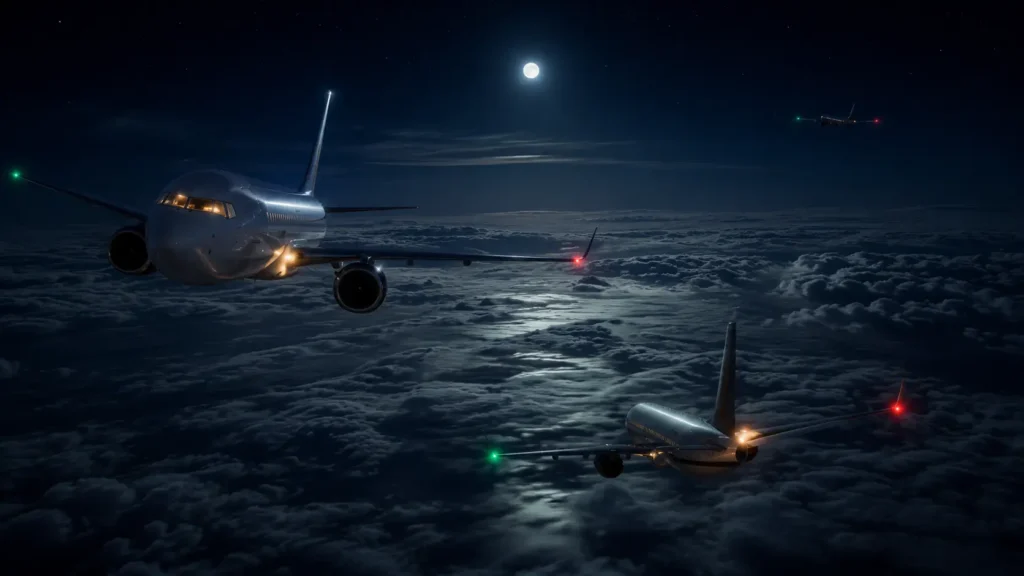
One of the smartest aspects of TCAS II is that it coordinates both aircraft involved in the potential conflict.
Without coordination, both pilots might instinctively choose the same escape direction. If both aircraft climbed at the same time or both descended together, the danger could actually increase.
Instead, the systems communicate electronically through their transponders.
One cockpit may hear:
“Climb. Climb.”
At precisely the same moment, the other cockpit receives:
“Descend. Descend.”
These instructions are synchronized so each aircraft moves in opposite directions. The crews do not negotiate with each other, and they do not need to wait for approval. The onboard computers have already agreed on the safest solution.
A Tragedy That Changed Global Aviation
One of the most significant events involving TCAS occurred on July 1, 2002, above Überlingen, Germany.
A passenger aircraft operated by Bashkirian Airlines and a DHL cargo aircraft found themselves on a collision course during the night.
The DHL crew followed the instructions issued by TCAS. The passenger aircraft instead followed conflicting guidance from air traffic control.
The aircraft collided, claiming 71 lives.
Investigators concluded that the collision highlighted the importance of trusting coordinated collision avoidance instructions during an imminent emergency.
Today, international pilot training clearly states that when a genuine TCAS resolution advisory conflicts with air traffic control instructions, pilots must immediately follow the TCAS command. This important procedural change has strengthened aviation safety around the world.
Why Air Traffic Controllers Still Need TCAS
Air traffic controllers remain an essential part of aviation, but they also face enormous responsibility.
A single controller may monitor dozens of aircraft while managing changing weather, runway operations, emergency situations, and constant radio communication.
TCAS serves as an independent layer of protection.
Even if communication is delayed or an unexpected situation develops, each aircraft still carries its own intelligent collision avoidance system capable of making rapid decisions without waiting for outside assistance.
Rather than replacing controllers, TCAS works alongside them to create multiple layers of safety.
The Future of Collision Avoidance
Modern aviation continues to evolve.
Future aircraft are expected to combine Artificial Intelligence, satellite navigation, advanced weather forecasting, and real time aircraft networking to predict conflicts even earlier.
Instead of reacting seconds before a possible encounter, future systems may identify developing risks several minutes in advance and recommend smoother route adjustments that passengers never even notice.
The objective is not only preventing collisions but also making increasingly crowded skies safer and more efficient for everyone.
Final Thoughts
Commercial aviation has earned its reputation as one of the safest forms of transportation because safety is built through multiple independent layers rather than relying on a single person or technology.
Among those layers, Traffic Collision Avoidance System remains one of the most remarkable achievements in modern aviation. It constantly monitors nearby aircraft, predicts future flight paths, communicates directly with other airplanes, and issues coordinated instructions in about 0.35 seconds when every moment matters.
Millions of passengers board aircraft each day without ever hearing the calm electronic voice that protects them in the background. That silence is perhaps the greatest compliment any safety system can receive. When technology performs perfectly, most people never realize it was working at all.
Read Also
How Airplane Black Boxes Survive Massive Crashes
https://aiwalanews.com/how-airplane-black-boxes-survive-massive-crashes/
Why Airplane Windows Are Round Instead of Square
https://aiwalanews.com/why-airplane-windows-are-round-instead-of-square/
© AiwalaNews | Global Tech & Privacy Edition | April 2026
