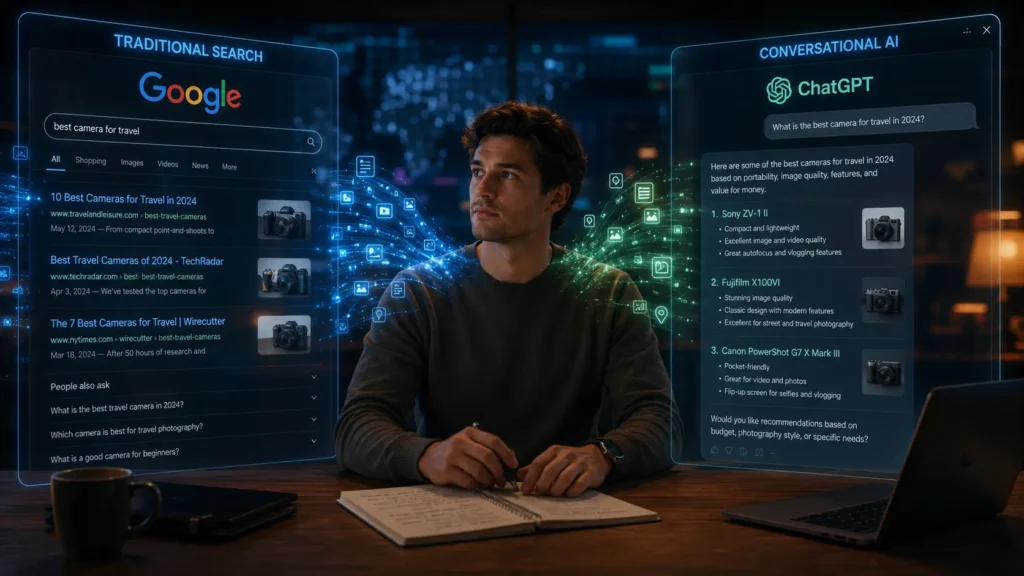
For years, searching the internet followed a familiar routine. You typed a question into Google, scanned through several blue links, opened a few websites, compared information, and finally found your answer.
Today, that habit is beginning to change.
Millions of people now ask questions directly to artificial intelligence assistants instead of opening a traditional search engine. Whether it is writing an email, comparing smartphones, explaining a medical term, or planning a vacation, many users expect one clear answer instead of ten different links.
This shift does not mean Google is disappearing tomorrow. It does mean that AI search is changing what people expect from finding information online.
Search Is Becoming A Conversation
Traditional search was designed to help people discover websites.
Modern AI powered search is designed to understand questions.
Imagine asking, “Which laptop is best for video editing under one thousand dollars?”
A traditional search engine might display shopping pages, review websites, discussion forums, and videos.
An AI search assistant can summarize the strengths of several laptops, explain the differences, compare specifications, and even recommend one based on your needs.
For many users, this feels less like searching and more like talking to an expert.
That experience is becoming one of the biggest reasons AI search continues to grow.
People Want Answers, Not Endless Links
Think about the last time you searched for a simple question.
Did you enjoy opening five different websites before finding the information?
Probably not.
Modern internet users value speed more than ever.
Instead of reading multiple articles, they often prefer one detailed explanation that combines information into an easy to understand response.
This changing behavior is encouraging technology companies to rethink how search should work in the future.
Google has already introduced more AI generated summaries, while other companies are building search experiences where conversation becomes the primary interface.
Real Example
Imagine a college student preparing a presentation about renewable energy.
Five years ago, they might have opened several websites, copied notes into a document, and spent an hour organizing the information.
Today, an AI assistant can explain the topic, compare solar and wind energy, create an outline, suggest reliable sources, and answer follow up questions within minutes.
The student still benefits from checking original sources, but the research process becomes significantly faster.
This is not replacing knowledge.
It is changing how knowledge is discovered.
Trust Will Decide The Winners
One important challenge remains.
Artificial intelligence can occasionally generate incorrect information with great confidence.
Because of this, trust may become the most valuable feature of future search systems.
People want answers that are accurate, current, and supported by reliable sources.
The companies that combine intelligent conversation with strong factual accuracy are likely to earn the greatest public confidence.
Future search is not simply about producing answers quickly.
It is about producing answers people can trust.
Screenshot Suggestion
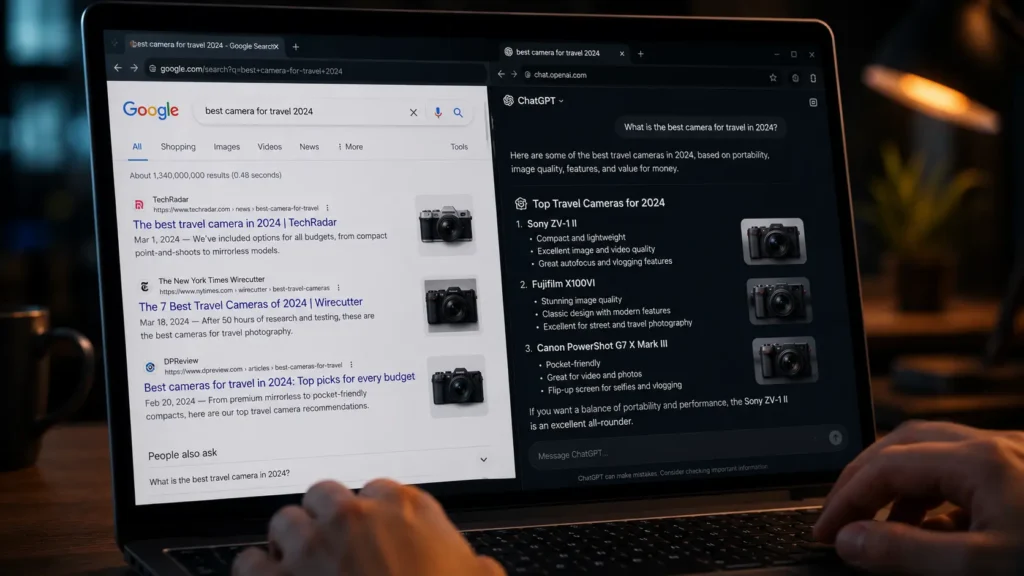
Screenshot: Compare the same question entered into Google Search and an AI assistant. Show how one provides multiple website links while the other delivers a structured summary with conversational responses. This visual instantly demonstrates the difference readers are learning about.

Search Will Become More Personal
Future AI systems are expected to understand user preferences more effectively.
Instead of asking the same questions repeatedly, your assistant may remember that you prefer detailed technical explanations, shorter summaries, vegetarian recipes, or budget travel recommendations.
This creates a more personalized experience.
At the same time, privacy will become even more important.
Users will increasingly ask how much personal information should be remembered and how long it should be stored.
Balancing convenience with privacy will remain one of the defining challenges of AI search.
The Role Of Websites Will Change
Many publishers worry that AI could reduce website traffic.
The reality may be more balanced.
Simple questions may receive complete answers directly inside AI search.
However, detailed research, expert opinions, original reporting, product reviews, investigative journalism, and unique experiences will still require human created content.
Artificial intelligence cannot replace genuine expertise or first hand reporting that never existed online before.
In many cases, AI will introduce readers to trusted publishers rather than replacing them entirely.
Simple Comparison
| Traditional Search | AI Search |
|---|---|
| Finds websites | Provides direct answers |
| Requires opening multiple pages | Combines information into one response |
| User compares sources | AI summarizes information |
| Focus on keywords | Focus on natural conversation |
| Navigation first | Understanding first |
Google Is Not Standing Still
Some people believe AI and Google are competing against each other.
In reality, Google itself is investing heavily in artificial intelligence.
Many recent search improvements already use advanced AI models to understand questions more naturally and deliver richer results.
Rather than disappearing, traditional search engines are evolving.
The future is likely to combine classic web search with intelligent conversational assistance.
This means users can still explore original websites while receiving faster summaries when appropriate.
The Next Chapter Of Search Has Already Begun
The biggest change is not the technology itself.
It is the way people think about finding information.
Instead of searching for websites, people are beginning to search for understanding.
That shift is transforming the internet faster than many realize.
Will AI completely replace Google?
Probably not.
Will AI permanently change how billions of people discover information?
That future is already unfolding today.
The companies that succeed will not simply build smarter artificial intelligence.
They will build systems that earn trust, respect privacy, and help people understand the world with greater clarity than ever before.
Read Also
Read also: https://aiwalanews.com/how-websites-recognize-you-even-without-cookies/
Read also: https://aiwalanews.com/what-happens-inside-googles-data-centers-when-you-search/
© AiwalaNews | Global Tech & Privacy Edition | April 2026
