
A friend who spent a few years working night shifts at a regional internet provider once tried to explain his job to me at a dinner party, and I remember the table going quiet the way it does when someone accidentally says something more interesting than expected. He wasn’t fixing customer wifi routers. He was babysitting rows of humming metal cabinets in a windowless building, machines most subscribers will never see, hear about, or think about, that quietly decide how their internet connection actually behaves every single second it’s active.
That conversation stuck with me because most people, myself included at the time, picture their internet provider as basically a big pipe. Turn on your router, data flows in, that’s the whole story. It isn’t. Sitting between your house and the wider internet is a layer of specialized computers doing far more than simply passing your data along.
The Machine That Turns Your Signal Into Internet
If you have cable internet, the very first serious piece of equipment your connection touches after leaving your neighborhood is something called a CMTS, short for cable modem termination system. Its entire job is to take the signals coming from hundreds of individual cable modems in your area and convert them into a form that can travel onward to the wider internet, then do the same thing in reverse for everything coming back to you.
If you’re on DSL instead, a similar role gets handled by a DSLAM, which performs essentially the same function but over old fashioned copper phone lines instead of coaxial cable. Fiber networks use their own equivalent too. None of these boxes are things a customer ever interacts with directly, they usually live inside a nondescript building or a green cabinet on a street corner, doing constant, invisible work every time you load a page.
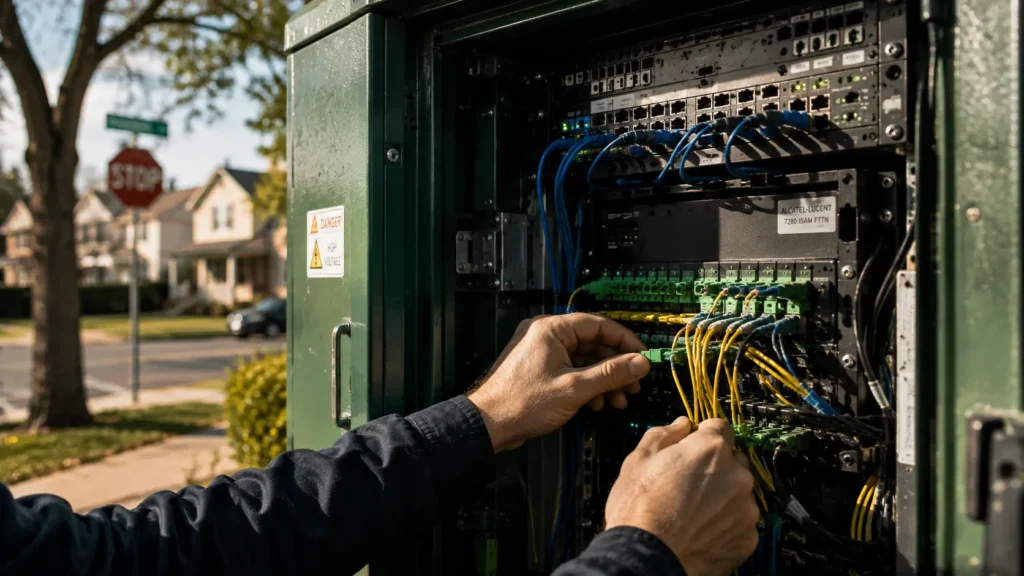
The Part That Actually Looks Inside Your Traffic
Here’s where things get genuinely interesting, and a little uncomfortable. Beyond the equipment simply routing your connection, many providers also run deep packet inspection, technology capable of looking past the basic address information on a piece of data and actually examining what’s inside it.
A standard router only checks something like an envelope’s exterior, where it’s coming from, where it’s going. Deep packet inspection, often shortened to DPI, opens the envelope. According to networking documentation from Cisco and independent security researchers, DPI systems can identify the specific application or service generating a piece of traffic, reroute it, prioritize it, throttle it, or block it entirely, all based on rules the provider itself decides to enforce.
Providers generally frame this technology around legitimate purposes: managing network congestion during peak hours, defending against distributed denial of service attacks, and satisfying legally required wiretap capabilities that regulators in nearly every country require providers to support. But the same underlying documentation makes clear the technology’s reach extends further than that. DPI can also be used for targeted advertising based on browsing habits, usage based billing, and identifying peer to peer file sharing for copyright enforcement purposes.
Why This Matters More Than It Sounds
I spoke with a network security consultant who’s spent years auditing ISP infrastructure for compliance work (she asked not to be named since her contracts include confidentiality clauses around client network details). Her framing was direct: “People assume encryption means their provider can’t see anything meaningful anymore. That’s only partly true. Even encrypted traffic still reveals metadata, timing, size, destination, and DPI systems are built specifically to work with exactly that kind of information.”
That distinction matters. Even when a website itself is fully encrypted, the surrounding pattern, how much data moved, when, and roughly where it went, can still be visible to the equipment sitting inside your provider’s network, long before your traffic ever reaches its final destination.

Every Device You Own Leaves a Fingerprint Before You Even Load a Page
One detail that surprised me while looking into this: the moment any device on your home network requests an address to get online, that request passes through equipment that logs exactly which physical port, node, and slot it came from. In cable and fiber networks, this information gets attached automatically at the hardware level, and it’s specifically designed to be extremely difficult to fake, since doing so would require actually compromising the provider’s physical equipment. It’s a detail built for accountability and troubleshooting, but it also means your provider has a far more precise picture of your home network’s activity than most people ever consider.
Not Necessarily Sinister, Just Invisible
None of this is presented as some hidden conspiracy by the companies that build it. Provider documentation is fairly open about what this equipment does, congestion management, security, billing accuracy, legal compliance. The problem isn’t secrecy exactly, it’s that almost nobody outside the industry ever reads that documentation, so an entire layer of infrastructure quietly making decisions about your traffic stays functionally invisible to the people relying on it every day.
The next time your connection feels instant, like data simply materializes the moment you click something, it’s worth remembering it didn’t. It passed through a chain of specialized machines first, each one making a quiet decision about your traffic before you ever noticed a delay, or didn’t.
Read also this: Why ATMs Almost Never Run Out Of Cash | Inside The Machines That Sort Millions Of Packages Every Day
© AiwalaNews | Global Tech & Privacy Edition | April 2026
