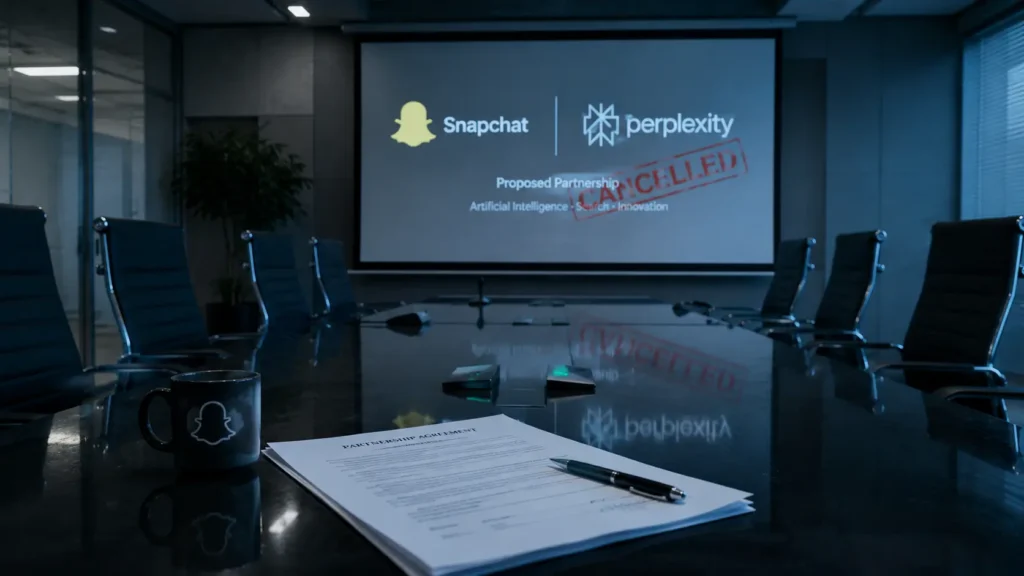
It was supposed to be the deal that validated AI search inside social media. When Snap and Perplexity announced their partnership in November 2025, it felt like the beginning of something a blueprint for how AI startups and established platforms could grow together, with cash, equity, and a shared vision of what the next generation of social apps could look like.
Five months later, it’s over. And the way it ended says more about the state of AI than either company wants to admit.
What the Deal Actually Was
Announced as part of Snap’s third-quarter earnings last November, the deal would have seen Perplexity’s AI search engine integrated directly into Snapchat’s Chat interface allowing users to ask questions and receive conversational answers without leaving the app.
Under the original terms, Perplexity was set to pay Snap roughly $400 million across twelve months in a mix of cash and equity making it one of the largest AI distribution deals signed between a startup and a major social platform in 2025.
Snap shares jumped 15% after the deal was announced, with the company telling investors that revenue from the partnership was expected to begin contributing to its financials in 2026. Wall Street loved the story. A struggling social media company finding a high-margin AI revenue stream. A fast-growing AI startup buying distribution to hundreds of millions of young users. On paper, it looked clean.
It wasn’t.
What Actually Happened
A limited rollout reached only a subset of Snapchat users before the feature was quietly shelved never reaching the full user base.
Friction between the two companies had been visible for months. As far back as February, Snap had publicly acknowledged that both sides were still unable to settle on how a wider deployment would work.
That February disclosure was the first sign that something was wrong buried in investor language, easy to miss if you weren’t paying attention. Snap said in its fourth-quarter investor letter: “Our Q1 revenue guidance range excludes any potential revenue from the Perplexity integration as we have yet to mutually agree on a path to a broader roll out.”
Translation: the deal existed on paper. The product didn’t.
By early 2026, both companies acknowledged in public filings that they had not agreed on a path to broader deployment, and the deal was formally unwound a few weeks later.
The official statement, when it finally came, was careful and corporate. “After working together, Snap and Perplexity determined that the original implementation was not the right fit for each company’s product goals and have resolved the matter amicably on confidential terms,” a spokesperson said.
Amicable. Confidential. Clean on the surface. But underneath that language is a deal that burned five months, a product that never shipped at scale, and a $400 million revenue line that simply disappeared.

What Went Wrong
Neither company has said explicitly what broke down. “Product fit” is the kind of phrase that sounds specific but explains nothing. So what does the available evidence actually suggest?
The core tension appears to have been about how Perplexity would live inside Snapchat and whose experience it would serve. Perplexity’s product is built around a specific interaction model: you ask a question, you get a sourced, synthesised answer. It’s deliberate, research-oriented, and designed for users who want depth.
Snapchat’s users are predominantly young, mobile-first, and built around a fundamentally different interaction model ephemeral, visual, fast. The Chat interface where Perplexity was set to live is where people talk to friends, not where they go to research topics.
The collapse raises fresh questions about how much AI users actually want inside social apps. That question is more uncomfortable than it sounds. The assumption baked into nearly every AI-social partnership of the last two years is that users want smarter answers in their social feeds, their messaging apps, their comment sections. The Snap-Perplexity outcome suggests that assumption may be less solid than it looked.
Plugging a research-grade AI answer engine into a platform where the primary use case is sending selfies to friends isn’t a product strategy. It’s a distribution deal dressed up as one.
The Financial Fallout
Snap’s updated revenue guidance assumes zero contribution from the Perplexity partnership removing an expected 2026 monetization tailwind that investors had begun to price into the stock.
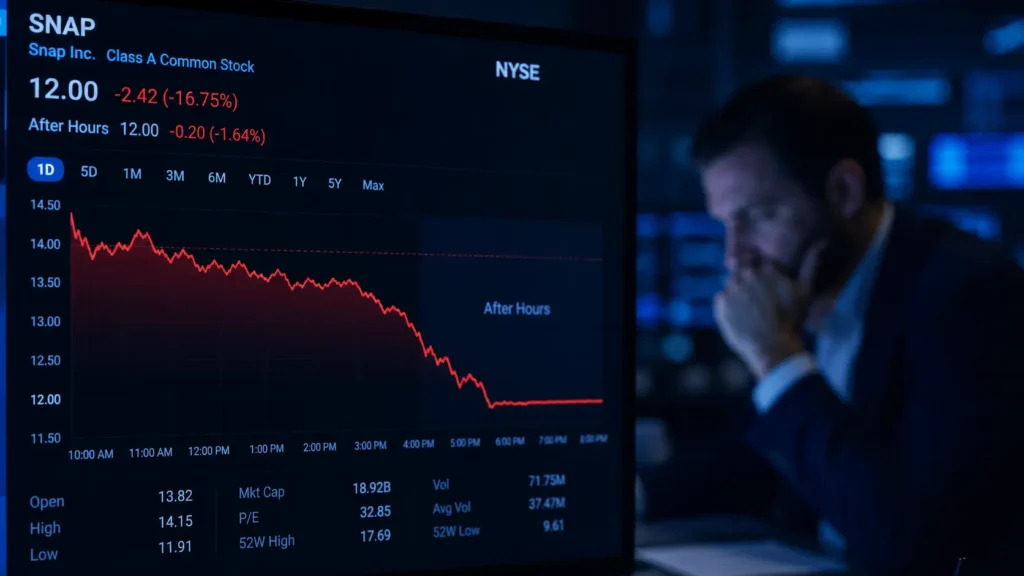
Snap shares dropped about 4% in extended trading after the company reported first-quarter earnings and confirmed the deal’s end a sharp reversal from the 15% jump the announcement had generated five months earlier.
That symmetry is telling. The market gave Snap credit for a partnership it hadn’t built yet, then took it away when the building didn’t happen. For a company that has spent years trying to prove it can grow revenue as aggressively as it grows users, losing a $400 million line item in the same quarter it was supposed to materialize is a meaningful setback.
The cancellation removes a key strategic pillar from the social media company’s near-term AI roadmap and erases an expected revenue stream that investors had begun to price into the stock.
What It Means for Perplexity
The deal’s collapse stings differently for Perplexity. For Snap, this was a revenue stream. For Perplexity, this was a distribution play access to Snapchat’s hundreds of millions of users, the majority of them under 30, at a moment when building consumer habits around AI search is the entire competitive game.
That distribution is now gone. And the $400 million that Perplexity was committed to paying Snap a significant capital outlay for a startup, even a well-funded one — presumably stays largely unspent, which preserves runway but doesn’t solve the underlying challenge.
The end of the Perplexity deal does not mean Snapchat is stepping away from AI entirely the company is pursuing other AI-driven revenue streams in its chat product. Which means Perplexity’s window to own the Snapchat ecosystem is now closed, and whoever Snap partners with next gets that slot instead.
The Bigger Warning
The Snap-Perplexity collapse is part of a broader pattern that is starting to emerge across the AI industry: partnerships announced with fanfare, built with optimism, and quietly unwound when the product reality doesn’t match the deal deck.
Integrating AI into existing consumer products is harder than signing the term sheet. Users don’t automatically want AI injected into the apps they already use in specific, habitual ways. Product teams at social platforms and AI startups often have fundamentally different ideas about what “integration” actually means and those differences don’t always surface until the build is already underway.
The deals that will actually work are the ones where the AI makes the existing user behavior better not the ones that ask users to develop new behaviors inside platforms they already have strong habits around.
Snap and Perplexity both learned that lesson the expensive way. The question now is whether the rest of the industry is paying attention.
© AiwalaNews | Global Tech & Privacy Edition | May 2026
Read Also:
- 🔗 Perplexity AI vs Google Search: The Battle for the Future of How We Find Things
- 🔗 Why AI Partnerships Keep Failing — And What Needs to Change
