You open your banking app. You type your password correctly. You pass the one-time PIN sent to your phone. Everything checks out at least, everything you can see checks out.
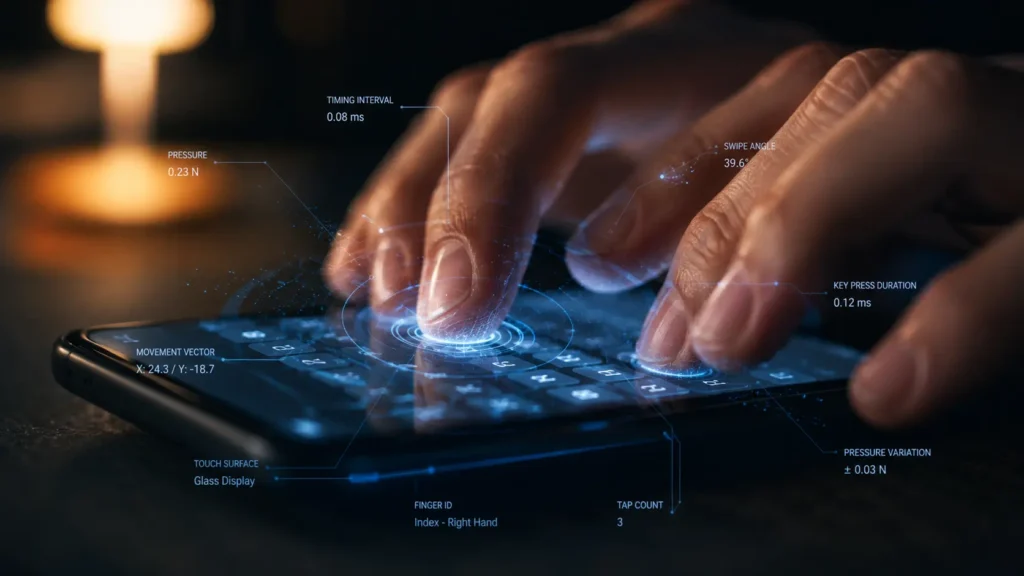
But somewhere in the background, in a window of time too small to perceive, a system has already run hundreds of calculations about you. It has measured how fast you typed. It has clocked the angle you’re holding your phone. It has checked whether the pressure of your thumb on the screen matches the pressure it has stored from the last forty times you logged in. It has verified your device, your location, your network, and the precise millisecond timing between each keystroke.
And if any of those signals feels wrong not wrong like a failed password, but wrong like someone else is in this body a flag goes up before you’ve finished loading the dashboard.
This is modern bank fraud detection. And it’s operating at a level of sophistication most people have no idea exists.
The Password Is the Easy Part
For years, bank security was built around a simple question: do you know the right thing? The right password. The right PIN. The right answer to your mother’s maiden name.
That model is broken. Not cracked broken. Credentials are bought and sold in bulk on dark web markets. A fraudster with your username and password doesn’t need to be clever. They just need to buy a list.
Authentication used to ask: do you know the right password? Behavioral biometrics asks a harder question: do you move like the real account holder? The technology analyzes continuous interaction signals typing cadence, swipe pressure, scroll rhythm, device grip angle, mouse movement patterns to build a behavioral baseline for each customer. Deviations from that baseline trigger risk flags even when credentials are valid.
This matters because credential theft is no longer the hard part of account takeover. Fraudsters buy credentials in bulk. What they can’t fake easily is the physical interaction pattern of the legitimate customer.
Your password is something you know. Your behavior is something you are. And the second one is exponentially harder to steal.
What the System Is Actually Measuring
AI systems analyze involuntary behavioral signals the kind you produce without thinking about them. These behaviors are extremely difficult for fraudsters to replicate, even if they have stolen valid login credentials.
The list of what gets measured is longer than most people expect. Typing speed and rhythm not just how fast, but the precise timing between individual key presses, a signature as unique as a fingerprint. Swipe velocity and pressure. The angle your device sits at while you use it. How long your thumb hovers before tapping. Whether you correct typos in your usual way or hesitate differently. The micro-tremors in your hand that produce a distinctive pattern on touch sensors.
Unlike traditional biometrics such as fingerprints or facial recognition used at login, behavioral biometrics operate continuously in the background not just at the point of entry, but throughout the entire session.
That last point matters enormously. It means the system isn’t just asking “is this the right person logging in?” It’s asking “is this still the right person five minutes into the session?” If you hand your unlocked phone to someone else mid-session, the behavioral shift will register even if they never entered a password.
The Decision Happens in Milliseconds
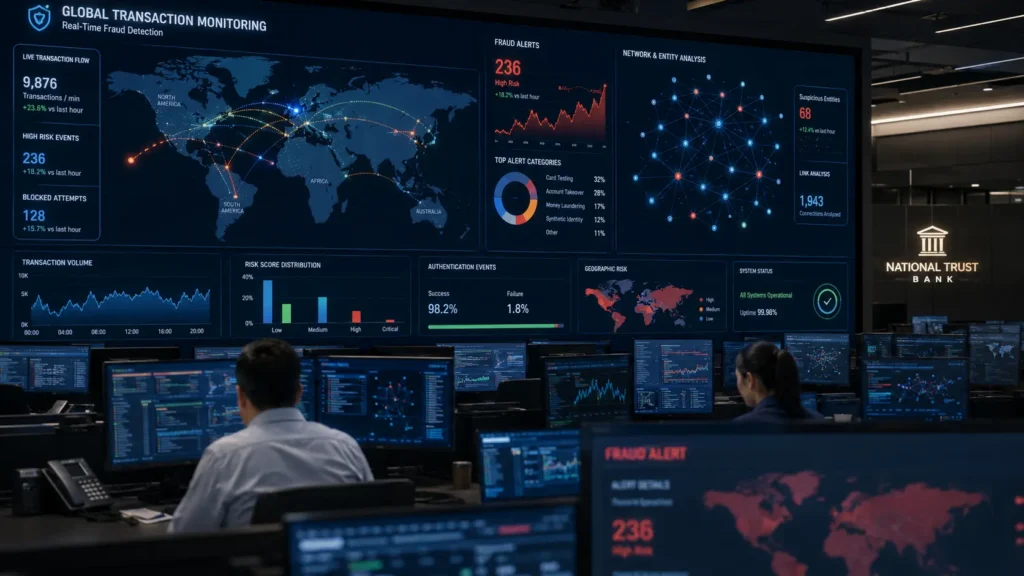
Because machine learning models can analyze transactions in milliseconds, banks can block, delay, or verify activity before losses occur.
Advanced fraud detection architectures use stream processing to enable sub-60-second detection, edge computing to move detection closer to transaction sources, and event-driven architecture supporting millisecond response times.
The 0.3-second window isn’t an exaggeration it’s the operational target. By the time your home screen loads, the system has already made a risk assessment. High confidence you’re you: proceed invisibly. Low confidence: queue for step-up authentication. Flagged as likely fraud: block and alert.
The most advanced systems deliver real-time evaluations in under 50 milliseconds, supporting high-volume financial environments linking document, transaction, and behavioral data into unified identity profiles for ongoing monitoring.
You never see any of this. That’s the point.
Graph Networks: How Banks Catch Fraud Rings
Individual account monitoring catches individual fraudsters. But organized fraud rings operating across hundreds of accounts simultaneously looks clean at the account level. Each account behaves plausibly. No single transaction triggers a rule.
Graph network analysis maps the relationships between accounts, devices, phone numbers, email addresses, and IP addresses. A fraud ring operating across hundreds of accounts will look clean at the account level each account behaves plausibly on its own. But the graph reveals what individual account monitoring cannot: shared infrastructure, coordinated timing, and the network topology of organized criminal operations.
A fraudster using the same device to access ten different accounts. A cluster of new accounts all registered from the same IP range on the same day. Five accounts that have never interacted but all transferred money to the same recipient within an hour. The graph sees these patterns. The traditional rule-based system doesn’t.
The Deepfake Problem Banks Are Racing to Solve
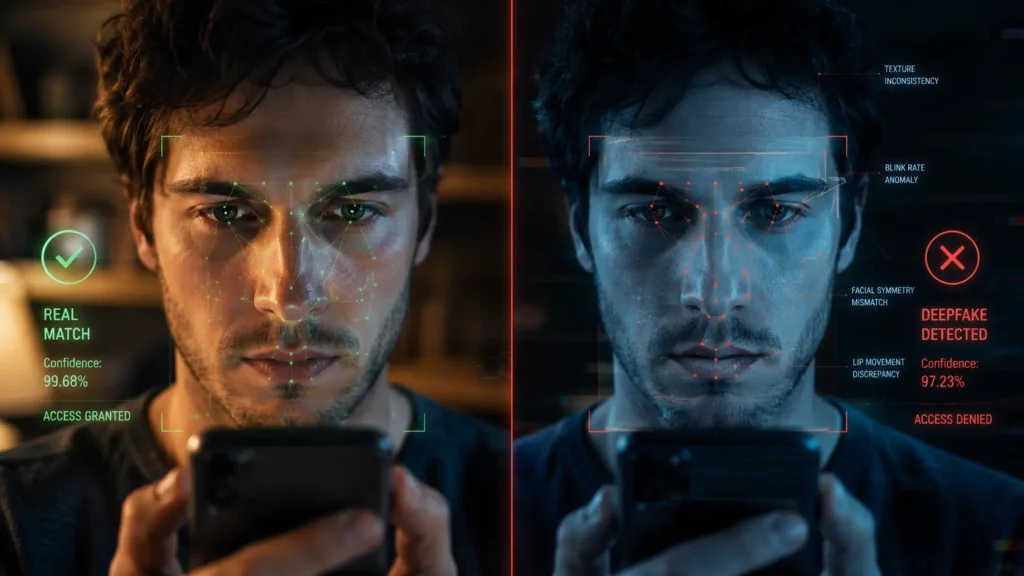
The newest threat to all of this is one that the fraud detection industry is watching with genuine concern: deepfakes.
The industry expects 30% of enterprises to consider biometric authentication unreliable in isolation due to deepfakes by 2026. Banks are implementing deepfake detection technology, enhanced biometric authentication, and multi-modal verification systems in response.
Systems will read depth, heat, and micro-motion to spot fake visuals. Voice tools will sense breath and vibration to stop voice clones. AI will play both sides but banks are aiming to keep defense one move ahead.
The deepfake threat is why no serious bank fraud system in 2026 relies on any single signal. The architecture is deliberately redundant behavioral biometrics backed by device intelligence backed by graph analysis backed by transaction pattern modeling. Defeating one layer doesn’t defeat the system. It just triggers the next one.
What This Means for You
Most of the time, you never notice any of this. That’s intentional. AI systems may enhance security for users by offering real-time protection, significantly reducing false transaction declines, and providing “invisible” security protection that operates without adding friction for legitimate users.
Genuine users are allowed to continue with their transactions, whereas suspicious transactions are sent for step-up authentication. In cases of actual fraud, behavioral data offers precise insight into exactly where a takeover occurred and how the fraudster’s interaction patterns diverged from the account holder’s baseline.
The rare times you do notice the unexpected verification request, the transaction that gets briefly held, the login that asks for a second factor even though you’ve never triggered that before that’s usually the system catching something real. Not a glitch. A signal.
Your bank isn’t watching you because it suspects you. It’s watching you so precisely that it can immediately tell when someone else is pretending to be you.
In the 0.3 seconds before your dashboard loads, that distinction has already been made.
© AiwalaNews | Global Tech & Privacy Edition | May 2026
Read Also:
- 🔗 How AI Is Changing Cybersecurity — And What It Means for Your Data
- 🔗 Deepfakes Are Now a Banking Problem. Here’s How Banks Are Fighting Back
