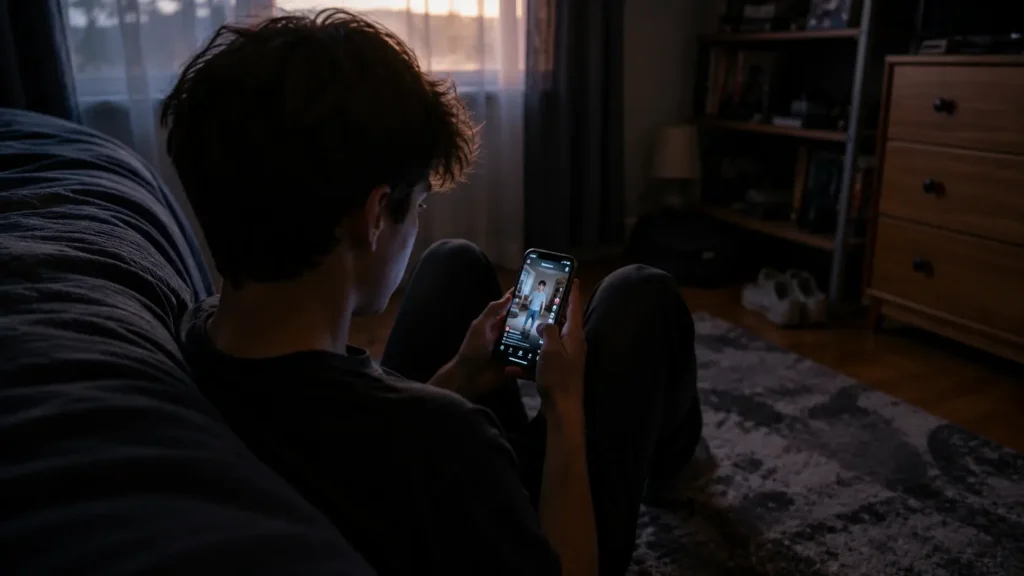
You didn’t open TikTok looking for sad content. You opened it to waste ten minutes.
But somewhere between the cooking videos and the comedy skits, something shifted. The videos got quieter. More introspective. Someone talking about not wanting to get out of bed. A poem about feeling invisible. A creator describing the exact hollowness you’ve been carrying around for three weeks — the one you haven’t told anyone about.
You watched all of it. You kept scrolling.
And TikTok noticed.
The Algorithm That Reads Emotional State
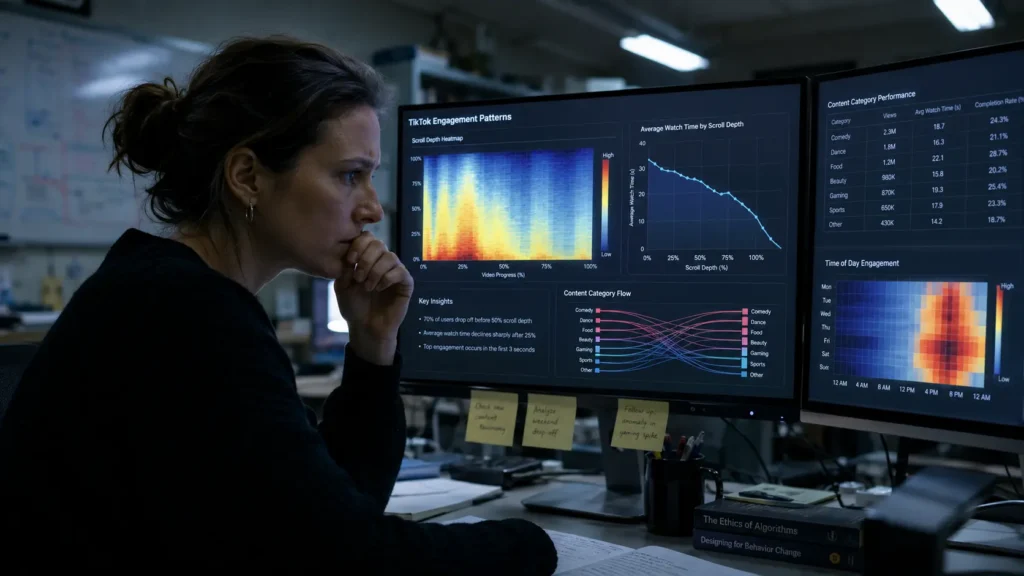
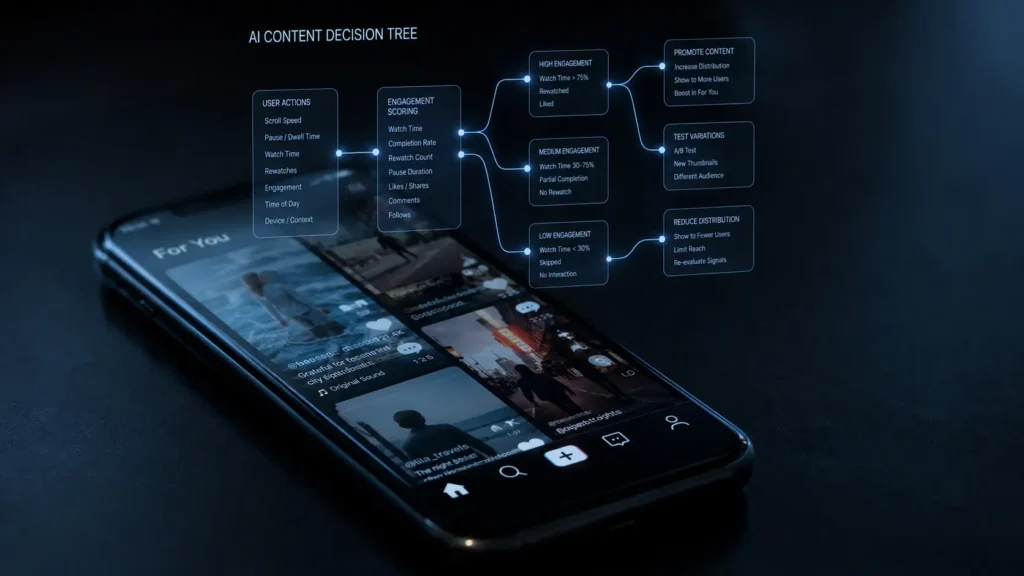
TikTok’s recommendation system is the most studied and least understood algorithm in social media. What we know publicly is that it doesn’t work like Google it doesn’t primarily respond to what you search for. It responds to what you do. Every pause. Every replay. Every video you watch to the end without engaging. Every one you skip in the first two seconds.
Young people view mental health-related content organically, through self-directed searches, or via direction from complex algorithms that learn and predict a user’s interest in specific content types such as mental health advice and information.
The word “predict” is doing significant work in that sentence. TikTok’s algorithm doesn’t wait for you to signal interest. It infers it from behavioral patterns you’re not consciously producing and then tests that inference by serving content it thinks you’ll respond to.
TikTok’s algorithm favors mental health content over many other topics, including politics, cats, and Taylor Swift, according to a Washington Post analysis. Content about mental illness and neurological differences is extremely popular across social media apps, with about as many TikTok posts using the hashtag #mentalhealth as those that mention #sports.
That isn’t coincidence. Mental health content performs exceptionally well in TikTok’s engagement metrics and the algorithm serves what performs.
What the Research Actually Shows
The relationship between TikTok use and mental health has been studied seriously now and the findings are uncomfortable.
A meta-analysis of multiple studies found a statistically significant positive association between problematic TikTok use and depression, and between TikTok use and anxiety. The research also found associations between TikTok use and body image issues, poor sleep, anger, distress intolerance, and stress.
A longitudinal study tracking 715 adult TikTok users across two months assessed passive viewing, participatory use, contributory use, and problematic use alongside depression, social anxiety, and life satisfaction. The research examined whether TikTok use contributes to changes in mental health, whether mental health conditions shape how people engage with the platform, or whether both are true simultaneously.
The answer to that last question whether both are true at once is the part that matters most. Because it describes a loop. A person feeling low watches more passive content. Passive viewing correlates with worsening mental health indicators. Worsening mental health leads to more passive viewing. The algorithm, optimizing purely for engagement, feeds the loop without knowing or caring that it exists.
The Stickiness Problem
There’s a specific mechanism researchers have identified that explains why mental health content spreads so aggressively through TikTok’s recommendation system — and why it’s so hard to escape once it starts appearing.
Mental health content may become particularly “sticky” because it’s a topic that a user only wants to engage with sometimes making it unpredictable in a way that drives repeated return visits to the platform, according to Laura Edelson, a computer science professor at Northeastern University.
Unpredictability is precisely what engagement algorithms reward. If a topic reliably interests you every time, the algorithm serves it and you engage. But if a topic interests you sometimes when you’re in a particular emotional state, at a particular time of day, in a particular mood the algorithm learns to test it repeatedly, waiting for the conditions that produce engagement.
It’s not that TikTok knows you’re depressed in the way a friend would know. It’s that TikTok has learned, from millions of behavioral data points, that certain viewing patterns correlate with certain emotional states — and that serving specific content to people in those states produces more engagement than serving anything else.
The result looks, from the outside, exactly like the algorithm knowing something about you before your friends do.
The $1.7 Million Study Trying to Understand the Damage
The research community has taken this seriously enough that major institutions are now funding large-scale audits of the algorithm itself.
Using recently acquired data from more than 10,000 adolescent users, researcher Munmun De Choudhury of Georgia Tech is auditing TikTok’s recommendation algorithm and studying its impact on young people’s behavior and mental health — leading a multi-institutional team on a four-year, $1.7 million grant. “We hope to learn the different types of negative exposures that young people experience when using TikTok,” De Choudhury said. “This can help us characterise what they’re watching and build computational methods to understand the consumption behaviors of these participants and how they’re affected by the algorithm.”
De Choudhury is collaborating with Amy Orben at the University of Cambridge and Homa Hosseinmardi at UCLA. Social media platforms have become increasingly reluctant to share their data with researchers in recent years making this kind of access to 10,000 users’ data unusually significant.
The fact that this research requires a four-year timeline and $1.7 million in funding tells you something about how deliberately opaque TikTok’s systems are. Understanding what the algorithm is doing to mental health isn’t easy. The platform hasn’t made it easy.
The Two-Sided Reality
The story isn’t entirely dark and it would be dishonest to frame it that way.
For some users, TikTok’s mental health content has been genuinely life-changing. Amy Russell’s TikTok feed surfaced ADHD content that reflected her own experience after two years of learning about the condition on the platform, she sought a clinical assessment, received a diagnosis, started medication, and credits the transformation in part to TikTok.
The use of social media platforms and mobile apps in identifying and monitoring mental health symptoms is increasing each month and there have been encouraging results supporting their capacity to engage young people and increase mental health awareness.
The same mechanism that can spiral a vulnerable user deeper into depression content can also surface information about conditions they didn’t know they had, connect them to communities they didn’t know existed, and reduce the shame that keeps people from seeking help.
The algorithm doesn’t intend to help or harm. It optimizes for engagement and engagement cuts both ways.
What You Can Actually Do
The research points to one consistent finding: passive viewing is where the risk concentrates. Scrolling without intent. Watching without choosing. Letting the algorithm decide what emotional state to serve you next.
Healthcare professionals should be alert to recognising symptoms of problematic TikTok use among adolescents. The early identification of users with problematic patterns is essential to promoting mental health and wellbeing. Policymakers should develop appropriate interventions to reduce excessive use.
At the individual level, the intervention is simpler than any policy: notice when the feed shifts. Notice when the content stops being entertaining and starts being a mirror for something you haven’t said out loud. That shift isn’t random. The algorithm put it there because your behavior told it to.
What you do next is still your choice and it’s worth making it consciously.
If you or someone you know is struggling with depression or mental health, please reach out to a mental health professional or contact the iCall helpline at 9152987821 (India) or the 988 Suicide & Crisis Lifeline (US) by calling or texting 988.
© AiwalaNews | Global Tech & Privacy Edition | May 2026
Read Also:
- 🔗 Social Media Algorithms and Teen Mental Health: What Parents Need to Know
- 🔗 The Attention Economy Explained: How Apps Are Designed to Keep You Scrolling
