
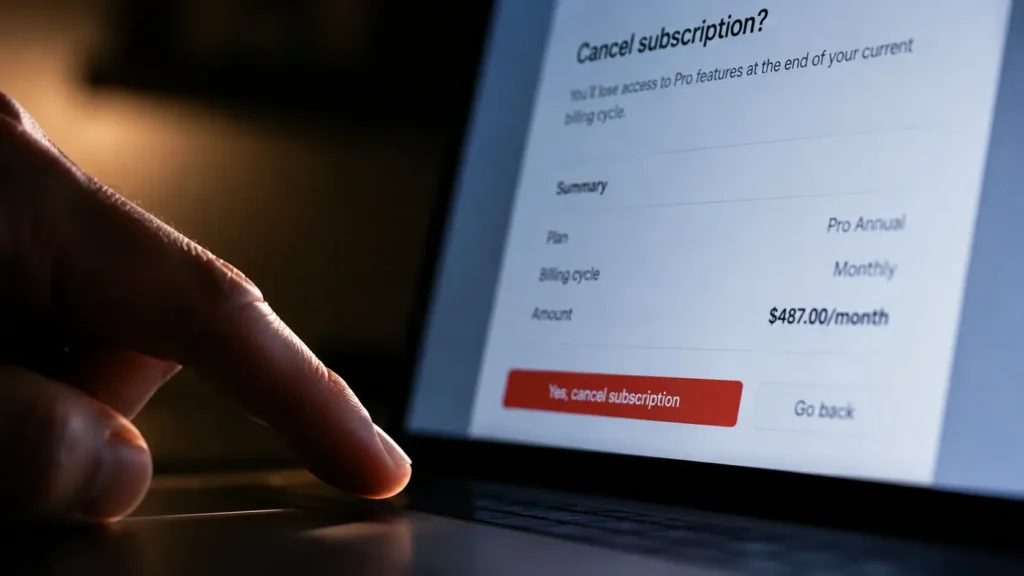
March of this year, I sat down with my bank statement and did something I’d been avoiding for months: I actually added it up.
$487 a month. Jasper for writing. Grammarly for editing. Otter.ai for transcription. Synthesia for video. Midjourney for images. Copy.ai for ads. Each one had a justification when I signed up. Together, they had quietly become a second rent payment one I’d stopped questioning because each individual charge was small enough to ignore.
The experiment I ran next changed how I work completely.
I cancelled everything. Every paid AI subscription, gone. Then I spent 30 days replacing each tool with a free alternative. I expected the quality to drop. For two or three tools, it did temporarily, until I found the right replacement. For the rest? The free version was genuinely better.
Here’s the exact stack I built. Total monthly cost: zero.
Writing & Thinking: Claude Free
Replaced: Jasper ($49/month) + Copy.ai ($49/month)
This was the switch I expected to hurt the most. Jasper had been my main writing tool for eighteen months. I’d built workflows around it. I knew its quirks.
What changed in 2025 is that free tiers on a new generation of AI tools now match or beat what most SaaS subscriptions actually deliver. This isn’t about downgrading. It’s about recognising that a $0/month tool can outperform the $69/month one you’ve been renewing on autopilot.
Claude free writes better than Jasper. Not slightly better noticeably, consistently better. Long-form articles, email sequences, ad copy, strategic thinking, document analysis Claude handles all of it with a quality ceiling that Jasper, as a wrapper around someone else’s model, was never going to match. The free tier has daily limits, but they’re generous enough for a full working day of moderate writing output.
Saved: $98/month
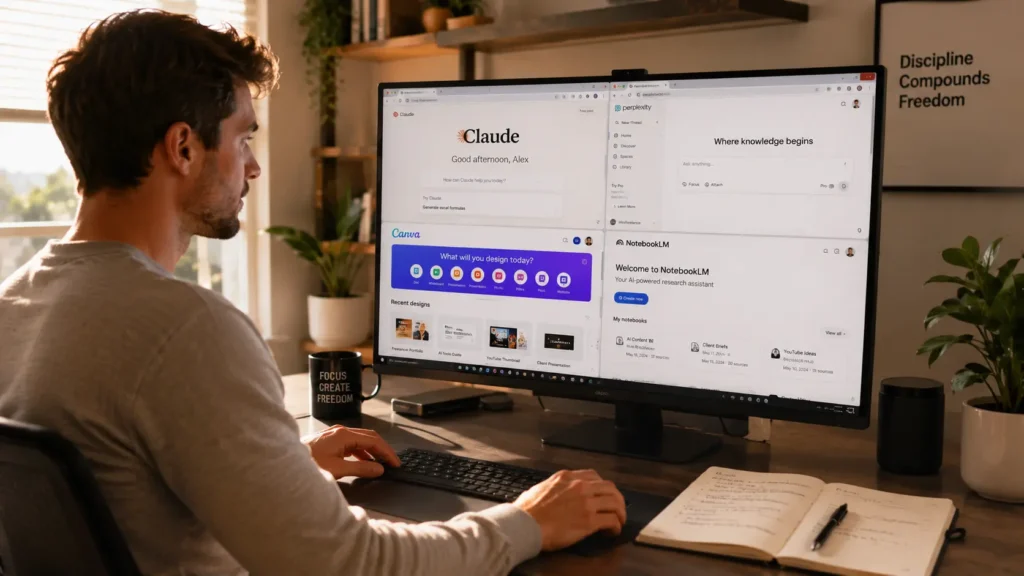
Research: Perplexity AI Free
Replaced: ChatGPT Plus for research ($20/month)
Stack just four common tools ChatGPT Plus, Perplexity Pro, Jasper, and Midjourney and you’re looking at roughly $120/month before you’ve touched a CRM or project management app.
The free tier of Perplexity handles the majority of what I was using ChatGPT Plus for: sourced research, current events, fact-checking, topic overviews. Every answer comes with citations I can verify in seconds. For the rare deep-dive that needs more, the five free Pro searches per day cover it.
The combination that replaced my entire research stack: Claude free for thinking and drafting, Perplexity free for research and sourcing. Together they cost nothing and cover more ground than ChatGPT Plus alone ever did.
Saved: $20/month
Meeting Transcription: Fireflies.ai Free
Replaced: Otter.ai Pro ($16.99/month)
Fireflies.ai transcribes better than Otter.ai Pro and pushes to your CRM at no cost. It’s not a compromis it’s an upgrade that happens to be free.
Fireflies free joins your meetings automatically, transcribes them in real time, generates summaries, pulls action items, and integrates with most CRMs. The accuracy is better than Otter.ai Pro was at any price. For anyone running client calls, team standups, or interviews, this is the most painless switch on the list.
Saved: $16.99/month
Image Generation: Canva AI Free
Replaced: Midjourney ($10/month) + part of Adobe Creative Cloud
Free AI image tools in 2026 now compete closely with premium design platforms for everyday use, especially for non-designers. In 2026, free AI image tools can generate professional visuals in seconds.
I’ll be honest: Midjourney still produces the most artistically impressive images when that’s what you need. But for 90% of actual work social media graphics, article headers, presentation visuals, marketing materials Canva’s free AI image generation produces results that are more useful than Midjourney outputs because they arrive in a design context you can edit immediately.
The free plan includes text-to-image generation, Magic Eraser, background removal, and a full design suite. For non-designers doing real work, it replaces both an image generation tool and a design platform in one.
Saved: $10/month + reduced Adobe dependency
SEO Research: Ubersuggest Free
Replaced: Semrush ($129/month)
This one surprised me most. Ubersuggest covers most of what solopreneurs actually use Semrush for, at $0/month. It’s not a compromise it’s an upgrade that happens to be free.
For a solo creator or small publisher, Ubersuggest free provides keyword research, search volume data, keyword difficulty scores, competitor analysis, and basic site auditing. Semrush is genuinely more powerful at the enterprise level but most people using it at $129/month are using 20% of its features. Ubersuggest covers that 20% for nothing.
Saved: $129/month
Video Content: CapCut AI Free
Replaced: Synthesia ($22/month)
Short-form video dominates content marketing in 2026. Free AI tools now handle auto-captioning, text-to-video, AI voiceovers, and script-to-video workflows making paid video editors unnecessary for basic and medium-level projects.
CapCut free does auto-captioning, AI voiceover, background removal, script-to-video generation, and template-based editing all at a quality level that Synthesia’s $22/month plan doesn’t consistently beat for social-first video content. For YouTube Shorts, Instagram Reels, and LinkedIn video, CapCut free is the tool.
Saved: $22/month
Document Intelligence: NotebookLM Free
Replaced: Various PDF analysis and research tools (~$20/month combined)
Google NotebookLM is the tool on this list that gets the strongest reaction from people who haven’t tried it. Upload your PDFs, reports, research papers, or notes and it builds an AI assistant that draws only from your documents. No hallucinations from external data. No generic answers pulled from the internet.
A university student can complete research assignments using free AI research tools instead of paying for academic software. Most users never hit the limits of free plans.
For a freelancer or small business owner, NotebookLM replaces the combination of a PDF reader, document summarizer, and research assistant all for free, all without data ever leaving your control.
Saved: ~$20/month
The Six-Month Verdict
At the end of the 30-day experiment, seven free tools were actually better than the paid versions being replaced. Most people are still paying out of habit, not necessity.
Six months later, I haven’t gone back to a single paid subscription from the original stack. Total saved: somewhere between $400 and $500 every month money that was quietly disappearing into tools I’d stopped questioning.
According to Thryv, 66% of small businesses using AI save $500 to $2,000 every month by switching to smarter tools. Organizations wasted an estimated $21 million annually on unused or underused SaaS licenses. The individual version of that waste is quieter but just as real: the $20 charges you don’t notice until you add them up.
The playbook is simple. Pick the subscription that’s burning your budget hardest right now. Spend one week with the free AI alternative. See what changes.
The answer will probably surprise you.
© AiwalaNews | Global Tech & Privacy Edition | May 2026
Read Also:
- 🔗 7 Free AI Tools in 2026 That Are Better Than Paid Ones
- 🔗 How to Build a Full AI Workflow for Free — No Credit Card Required
