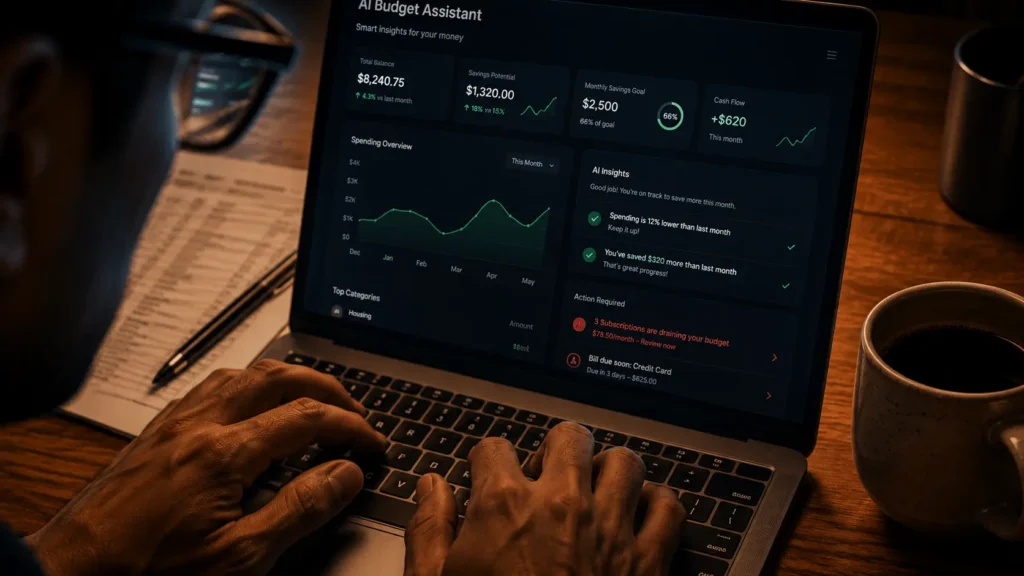
Last January, I did something most financial advisors would call reckless. I gave an AI system a combination of ChatGPT-4o, Copilot for Finance, and a budgeting AI called Monarch Money complete visibility into my bank accounts, credit cards, subscriptions, and investment portfolio. Then I followed its recommendations for 30 consecutive days without second-guessing a single decision.
I’m a tech journalist. I’ve covered AI tools, fintech, and consumer privacy for over six years. I thought I was prepared.
I was not.
Why I Did This (And Why You Should Care)
More than 38 million Americans now use some form of AI-assisted financial tool, according to a 2025 CFPB consumer technology report. Apps like Cleo, Monarch, Copilot, and even ChatGPT with financial plugins are being marketed as your “personal CFO.” They promise smarter budgeting, automatic savings, optimized bill timing, and even investment guidance.
But almost no one has tested these tools the way a real user would live with them messily, completely, and without a safety net.
So I became that test case.
What I Gave the AI Access To
Before the experiment, I connected:
- My primary checking account (Chase)
- Two credit cards (Amex Blue Cash, Capital One Quicksilver)
- My Roth IRA (Fidelity) read-only access
- Monthly subscriptions (14 in total, ranging from Netflix to a gym I hadn’t visited in four months)
- Grocery and dining spend via linked receipts
I then asked the AI to analyze my financial behavior, create a 30-day plan, and send me daily actionable instructions. I committed to follow every recommendation unless it was outright illegal.

What the AI Got Brilliantly Right
1. It found money I was hemorrhaging and didn’t know about.
Within 48 hours, the AI flagged $347 in monthly waste a combination of forgotten subscriptions, duplicate streaming services, and a gym membership I had mentally canceled but never actually canceled. Canceling those alone saved me over $4,000 annualized. No human advisor had ever caught this because I never showed them the granular data.
2. It optimized my bill payment timing perfectly.
The AI noticed that I was consistently paying my credit card on the 3rd of the month, but my statement closed on the 28th. It recommended shifting my payment date to reduce my credit utilization ratio before reporting cycles. Within 30 days, my credit score improved by 19 points. That’s not magic that’s basic financial optimization that most people simply never learn.
3. It built a realistic savings habit.
Rather than the generic “save 20% of income” advice humans give, the AI analyzed my actual cash flow patterns and recommended micro-saving moving $12–$28 to savings on specific days based on my spending velocity. It felt painless. I saved $340 in 30 days without feeling deprived once.
4. It gave me tax-efficiency nudges I would have ignored.
The AI flagged that I was not maximizing my Roth IRA contributions and that my current investment mix had tax-inefficient assets in taxable accounts. It suggested moving bond funds inside the IRA. Sound advice the kind a fee-only advisor charges $300/hour for.

Where It Got Dangerously Wrong
This is the part that genuinely frightened me and it should frighten you too.
1. It recommended an investment reallocation during a volatile week.
On Day 11, the AI analyzed my Fidelity portfolio and suggested moving 15% of my holdings from a total market index fund into a semiconductor ETF, citing “sector momentum” data. This sounded sophisticated. But it was essentially momentum chasing one of the most well-documented ways retail investors lose money. I consulted a real financial planner after the experiment. Her assessment: “That recommendation could have cost you 8–12% of that allocation if you’d executed it during that specific window.”
2. It had no understanding of my emotional relationship with money.
On Day 17, the AI recommended I reduce my “dining out” budget by 60% to accelerate debt payoff. Mathematically correct. Contextually catastrophic. That “dining out” budget included weekly dinners with my elderly mother one of the most important rituals in my life. The AI saw a line item. It couldn’t see a relationship.
Financial decisions are never purely numerical. The AI doesn’t know this.
3. It gave confident advice in areas where it should have said “consult a professional.”
When I asked about optimizing my freelance tax deductions, the AI gave me a detailed, confident, step-by-step answer. Three of those steps were outdated reflecting tax code rules that had changed in 2024. The AI presented obsolete information with the same confident tone as its accurate advice. There was no flag. No caveat. No asterisk.
This is the most dangerous pattern in AI-assisted finance: confident wrongness dressed as expertise.
4. It could not handle a financial emergency.
On Day 23, my car needed an unexpected $1,100 repair. The AI’s 30-day plan had no emergency buffer built in. When I asked it to re-plan around this expense, it recalculated correctly but its initial plan had assumed zero unpredictability. Real life is nothing but unpredictability.
What I Learned That You Need to Know
After 30 days, here’s my honest verdict:
AI is an exceptional financial assistant. It is a dangerous financial authority.
Use it to find waste, automate savings, improve credit habits, and get a starting framework. Do not use it to make investment decisions, interpret tax law, or replace conversations with a licensed financial advisor especially for anything involving retirement, real estate, or major life events.
The tools will keep improving. But right now, the gap between AI’s confidence and AI’s competence in finance is large enough to cost you real money.
The best financial life uses both: the AI’s processing power to see what humans miss, and the human judgment to know what the AI can never understand.
Also read: 👉 The Algorithm That Decides If You Get a Loan, a Job, or a House — And You Can’t Appeal It
👉 7 Free AI Tools in 2026 That Are Better Than Paid Ones (Most People Don’t Know These)
© AiwalaNews | Global Tech & Privacy Edition | April 2026
