Author’s note: This article is based on documented research, publicly available data, Uber’s own technical publications, academic studies, and verified statements from Uber executives. Where claims are disputed or unproven, that is stated clearly.
You open Uber. You see a surge price. You accept it.
In the seconds before that price appeared, a system had already decided you were likely to pay it. Understanding how that calculation works is the difference between paying what Uber decides and paying what the ride is actually worth.
The Algorithm Runs Before You See the Number
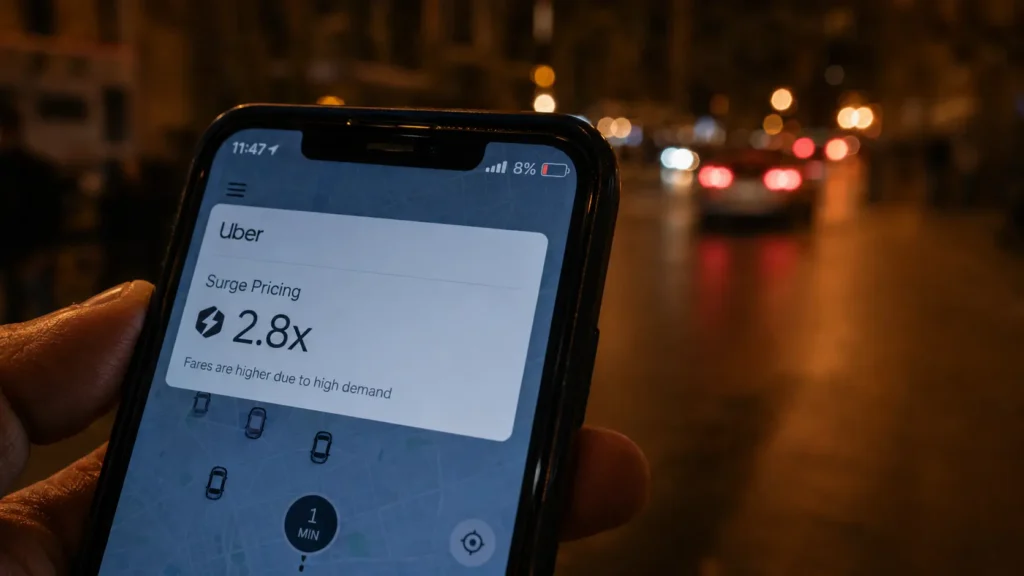
Surge pricing is automatically activated by algorithms that detect shifts in rider demand and driver availability in real time, all over a city. Prices update frequently. To optimize reliability, the surge algorithm reacts to driver availability and rider demand at a hyperlocal level.
The algorithm divides cities into micro-zones of just a few city blocks and recalculates prices every one to two minutes. Uber surge can reach 7 to 8 times normal fares during extreme events. Two people standing on opposite sides of the same street can see completely different prices because they’re sitting in different micro-zones with different supply-demand ratios.
Uber uses historical data and machine learning models to predict when and where demand will be high. The algorithm can anticipate a surge in ride requests after a major concert ends or during a rainstorm adjusting prices before the wave of demand even arrives.
This is the critical detail most people miss. The system isn’t just reactive. It’s predictive. By the time you open the app, the algorithm has already moved.
Predicting You Not Just the Market
Supply-and-demand surge is economics. What Uber has also researched goes a step further: predicting not just when to surge, but who will accept the price.
Uber predicts if a given rider is sensitive to surge whether they will accept a surged price or wait 15 to 20 minutes for prices to fall. The multipliers can be quite different for different individuals because Uber predicts “willingness to pay” by combining various real-time data with user history.
Uber’s algorithms have the means and opportunity to identify and set higher prices for groups of customers manifesting a predictably higher willingness to pay including riders requesting trips for the first time between a particular origin and destination, such as foreign travelers arriving at international airports who may not be familiar with local fares.
There is also a large drop in demand when surge multipliers cross round-number thresholds from 1.9x to 2x, for example. Human psychology responds differently to rounded numbers, and Uber’s pricing reflects that understanding.
This is behavioral economics running at industrial scale. The price you see is calibrated against a model of how people like you tend to respond to pricing pressure — not just what the market says the ride costs.

The Battery Controversy: What’s Documented vs. What’s Disputed
No article on Uber’s pricing intelligence is honest without addressing the battery level question directly.
Uber’s former chief economic officer Keith Chen revealed publicly that Uber’s research shows people are more likely to accept surge pricing when their phone battery is low. That statement from a senior Uber executive is documented and uncontested.
What is contested is whether Uber acts on that knowledge in its pricing.
Uber’s published position is categorical. Uber’s official pricing principles state: “Uber does not use phone model, device hardware, operating system, software version, battery level, or similar technical characteristics as inputs to set prices or promotions.”
But the record is genuinely complicated. In 2023, Belgian newspaper Dernière Heure tested two phones and found a ride quote of €17.56 on a phone with 12% battery versus €16.60 on a phone with 84% battery. Uber denied using battery level to calculate fares.
Overall, while there is evidence to suggest that users with low phone batteries are more likely to pay for surge pricing, it remains unclear whether Uber charges more based on phone battery level.
The honest position: Uber knows low-battery users are more price-accepting. Uber collects battery data. Uber denies using it for pricing. Independent tests have produced inconsistent results. The question is not fully settled — and regulators are increasingly paying attention.
What Data Uber Actually Collects
This part is not disputed. It’s in Uber’s own terms of service.
Customers agree to let Uber access hardware models, device IP address, unique device identifiers, operating systems, software, preferred languages, advertising identifiers, device motion data, and mobile network data.
Factors that could theoretically feed willingness-to-pay models include phone type iPhone users tend to be wealthier than Android users battery power, credit card type, and phone number area codes associated with higher-income zip codes. Stanford’s Center for Automotive Research has documented these as potential pricing vectors, even if Uber currently denies using them.
Uber’s CEO described the trajectory directly in an investor call: “You’ve gone from just flat time and distance to now kind of point estimates for every single trip based on the driver… targeting of different trips to different drivers based on their preferences or based on behavioral patterns that they’re showing us that really is the focus going forward, offering the right trip at the right price to the right driver.”
That quote is about drivers. The same behavioral-targeting logic applied to riders is what this entire conversation is about.
What You Can Do Right No
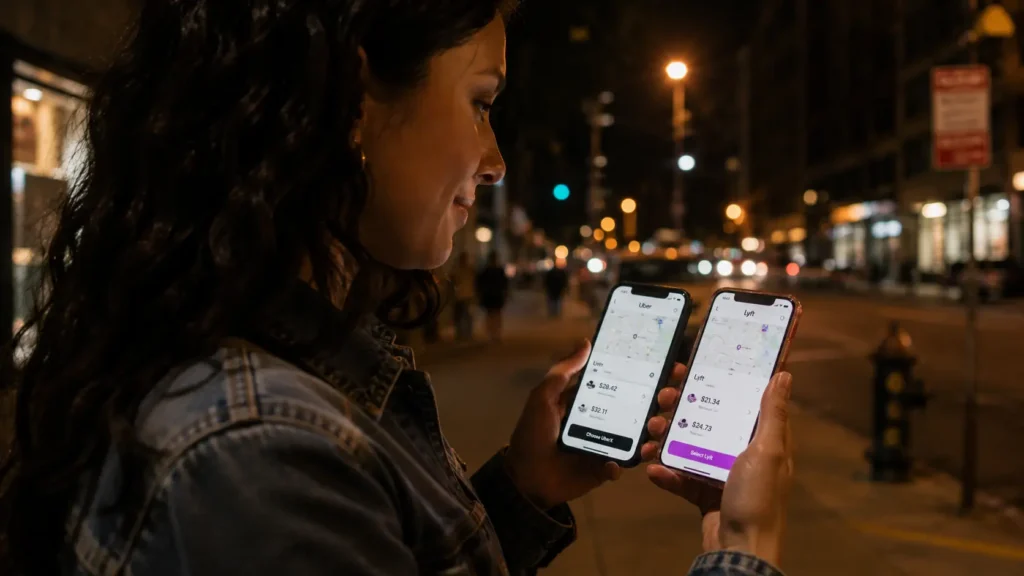
Uber and Lyft surge independently. Their algorithms run on separate systems, so one app can be at 2x while the other shows a normal fare. There is roughly a 40% chance the competing app will be cheaper during a surge event. The most reliable surge windows are Friday evening rush from 4 to 7 PM, bar close from 1:30 to 2:30 AM, and the first 15 minutes after major events end. Waiting just 10 to 15 minutes after a triggering event causes most surge multipliers to drop by 50% as additional drivers enter the zone.
Riders who compare Uber and Lyft fares consistently before booking save an average of $4 to $8 per ride totaling $200 to $500 annually based on typical urban usage. The comparison takes under 10 seconds.
Additional moves that work: walk one block before opening the app micro-zone boundaries mean a short walk can drop you into a lower-surge area. Book Uber Reserve in advance to lock in a fare before recalculation. And never book in the first five minutes after a concert, game, or event ends that’s when the algorithm is at its most aggressive.
The Bottom Line
Uber’s pricing system is more sophisticated than most riders realize and more transparent than its critics typically acknowledge. The supply-demand mechanics are real and publicly documented. The behavioral prediction layer is also real, confirmed by Uber’s own executives.
Where evidence becomes murky is whether your specific data battery, device, payment method feeds the price shown to you specifically. Uber denies it. Tests conflict. Scrutiny is growing.
What is not murky: before the price appears on your screen, the algorithm already ran a model on you.
Note: This article is for informational purposes only and does not constitute financial or legal advice.
© AiwalaNews | Global Tech & Privacy Edition | May 2026
Read Also:
- 🔗 How Your Bank Knows It’s Not You Within 0.3 Seconds of Login
- 🔗 The Hidden Data Economy: What Apps Know About You and How They Use It
