This article is based on peer-reviewed research published in academic journals including Frontiers in Psychiatry, Heliyon, and the National Institutes of Health. All findings are attributed to their original studies. This is not medical advice if you are experiencing mental health difficulties, please consult a qualified healthcare professional.
You haven’t told your phone anything is wrong. You haven’t searched for anything unusual. You’ve just been carrying it around, the way you always do.
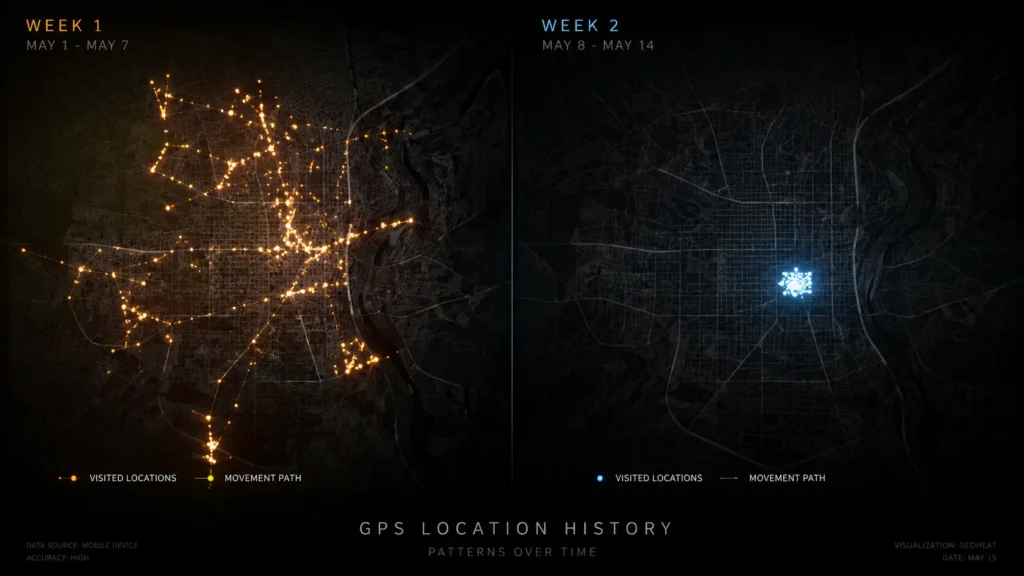
But something has changed. You’re staying home more. Sleeping later. Texting back slower. Moving less. Your phone noticed all of it weeks before you connected the dots yourself.
This isn’t speculation. It’s peer-reviewed science. And it’s already inside the device in your pocket.
The Research That Started It
A landmark study recruited 40 adult participants to carry smartphones loaded with a sensor data acquisition app for two weeks. Researchers then cross-referenced the collected sensor data against each participant’s self-reported depression survey scores. The findings were striking: GPS and usage sensor data reliably correlated with depressive symptom severity meaning the phone’s passive data was already reflecting what the clinical questionnaire later confirmed.
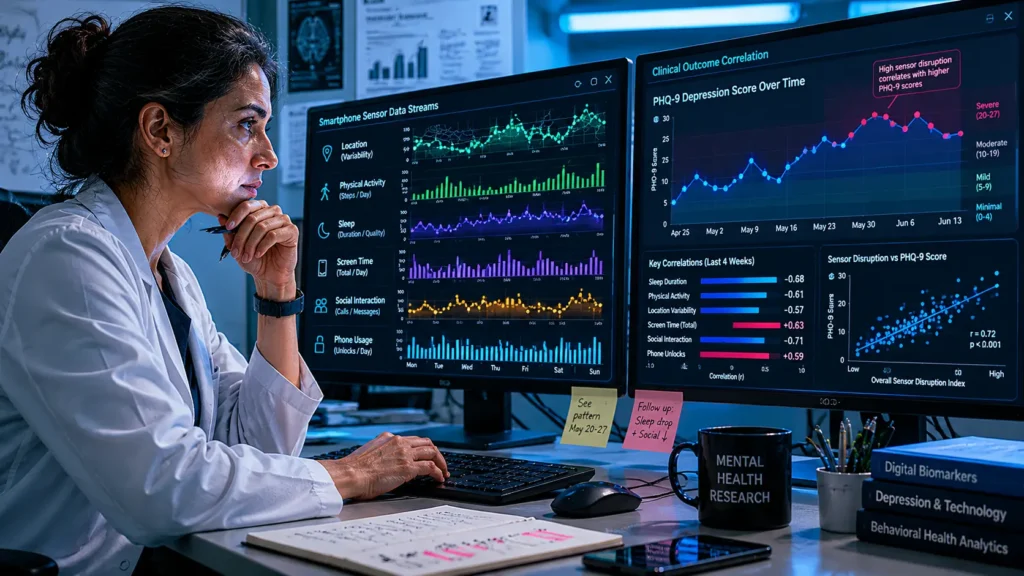
A more recent 2025 study published in Frontiers in Psychiatry used accelerometers, gyroscopes, and light sensors to establish associations between smartphone-derived behavioral patterns and PHQ-9 depression scores. The results yielded accuracy rates between 73.11% and 88.24% meaning the sensor data alone correctly identified depression indicators in nearly nine out of ten cases.
These aren’t fringe findings. They’re replicated across dozens of peer-reviewed studies, across multiple countries, using multiple sensor types. The conclusion converges every time: your phone’s passive sensor data is a remarkably accurate mirror of your mental state.
The Sensors Doing the Watching
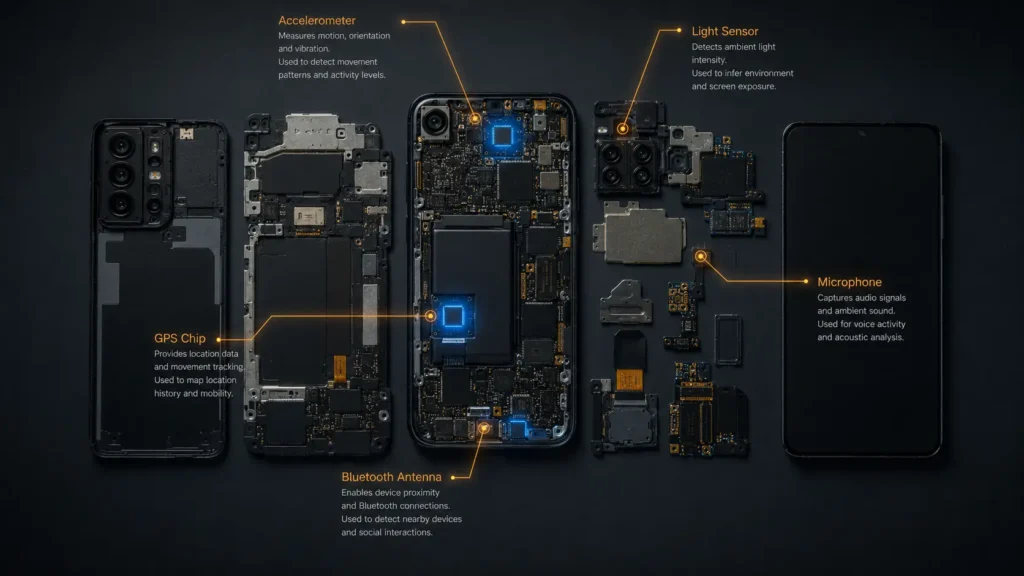
Your phone contains between 12 and 20 sensors depending on the model. Most people know about GPS and the camera. The sensors quietly building a picture of your emotional state are different ones entirely.
GPS and Location Data
A research group at the University of Virginia investigated the link between emotional state and a tendency to spend more time at home. They collected GPS data from participants’ phones to measure time spent at home, alongside daily self-reported mood ratings hypothesizing that higher depression and social anxiety symptoms would be associated with withdrawal and increased time at home. The hypothesis was confirmed.
GPS and WiFi association logs were the most used sensors across 35 studies reviewed in a comprehensive scoping review with researchers extracting features including transition frequency, time spent in specific locations, and uniformity of movement.
When your GPS data shows you’ve stopped going to the gym, stopped visiting friends, and started spending every evening in one location the pattern has clinical significance, whether you’ve noticed it or not.
Accelerometer and Movement Data
Findings showed negative correlations between PHQ-9 depression scores and dietary regularity, bedtime consistency, and physical activity levels all measurable through accelerometer data that tracks movement, step count, and sleep-wake timing.
The accelerometer doesn’t know you’re depressed. It knows you stopped moving. It knows your sleep schedule shifted by two hours. It knows the regularity of your daily patterns has broken down. Those behavioral changes are the signal and the accelerometer captures them continuously, without you doing anything.
Bluetooth Proximity Data
Research explored whether phones’ Bluetooth proximity data measuring the number of nearby Bluetooth devices, known as Nearby Bluetooth Device Count (NBDC) could predict the severity of depressive symptoms. During the two weeks before a worsening of depressive symptoms, participants were seen to have lower total NBDC counts and lower variety in the devices they interacted with meaning they were around fewer people, in fewer different places, consistently before their depression scores worsened.
Your Bluetooth sensor is tracking social proximity without asking permission or displaying a notification. The data it generates maps your social life and social withdrawal is one of the most reliable early indicators of depression.
Screen Usage and Typing Patterns
Electronic usage data including social media use, device activity, and screen-on time was included in digital phenotyping studies alongside passive sensor data. Changes in how long you use your phone, when you use it, and how you interact with it produce behavioral signatures that researchers can associate with mental state changes.
Typing speed. Response latency. The time between opening an app and closing it. How often you check your phone at 2 AM. Each of these is a data point and collectively, their patterns shift measurably before most people consciously recognize that something is wrong.
Digital Phenotyping: The Science Behind It
The field studying all of this has a name: digital phenotyping the use of smartphone and wearable sensor data to build a continuous, objective picture of behavioral health.
Digital phenotyping involves continuous, ongoing data collection from participants’ smartphones, improving ecological validity. This new type of data stream shows promise for prevention, as evidenced by a pilot mental health monitoring program across multiple universities in the United States.
One longitudinal study monitored 12 patients continuously during their daily lives for an average of 12 weeks each resulting in over 1,000 days of smartphone sensor data. The study investigated whether sensor data could recognize mental health episodes and detect behavior changes that signal the onset of an episode using objective data, not self-report.
The key advantage of this approach over traditional mental health assessment is timing. A clinical questionnaire captures how you feel when you sit down to fill it out. Sensor data captures how you’ve been living for the past three months the drift that happens before the conscious recognition.
The Two-Sided Reality
The implications of this technology are genuinely double-edged.
On the positive side: early detection of depression is one of the most significant unsolved problems in mental healthcare. Depression is frequently undiagnosed for months or years partly because people don’t recognize the early signs, and partly because clinical assessments are episodic. Continuous sensor monitoring could catch what episodic assessments miss, flagging behavioral changes in time for meaningful intervention.
This approach supports non-invasive mental health interventions meaning care triggered by objective data, not crisis. The potential to reduce the gap between symptom onset and treatment is clinically significant.
On the concerning side: the same data that could help a clinician help you could also be accessed by insurers, employers, or data brokers in ways that current privacy law doesn’t fully prevent. The sensor data your phone collects passively isn’t covered by the same protections as medical records.
Your phone may be the most sophisticated mental health monitoring device ever built. Whether that’s reassuring or unsettling depends entirely on who has access to what it knows.
If you or someone you know is experiencing depression or mental health difficulties, please reach out to a qualified healthcare professional. In the US, you can contact the 988 Suicide and Crisis Lifeline by calling or texting 988. In India, iCall is available at 9152987821
© AiwalaNews | Global Tech & Privacy Edition | May 2026
Read Also:
- 🔗 TikTok’s Algorithm Knows You’re Depressed Before Your Friends Do
- 🔗 How Your Bank Knows It’s Not You Within 0.3 Seconds of Login
