This article is based on verified government ban documentation, published privacy policy analysis, security research from Axis Intelligence, and regulatory statements from data protection authorities in Italy, Germany, South Korea, and the EU. This is for informational purposes only.
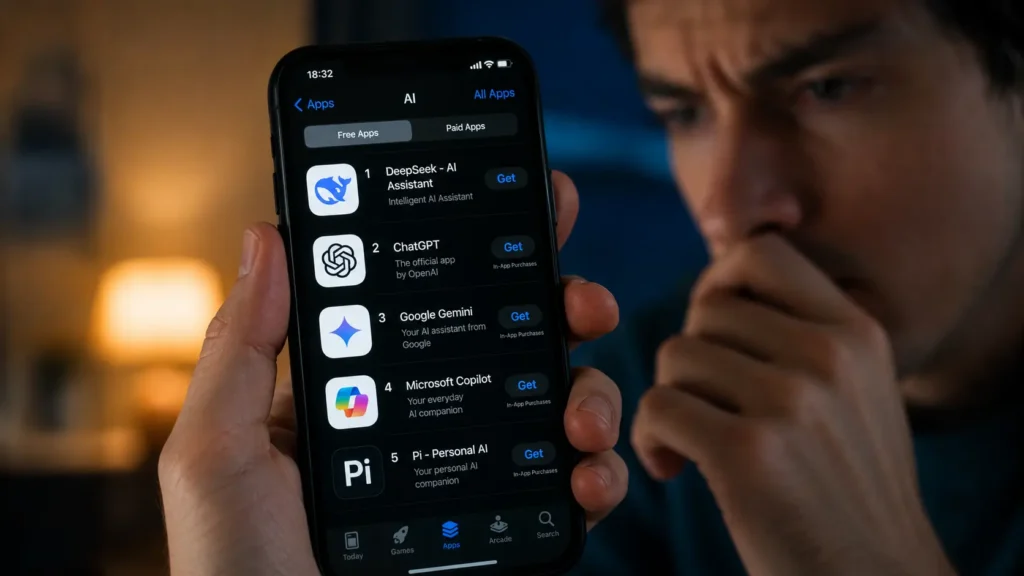
In January 2025, an AI app from a Chinese startup nobody had heard of did something that hadn’t happened since ChatGPT launched: it reached number one on the Apple App Store, overtaking OpenAI’s flagship product, in a matter of days.
The app was DeepSeek. And the panic it triggered in Silicon Valley and in government offices from Washington to Berlin was immediate, loud, and still unresolved.
DeepSeek burst onto the global AI scene with a bold claim: its R1 model could match ChatGPT’s capabilities at a fraction of the development cost. The app rocketed to the top of download charts, briefly overtaking ChatGPT on both Apple’s App Store and Google Play.
Then the investigations started.
What DeepSeek Actually Is
DeepSeek is a large language model AI assistant functionally similar to ChatGPT or Google Gemini. You ask it questions. It answers. It analyzes documents. It writes code. It summarizes research.
DeepSeek can do everything that ChatGPT can analyzing and summarizing data, generating images and videos, and providing AI-powered search. A key difference is that DeepSeek is trained to avoid politically sensitive questions.
That last detail is not a minor caveat. It means the model produces systematically different outputs on specific topics than Western AI models not because the information doesn’t exist, but because it has been deliberately excluded from the training process.
The technical achievement, however, is genuinely significant. DeepSeek-R1 made news for performance comparable to OpenAI’s o1 model at a fraction of the cost a development that directly challenged the assumption that cutting-edge AI required the kind of capital only American big tech could deploy.

The Data Problem That Triggered Seven Bans
The capability story is impressive. The privacy story is what triggered the bans.
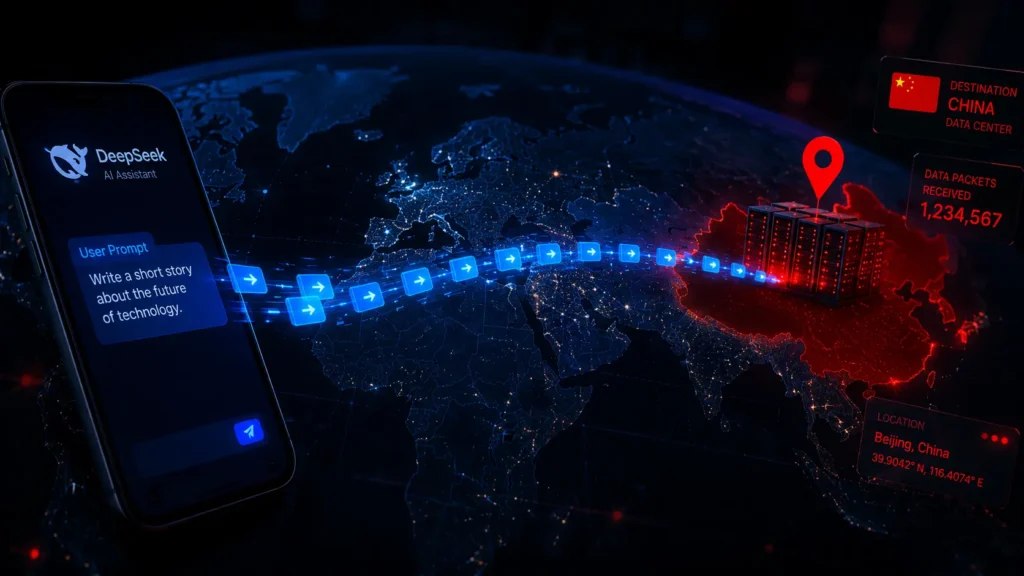
DeepSeek stores all user data on servers located in the People’s Republic of China. Under China’s 2017 National Intelligence Law, organizations and individuals must “support, assist, and cooperate with national intelligence efforts” meaning Chinese authorities can legally compel DeepSeek to hand over user data upon request, with no requirement to notify affected users.
DeepSeek collects chat history and prompts every conversation you have with the AI account information including email and phone number, device model, operating system, keystroke patterns and rhythms, IP address, system language, and website activity.
Keystroke patterns. That detail buried in DeepSeek’s own privacy policy is what security researchers flagged most prominently. Keystroke dynamics are a behavioral biometric. Collected over time, they can be used to identify individuals even when other identifying information has been removed.
As of 2026, the banned countries include Italy, the United States (government agencies), South Korea, Australia, Taiwan, and India. Italy banned DeepSeek first, followed by six others.
Why Apple and Google Are Caught in the Middle
Here’s where both companies face a genuinely difficult position and why “terrified” isn’t an overstatement.
Germany’s data protection commissioner Meike Kamp stated that DeepSeek’s transfer of user data to China is “unlawful” and has formally informed Google and Apple, requesting that the tech giants consider blocking the app on their app stores in Germany. “Chinese authorities have extensive access rights to personal data held by Chinese companies. DeepSeek users in China do not have enforceable rights and effective legal remedies as guaranteed in the European Union.”
Berlin’s data commissioner urged Apple and Google to consider removing the app from their stores, accusing DeepSeek of unlawfully transferring German user data to China and failing to provide equivalent GDPR-level data protection.
The dilemma this creates for both companies is structural. Apple and Google operate global app stores governed by local laws in every market they serve. If they remove DeepSeek in response to German regulatory pressure, they set a precedent for government-directed app removal that has implications far beyond this single case. If they don’t remove it, they potentially face regulatory action for knowingly distributing an app that regulators have formally flagged as illegal.
South Korea’s ban was enforced directly across Apple and Google app stores halting new downloads while existing users could still access the web version. South Korea demanded regulatory compliance before the suspension would be lifted.
Neither Apple nor Google publicly responded to Germany’s removal request.
The Security Vulnerabilities Beyond Privacy
The data jurisdiction problem is the headline. The technical security record is worse.
Documented security failures include a database breach exposing over one million records, critical mobile app vulnerabilities, and a 100% jailbreak success rate meaning every known jailbreak technique tested against DeepSeek’s safety guardrails succeeded. Governments in 7+ countries and dozens of US agencies have banned DeepSeek specifically because of these safety concerns.
Experts believe DeepSeek represents a worse threat to national security than TikTok because its technology enables fast data processing to discover and attack multi-scale security gaps. The US House panel branded DeepSeek a “profound threat” to America’s national security.
The 100% jailbreak rate is particularly significant for enterprise users. It means DeepSeek’s safety filtering the layer that prevents the model from producing harmful outputs can be bypassed reliably and completely. For individuals using it casually, this is a minor concern. For organizations using it to process sensitive information, it’s a documented risk.
The Honest Assessment
For casual, non-sensitive queries on a personal device, the risk is lower but still present. For anything involving personal, financial, or professional data, DeepSeek should be avoided. Because DeepSeek operates under Chinese jurisdiction, pursuing legal remedies from Western countries is extremely difficult.
DeepSeek’s technical achievement is real. Its model performance is legitimate. The competitive threat it represents to OpenAI and Google’s AI products is genuine and the cost efficiency it demonstrated has already forced the entire industry to reconsider its assumptions about what AI development requires.
But the data architecture is not separable from the product. Every prompt you type, every document you upload, every keystroke pattern you generate it goes to servers in China, under Chinese law, with no legal mechanism for Western users to request its deletion or restrict its use.
Apple and Google aren’t terrified of what DeepSeek can do as an AI. They’re terrified of being the distribution channel for what it does with your data.
Note: Users in countries where DeepSeek is not government-banned can still access the service, but should review its privacy policy carefully before using it for any sensitive queries. This article does not constitute legal or security advice.
© AiwalaNews | Global Tech & Privacy Edition | May 2026
Read Also:
- 🔗 The US vs China AI Race Is Almost a Tie — And That Should Scare Everyone
- 🔗 How to Disappear From Google Search Completely — Legal and Free
