This article is based on verified cybersecurity research from Fortinet, CyberDefenders, Cloudskope, and EC-Council University. All techniques described are documented in published security research. This is for educational purposes understanding attacks is the foundation of defending against them.
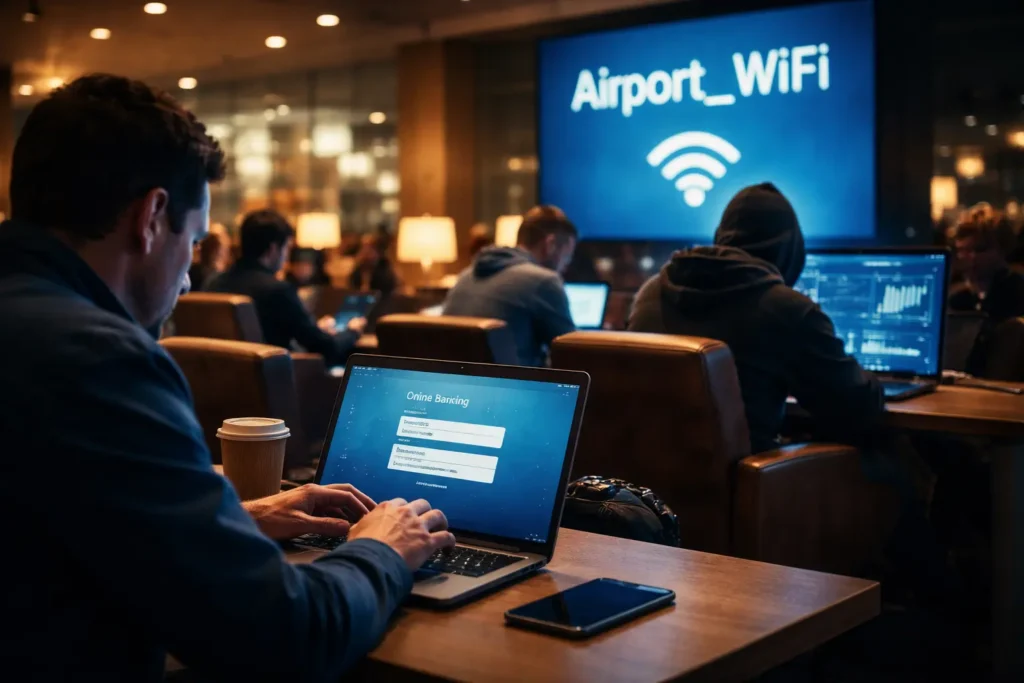
You’re sitting in an airport lounge. You connect to the free WiFi, open your banking app, and check your balance. Everything looks normal. No warning. No suspicious link. No unusual notification.
Three hours later, your account is drained.
You didn’t click anything wrong. You didn’t download anything. Your password was correct and unchanged. And yet, somewhere between your phone and your bank’s server, every credential you typed passed through someone else’s hands first.
This is a Man in the Middle attack one of the oldest, most dangerous, and least understood threats in cybersecurity. In 2026, it’s also one of the most automated.
What Is a Man in the Middle Attack
A Man-in-the-Middle attack occurs when a threat actor secretly inserts themselves between two communicating parties intercepting, reading, and often altering the data passing between them without either side realizing it.
None of the parties sending email, texting, or chatting are aware that an attacker has inserted their presence into the conversation and is stealing their data.
The mental model is straightforward. Imagine sending a letter to your bank. Normally it travels directly. In a MITM attack, someone intercepts it mid-transit, reads it, potentially changes it, reseals it perfectly, and forwards it on while sending you a convincing reply from the bank’s direction. Both you and the bank believe you’re communicating directly. Neither of you are.
Unlike attacks that target a single endpoint directly, a MITM attack subverts the communication channel itself. The attacker can passively eavesdrop on credentials, financial data, and intellectual property or actively forge responses to manipulate transactions and inject malware.
The Three Techniques Used Most Often
ARP Spoofing The Local Network Attack
On local area networks, ARP spoofing sends falsified ARP messages that associate the attacker’s MAC address with the IP address of another host redirecting all traffic through the attacker’s system. Once positioned as the network gateway, the attacker can intercept, read, and modify all traffic between local hosts and external destinations.
This is why public WiFi is dangerous. The coffee shop network, the airport lounge, the hotel any shared network is a potential ARP spoofing environment. The attacker doesn’t need to hack your device. They just need to be on the same network and redirect traffic through themselves.
SSL Stripping Making HTTPS Disappear
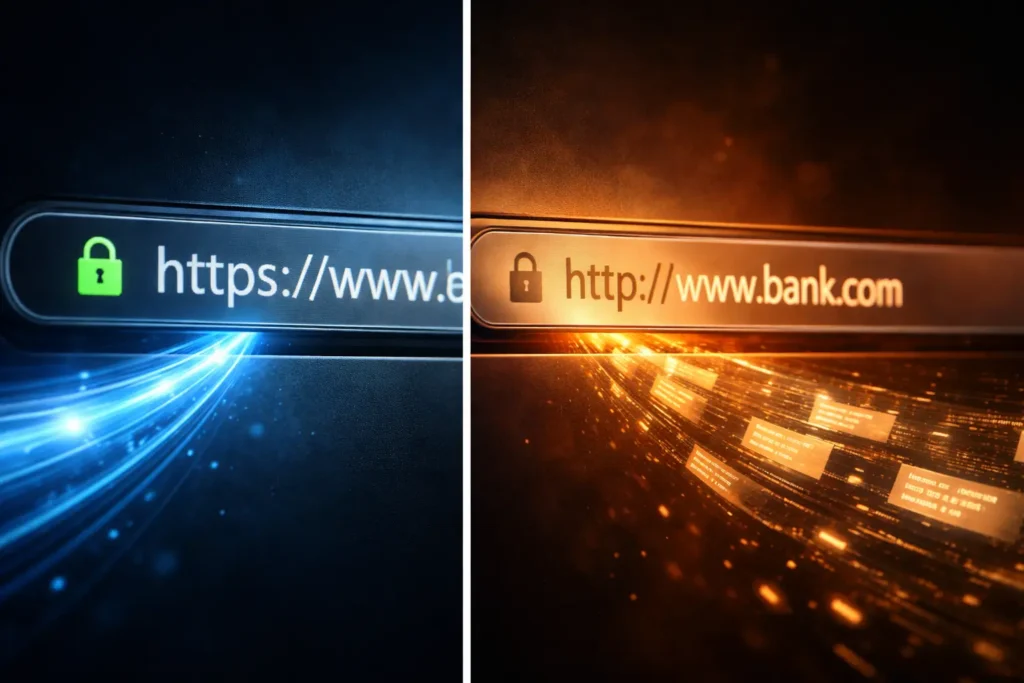
SSL stripping downgrades HTTPS connections to HTTP by intercepting the initial HTTP request before it redirects to HTTPS serving the victim an unencrypted connection while maintaining an encrypted connection to the legitimate server. From the victim’s perspective, they are browsing normally. From the attacker’s perspective, all traffic is visible in plaintext.
The lock icon in your browser is supposed to mean your connection is encrypted. SSL stripping removes that protection silently and most users never notice the difference between http:// and https:// in the address bar.
DNS Spoofing Sending You Somewhere Fake
In DNS spoofing, the attacker redirects a domain name to a malicious IP address meaning when you type your bank’s real URL, your request is silently rerouted to a replica site controlled by the attacker.
You type the correct address. You land on a perfect copy of your bank’s website. You log in. The attacker receives your credentials in plaintext and forwards a fake “incorrect password” message back to you while they access the real account.
The 2026 Upgrade: AI-Enhanced MITM
In 2026, MITM attacks have become targeted, automated, and often enhanced by artificial intelligence. Apart from the technical aspects, modern MITM attacks require a deep understanding of networks, cryptography, and human behavior and AI is now handling much of that complexity automatically.
The most dangerous evolution is the Adversary-in-the-Middle (AiTM) attack a variant specifically designed to defeat multi-factor authentication.
AiTM phishing proxies sit between the victim and the legitimate service, relaying credentials and session tokens in real time. When the victim completes MFA, the attacker captures the authenticated session token bypassing MFA entirely without needing the second factor themselves.
This is the detail that should concern anyone who believes MFA makes them fully protected. It does make attacks harder. It doesn’t make AiTM-style interception impossible.
Real-World Consequences
MITM attacks are used to gain unauthorized access to sensitive accounts including online banking, emails, and social media platforms. Consequences range from identity theft to corporate data breaches and the attack leaves minimal forensic evidence because no malware is installed on the victim’s device.
The no-malware aspect is what makes attribution and detection so difficult. Your device is clean. Your antivirus finds nothing. The attack happened in transit between you and the destination leaving no trace on either endpoint.
What Actually Protects You
Strong mutual authentication, end-to-end encryption, certificate pinning, and network monitoring together close most of the MITM attack surface.
For ordinary users, the practical defenses are simpler:
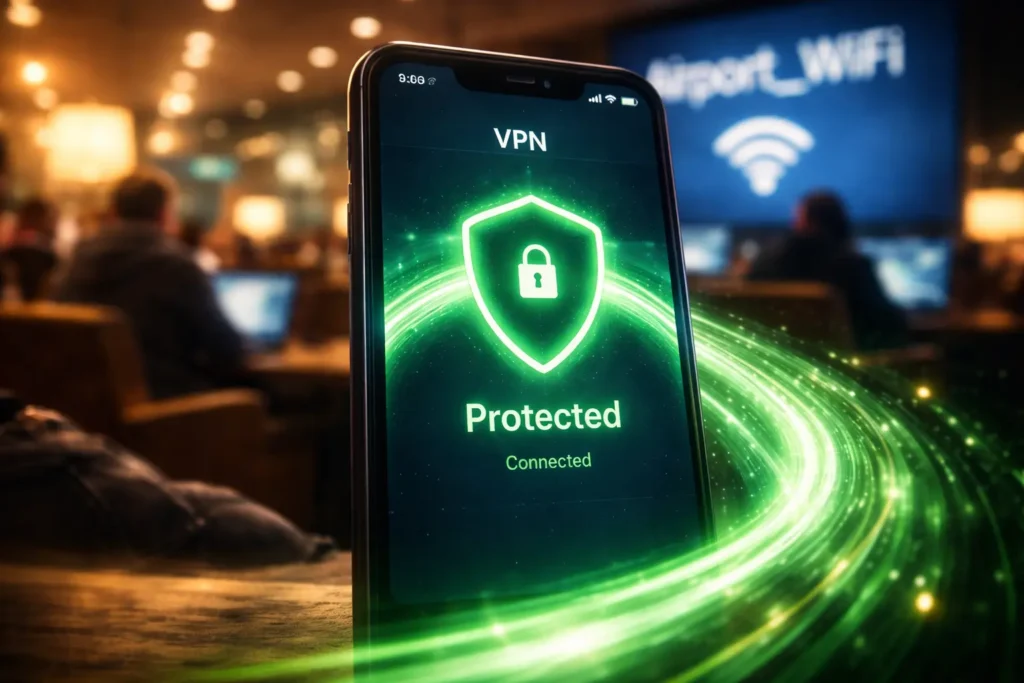
Never use public WiFi for sensitive accounts without a VPN. A reputable VPN encrypts your traffic before it leaves your device meaning even if an attacker intercepts it, they receive encrypted data they cannot read. Free VPNs carry their own risks; a paid, reputable VPN is a $3 to $5 monthly investment that closes the public WiFi attack vector almost entirely.
Always verify HTTPS before entering credentials. The Electronic Frontier Foundation reports HTTPS adoption grew to over 95% of web traffic by 2024 but the remaining unencrypted traffic represents millions of vulnerable connections daily. Check for the padlock and https:// on every page where you type a password.
Use hardware security keys for critical accounts. Unlike SMS-based MFA that AiTM attacks can intercept, hardware keys like YubiKey use cryptographic binding to the specific domain making session hijacking through a proxy technically infeasible.
Avoid sensitive transactions on shared networks. Hotel WiFi, airport lounges, café networks these are the highest-risk environments for ARP spoofing. Mobile data is significantly safer for banking and email on the move.
Certificate warnings are not clickable. When your browser warns you about an invalid or mismatched certificate, that warning is the security system detecting a potential interception. Clicking through it is the equivalent of seeing a stranger opening your mail and handing it to you anyway.
The Man in the Middle attack doesn’t need you to do anything wrong. It needs you to do something normal connect to WiFi, open a website, type a password while it sits invisibly between you and the destination.
In 2026, that invisible position is increasingly automated, increasingly AI-enhanced, and increasingly targeted. The defense isn’t paranoia. It’s infrastructure: encrypted connections, verified certificates, and never trusting a network you didn’t set up yourself.
Note: This article is for educational purposes only. If you suspect you’ve been the victim of a MITM attack, contact your financial institution immediately and change credentials from a trusted device on a secure network.
© AiwalaNews | Global Tech & Privacy Edition | May 2026
Read Also:
- 🔗 How Your Bank Knows It’s Not You Within 0.3 Seconds of Login
- 🔗 How AI Learns Your Weaknesses From Just a Few Clicks
