This article is based on the California data broker registry, congressional testimony from Duke University’s Sanford School of Public Policy, EPIC privacy research, verified platform documentation, and the 2026 congressional investigation findings. This is for informational purposes. For state-specific privacy rights, consult a privacy attorney.
Your data has already been sold. Not might be sold. Not could be sold. Already sold multiple times, to multiple buyers, for purposes you never agreed to.
As of 2026, California’s data broker registry lists over 542 registered brokers but industry estimates put the true number above 4,000 when including resellers and companies that broker data as a secondary business. The data broker industry generated over $365 billion globally in 2024.
The most dangerous data brokers operate in the background: companies like LexisNexis, Acxiom which holds profiles on 250 million Americans and Babel Street sell data to insurance companies, employers, lenders, and federal law enforcement.
Most people assume this is a distant, abstract problem. It isn’t. It’s operating on your data, right now, continuously and in 2026, it’s getting significantly more dangerous.
Where Your Data Actually Comes From
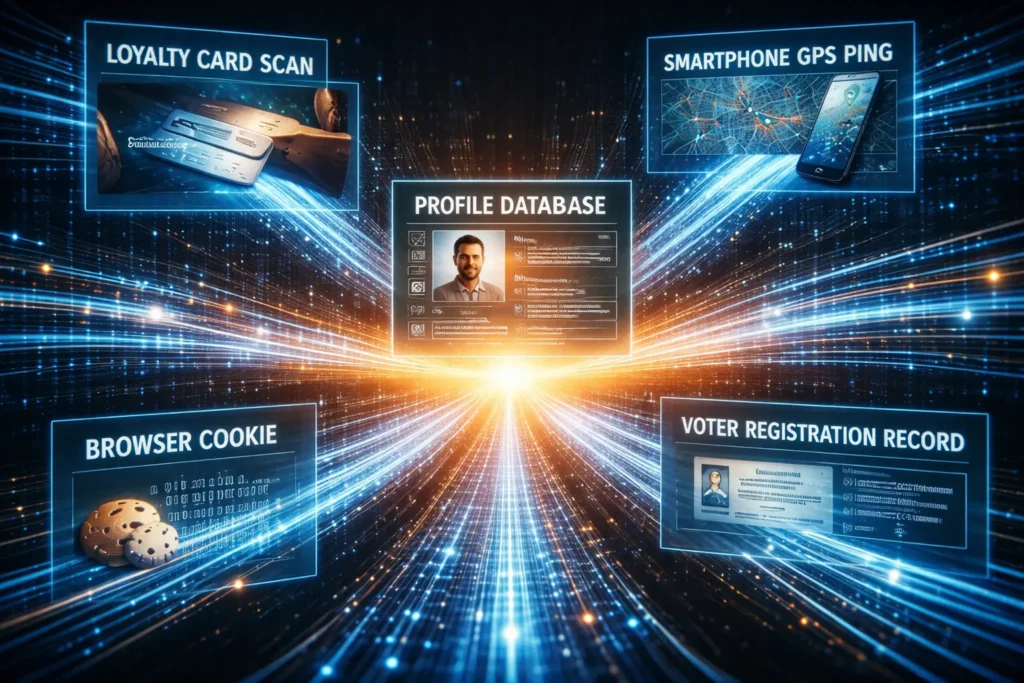
Data brokers work like factories. They pull information from the apps you use, websites you visit, loyalty cards you scan, public records, and location data from your phone. Then they combine it into a detailed picture of your life including where you go daily, down to GPS coordinates.
They pull from public records including voter registration, property deeds, and court filings; social media profiles; loyalty programs; online purchases; app usage data; and other data brokers. Most consumers unknowingly consent to data sharing in terms of service agreements they never read. Every time you use a store loyalty card, fill out a sweepstakes entry, or install a free app, that data has likely been sold dozens of times over.
Data brokers use secret algorithms to build profiles on every American citizen, regardless of whether the individual even knows that the data broker exists. They collect health information, sites visited online, products purchased, payment methods, and advertisements clicked and thanks to smartphones and wearables, they collect and sell real-time location data.

Who Is Buying It The Answer Nobody Wants to Hear
The buyers aren’t just advertisers. The list is longer and more alarming than most Americans realize.
Broker data is packaged and sold to advertisers, insurers, political groups, background-check sites and scammers. In 2026, AI-powered scams rely on data brokers: scammers don’t guess anymore they buy. They use broker data to tailor scams, impersonate companies you interact with, and even mimic family members.
The same industry also sells data including bulk cell phone location data to police departments and federal government agencies in ways that can reveal intimate details about Americans without a warrant. ICE is among the government agencies that buy commercial data about Americans in bulk.
And the threat has gone international. 33 California-registered data brokers reported selling data to or sharing data with non-US actors in North Korea, China, Russia, and Iran in 2025 and potentially into 2026. Five of these data brokers reportedly collected precise geolocation data before selling it to foreign adversary countries.
Your location data. Sold to foreign intelligence operations. Legally, because no federal law prevents it.
A 2026 congressional investigation found that breaches at just four major data brokers cost American consumers over $20 billion in identity theft losses.
The Tool That Shows You Who Has Your Data
Here’s where most privacy articles stop at the problem, without the solution. The solution exists. It’s free. Most Americans have never used it.
Step 1: Have I Been Pwned See Where Your Data Leaked
The most widely used free tool is Have I Been Pwned at haveibeenpwned.com. Enter your email address and it immediately shows every data breach your information appeared in the company, the date, and exactly what data was exposed.
This doesn’t show broker sales it shows breach exposure. But breaches are one of the primary pipelines feeding your data into the broker ecosystem. Knowing which breaches you’re in tells you which data is circulating.
Step 2: California’s DROP Platform One Request, Every Broker
California residents can use the new DELETE Act’s DROP platform, which launched in January 2026, to submit a single deletion request that reaches every registered broker in the state.
For non-California residents: Vermont’s data broker registry has been public since 2019 and lists companies that buy and sell personal data. Texas and Oregon both passed data broker registration laws in 2023, adding more transparency. These registries show you the companies in the business of trading your information.

Step 3: GhostVault Automated Deletion at Scale
GhostVault automates the opt-out process sending legal deletion demands to every broker on the registry, monitoring for re-listing, and resubmitting removal requests when data reappears. Under the California Consumer Privacy Act, you have the legal right to demand these companies delete your data regardless of what state you live in, since most major data brokers are California-registered.
Step 4: Manual Opt-Outs for the Highest-Risk Brokers
The sites most likely to have your data publicly visible: Spokeo, Whitepages, BeenVerified, Radaris, TruePeopleSearch, FastPeopleSearch, and Intelius. Each has an opt-out page search “[site name] opt out” to find it. Submit removal requests on each. Recheck every 90 days data reappears regularly from updated public records.
The Honest Limits
The lack of a comprehensive baseline US privacy law has allowed the data broker industry to build profiles on millions of Americans at great cost to privacy, civil rights, national security, and democracy.
Individual opt-outs slow the problem they don’t solve it. Data you remove from one broker reappears when another broker sells it back. The opt-out process is deliberately time-consuming. The industry is structured to make staying listed easier than getting removed.
The idea is to give people back ownership over their data so they are no longer at the behest of large corporations seeking to use and leverage it against them. Privacy in 2026 is more than a technology issue it’s about personal security.
You can’t opt out of the entire system. But you can make yourself significantly harder to find, target, and exploit and in 2026, that difference is worth the hour it takes to do it.
Note: Privacy rights vary by state. California, Texas, Oregon, and Vermont residents have specific statutory rights against data brokers. For complex situations involving harassment or identity theft, consult a privacy attorney or contact the FTC at ftc.gov/privacy.
© AiwalaNews | Global Tech & Privacy Edition | May 2026
Read Also:
- 🔗 How to Disappear From Google Search Completely — Legal and Free
- 🔗 The App on Your Phone Right Now That’s Selling Your Location to Advertisers
