This article is based on the FIFA-WTO Socioeconomic Impact Analysis (March 2025), Boston Consulting Group projections, verified FIFA bid documentation, and official economic impact assessments from host cities. This is for informational purposes.
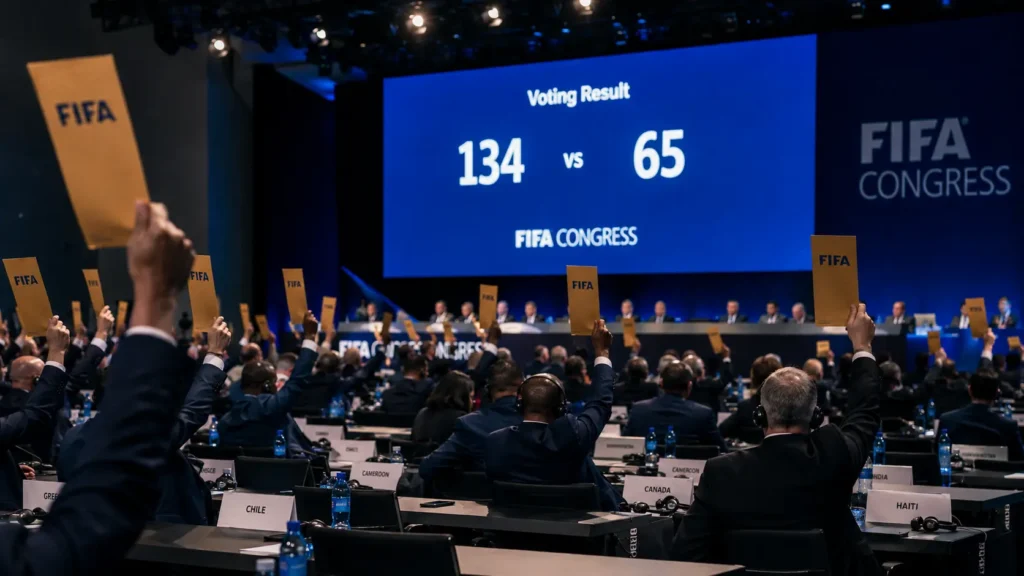
When FIFA member associations gathered in Moscow on June 13, 2018, to vote on the 2026 World Cup host, the decision took less time than most people expected.
The choice was between Morocco which had bid five times for a World Cup and never won and a joint North American bid from the United States, Canada, and Mexico. Morocco received 65 votes. North America received 134.
The reason wasn’t sentimentality or geography. It was a single number.
The North American bid promised FIFA a record $11 billion in profit nearly double the $6.6 billion FIFA expected to earn from Qatar 2022, and more than double the $5 billion Morocco projected. An optimistic promise of delivering $14 billion in revenue helped sway voters, along with the fact that no major construction work was required all 16 planned stadiums already existed.
FIFA chose North America because North America offered something no other continent could: the world’s most profitable advertising market, the world’s most advanced sports infrastructure, and the world’s largest appetite for sporting spectacle. All three, simultaneously, in one bid.
Why Three Countries Not One
The three-country format wasn’t sentimental. It was structural.
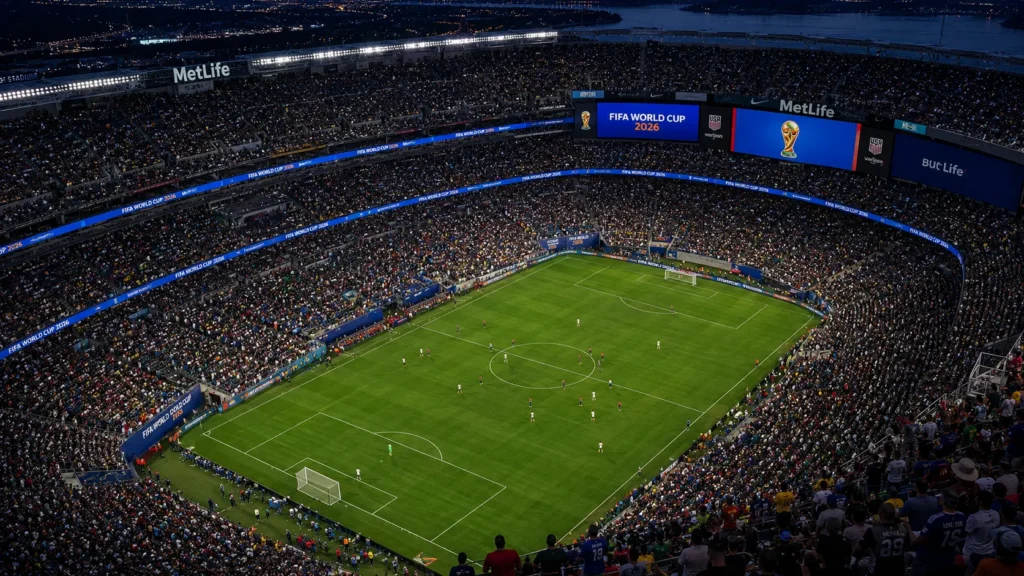
The 2026 tournament is the first with 48 teams up from 32 in previous editions requiring 104 matches across 16 host cities. The US will host 60 of 80 originally planned matches, with Canada and Mexico hosting 10 each. All matches from the quarterfinals forward will be held in the USA, with the Final at MetLife Stadium in New Jersey.
No single country needed to absorb all 104 matches. Distributing them across three nations with existing world-class infrastructure meant FIFA could expand the tournament’s scale without the construction costs that made Qatar so controversial.
Unlike Qatar 2022, where the host nation invested over $200 billion in infrastructure stadiums, metro systems, highways, hotels, an entire city zero new stadiums were built for 2026. This means a dramatically higher proportion of total spending flows directly into the event experience and tourism economy rather than construction.
That absence of construction cost is a fundamental reason the profit projections are so high. FIFA isn’t funding stadiums. It’s funding a tournament in stadiums that already exist.
The Money: A Number That Reframes Everything
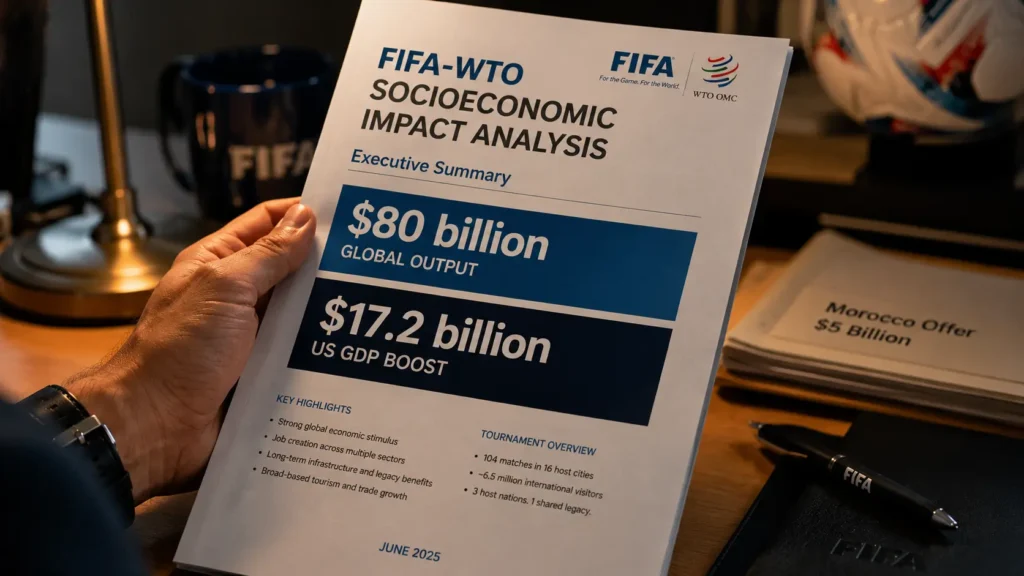
The FIFA-WTO Socioeconomic Impact Analysis estimates the 2026 World Cup could create a global gross output impact of $80 billion.
Breaking that down by country:
For the United States alone: $11.1 billion in event-related expenditure, a $17.2 billion GDP boost, $3.4 billion in government tax revenue (direct and indirect), $5.8 billion in labor income, and 185,000 full-time-equivalent jobs.
For Canada: FIFA’s economic impact assessment estimates $3.8 billion in positive economic output from hosting 13 matches in Vancouver and Toronto.
Total tournament spending breaks down as: tourist and visitor spending $6.2 billion (45%); FIFA operational spending $3.76 billion (27%); government and public investment $2.0 billion (14%); organizing committee spending $1.0 billion (7%); corporate and sponsor activation $0.94 billion (7%).
The US government tax revenue of $3.4 billion means the World Cup effectively pays for itself from a public finance perspective the tax revenue generated exceeds any government spending on infrastructure and security for the event.
What Individual Host Cities Actually See
Individual host cities are projected to see $160 to $620 million in incremental economic activity, with net benefits of approximately $90 to $480 million per city. A Boston Consulting Group study projects that the 2026 World Cup could generate more than $5 billion in short-term economic activity across North America, supporting approximately 40,000 jobs and over $1 billion in incremental worker earnings.
Boston/New England projects $1.1 billion in economic impact from 7 matches. Philadelphia projects $500 million from 6 matches with a Round of 16 game scheduled on July 4, aligning with America’s 250th anniversary celebrations.
Los Angeles projects $594 million in total regional economic impact. Atlanta projects $503 million. FIFA projects the 2026 tournament will generate $40.9 billion in GDP across North America, with US host cities seeing $160 to $620 million in incremental economic activity per city.
The Honest Complication
Not every projection is landing as planned.
Experts say ticket prices, inflation fears, and what analysts have called the “Trump slump” are putting fans off with hotel rates down by a third in some host cities from Atlanta to San Francisco. The projections were made in June 2024 and assumed a geopolitical environment that no longer exists.
Economists frequently distinguish between gross impact and net impact. Gross impact measures all the money spent in a city during the event. Net impact accounts for leakage and displacement local residents who leave the city during the tournament, regular tourism that gets crowded out, and money spent on imports rather than locally produced goods and services.
The gross projections are extraordinary. The net reality will depend heavily on how many international visitors actually travel and in 2026, that number is being influenced by visa friction, currency exchange rates, and geopolitical uncertainty in ways the original bid documents could not have anticipated.
Why It Still Makes Sense for Everyone
According to Sports Value’s analysis, the 2026 matchday revenue alone could equal the combined matchday revenue of the last six World Cups from 2002 to 2022.
For FIFA: unprecedented profit from a tournament requiring minimal infrastructure investment in the world’s most commercially valuable market.
For the US: a $17.2 billion GDP boost, 185,000 jobs, and a global showcase that positions its cities as international destinations for decades.
For Canada and Mexico: meaningful economic activity from a tournament they couldn’t have hosted alone, delivered through a partnership that made the entire bid viable.
The three-country format wasn’t a compromise. It was a calculation and for everyone at the table, the numbers worked out.
© AiwalaNews | Global Tech & Privacy Edition | May 2026
Read Also:
- 🔗 How to Watch FIFA World Cup 2026 in 4K for Free
- 🔗 How Ticket Scalpers Use Bots to Buy 10,000 World Cup Tickets in Seconds
