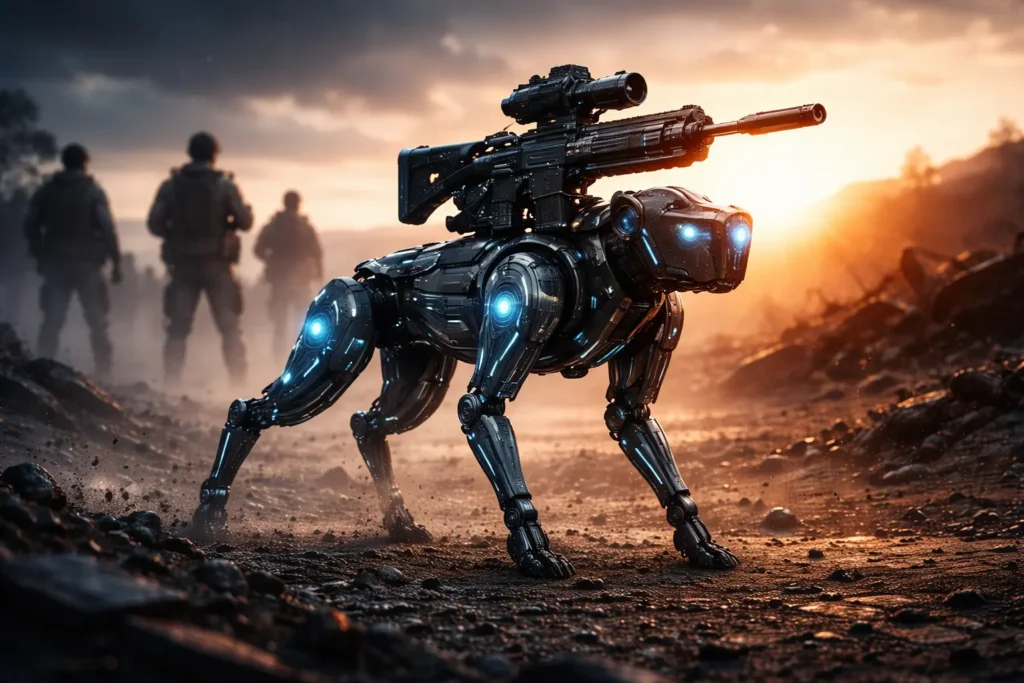
Imagine a battlefield where no human soldier needs to walk into the line of fire. Instead, a four-legged machine roughly the size of a large dog sprints across rubble, climbs obstacles, and opens fire on enemy positions. This is not a Hollywood script. This is happening right now, and China is leading the charge.
Armed robotic dogs have moved from laboratory experiments to military exercises, defense exhibitions, and soon possibly real combat zones. The question is no longer “will this technology exist?” The question is “how soon will it change warfare forever?”
What Exactly Is a Military Robot Dog?
A military robot dog, technically called a Quadrupedal Unmanned Ground Vehicle (Q-UGV), is a four-legged autonomous or semi-autonomous machine designed to operate in environments too dangerous or complex for traditional wheeled vehicles.
Unlike tanks or drones, robot dogs can:
- Climb stairs and navigate rubble
- Squeeze through narrow urban corridors
- Operate silently on reconnaissance missions
- Carry weapons, ammunition, or explosives
- Work in coordinated swarms controlled by a single operator
China’s versions are built to be cheap, fast, and deadly. Some models cost under $3,000 compared to $75,000 for a Boston Dynamics Spot robot. That price difference alone makes mass deployment a very real possibility.
China’s Robot Dog Timeline: From Showcase to Battlefield
2024 – The World Gets Its First Real Look
At the Zhuhai Airshow 2024, China unveiled its “Machine Wolf” cluster combat system. This wasn’t just one robot dog it was an entire ecosystem. The system included:
- Reconnaissance variants for surveillance and target identification
- Strike variants armed with rifles and grenade launchers
- Logistics variants for carrying ammunition and supplies
Videos from Chinese social media showed a medium-sized drone dropping a robot dog onto a rooftop, which then unfolded and began patrolling with a QBB-97 light machine gun mounted on its back. The world took notice.
Also during Golden Dragon 2024 a joint military exercise between China and Cambodia the PLA deployed two robotic dogs weighing 15kg and 50kg respectively, using them in assault operations alongside infantry units.

2025 – From Exercises to Parades to the Front Lines
By 2025, China’s robotic dog program had accelerated dramatically.
January–March 2025: Chinese military scientists proposed equipping Q-UGVs with thermobaric weapons devastating explosive devices second only to nuclear arms in lethality for use in urban warfare and clearing underground bunkers. The proposal came after PLA drills revealed that robot dogs struggled to flush enemies from fortified buildings using lighter weapons alone.
July 2025: The PLA conducted full-scale tactical exercises where robotic dogs operated on the front lines as part of assault units. The robots performed:
- Reconnaissance and enemy spotting
- Breaching fortified defenses
- Fire support for advancing infantry
- Ammunition transport for scattered soldiers
Operators launched FPV drones by throwing them into the air a new unconventional tactic while robot dogs moved alongside ground troops in coordinated attacks.
September 2025 – The “9·3” Parade: In one of China’s most watched military parades, 480 robot dog units were displayed in cluster formation a public show of scale and manufacturing capability that sent a clear message to the world.
October 2025: In a dramatic amphibious landing exercise broadcast on China’s state television CCTV, the PLA deployed robot dogs loaded with explosives in the first wave of landing forces. They ran across ditches, climbed barriers, and cleared beach passages before human soldiers arrived. A separate robot dog armed with a machine gun accompanied paratroopers advancing through jungle terrain to infiltrate enemy rear positions.
November 2025: China showcased a motion-controlled humanoid combat robot at the 12th International Army Cadets Week operated by a human wearing a motion-sensing suit, the robot mirrored the soldier’s every movement in real time using AI.
2026 – Missiles Enter the Picture
At the World Defense Show 2026 in Riyadh, Saudi Arabia, a Chinese state-linked defense firm unveiled what many defense analysts called a game-changer:
A robotic dog equipped with four compact anti-tank guided missiles (ATGMs).
The system featured:
- Twin missile pods mounted on the robot’s back
- Compatibility with lightweight short-range anti-tank missiles
- Semi-autonomous combat modes with a human operator in the loop for weapons release
- A modular design adaptable to different mission types
Company representatives described it as a “mobile remote fire-support asset” designed for high-risk urban and complex terrain environments. Multiple Middle Eastern and Asian military delegations examined the system closely at the exhibition.

The “Wolf Pack” Strategy: One Soldier, Many Robots
Perhaps the most chilling development isn’t the weapons themselves it’s the coordination capability.
China’s PLA revealed an intelligent “wolf pack” system where multiple robot dogs can coordinate directly with each other, allowing a single soldier to control an entire group without micromanaging each unit.
The system includes three specialized variants:
- Shadow – designed for reconnaissance and situational awareness
- Polar – tasked with logistical support
- Bloody – the combat variant, equipped with missiles, grenade launchers, or automatic weapons
This swarm intelligence — combined with FPV drones operating overhead creates a multi-layered, semi-autonomous assault system that could overwhelm traditional defenses.
Why China Has a Massive Advantage Right Now
1. Cost
Chinese military robot dogs are reportedly 1/12th the cost of their US counterparts. This makes mass production and even treating units as expendable a realistic strategy.
2. Speed of Development
China has transitioned from R&D to military exercises to international export showcases in just a few years a pace that Western militaries are struggling to match.
3. Military-Civil Fusion
Companies like Unitree Robotics — which sells robot dogs for under $3,000 have sold extensively to Chinese universities that serve as defense R&D hubs. Unitree has partnerships with Huawei, ZTE, and iFlytek, all of which are deeply integrated into China’s military modernization strategy.
4. Scale
The robotic dog market in China is projected to grow at a 37.5% CAGR between 2025 and 2030, with military applications dominating demand.
What Does This Mean for the US, UK, and India?
United States
The US military is still largely in the testing phase with robotic ground systems. While companies like Boston Dynamics and Ghost Robotics have developed military-grade robots, none have been deployed in combat roles at the scale China is approaching. The Pentagon is watching closely and racing to close the gap.
United Kingdom & NATO
NATO allies have begun serious discussions about autonomous ground systems, but none have matched China’s pace of development or public demonstration. British defense analysts have raised alarms that the alliance needs a coordinated robotic warfare doctrine before these systems reach actual battlefields.
India
For India, the implications are direct and urgent. China has deployed robot dogs in exercises near complex terrain terrain that closely resembles India’s Himalayan border zones. Armed Q-UGVs capable of navigating mountain passes, carrying supplies, and providing fire support could fundamentally alter the balance in any future high-altitude conflict. India’s own robotics program remains in early stages by comparison.
The Big Question: Are They on Real Battlefields Yet?
No not yet. As of April 2026, there is no confirmed evidence that China has deployed armed robotic dogs in active combat operations on a real frontline.
Everything documented so far falls into three categories:
- Military exercises and drills – highly realistic, but controlled environments
- Defense exhibitions and parades – showcasing capability to the world
- Proposed doctrines – military scientists publishing papers on future use cases
However, the gap between “exercise-ready” and “combat-deployed” is narrowing fast. The 480-unit parade cluster, the missile-armed showcase at WDS 2026, and the increasingly realistic combat exercises all point to one conclusion:
Deployment is a matter of when, not if.
Ethical and Global Security Concerns
The rise of armed robotic dogs raises profound questions that the world has barely begun to answer:
- Who is responsible when a robot dog kills a civilian the operator, the programmer, or the government?
- Can international law keep up with autonomous weapons systems?
- Will an AI arms race between superpowers lower the threshold for starting conflicts?
- How do you surrender to a machine?
The United Nations has discussed a ban on fully autonomous lethal weapons systems, but no binding treaty exists. China, the US, and Russia have all resisted hard limits on autonomous weapons development.
Conclusion
China’s armed robot dogs are real, tested, increasingly capable, and approaching operational readiness at a pace that should concern every major military power on earth.
They are not yet confirmed on active battlefields. But they have run through jungle exercises, leaped onto rooftops from drones, fired rifles alongside paratroopers, and now carry anti-tank missiles to international arms fairs.
The age of robotic warfare is not approaching. It has already begun its opening act.
The only question that remains is: Who will write the rules and will anyone listen?
