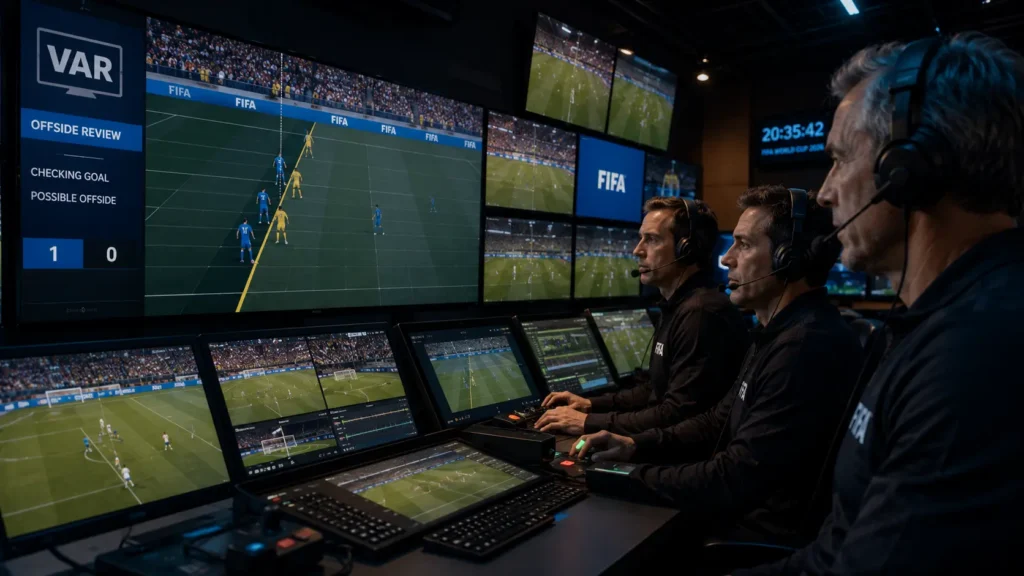
When the referee’s whistle blows during FIFA World Cup 2026, something invisible is already happening. Above the pitch, a network of cameras is capturing the exact position of every single player, dozens of times per second and an AI system is deciding, almost instantly, whether what just happened broke the rules.
This isn’t science fiction. It’s the most heavily monitored sporting event in human history, and most fans watching from their living rooms have no idea how deep the technology actually goes.
The Camera Network Watching Every Inch of the Pitch
At the heart of the system is Semi-Automated Offside Technology, or SAOT, which relies on a network of 29 dedicated cameras capturing player movement across the pitch at 50 frames per second.
This camera-based tracking system, combined with a sensor-equipped match ball and body cameras worn by referees, forms a layer of sensors and artificial intelligence that now sits between what happens on the pitch and what the referee actually decides.
The 29-camera SAOT system feeding positional data into the player models was originally introduced at the 2022 World Cup in Qatar for semi-automated offside tracking. But the 2026 version goes considerably further than anything fans have seen before.
Every Player Gets Digitally Scanned Before Stepping on the Field
Here’s the part most fans don’t know: before a single ball is kicked, every player in the tournament is turned into a precise digital model.
FIFA built individual body scans of all 1,248 players from all 48 nations before the tournament began. Each scan takes about one second, and the result is an AI-generated avatar that matches the real player’s body shape, proportions, and number.
Each scan captures highly accurate body-part dimensions, allowing the system to track players reliably during fast or obstructed movements even during crowded penalty-box scrambles.
FIFA describes these AI-enabled 3D player avatars as a significant development in semi-automated offside technology, since previous tournaments relied on generic, cartoonish placeholder figures rather than accurate representations of the actual players.
So when you see a 3D figure rotating on your screen during a VAR review, you’re not looking at a stand-in. You’re looking at a digital replica of the actual player involved, built from their own individual body scan.

How the AI Actually Makes an Offside Call
The process happens far faster than any human referee ever could manage alone.
The combination of the smart ball and AI player tracking powers FIFA’s semi-automated offside system. The technology can identify the exact moment a pass is made and instantly compare player positions, allowing officials to make offside decisions much faster than before.
When a potential offside occurs, the system automatically alerts the VAR team, which confirms the call before relaying it to the on-field referee.
A real-time audio alert is now sent directly to the assistant referee if a player is more than 10 cm offside a dramatic improvement from earlier versions of the system, which previously only alerted officials if a player was more than 50 cm offside.
That tightening of the margin from 50 cm down to 10 cm is the difference between a system that catches obvious mistakes and one that catches genuinely close calls.
The Speed Difference Fans Will Actually Notice
It will be three minutes from whistle to whistle in both halves, according to Manolo Zubiria, Chief Tournament Officer, USA, for the FIFA World Cup 2026 referring to the total time the new system is expected to save across a match compared to older review processes.
For fans who’ve sat through agonizing five-minute VAR delays in past tournaments, that speed improvement is the headline benefit hiding behind all the technical jargon.

Why You’re Seeing Realistic 3D Replays Now
The 3D models are being incorporated directly into the host broadcast, enabling offside decisions determined by the VAR system to be displayed more realistically and in a more engaging way to fans at stadiums and viewers around the world.
After an offside decision is confirmed, the system generates a digital reconstruction of the incident, displaying player positions, body points, and the moment of contact with remarkable clarity helping explain complex calls to players, coaches, broadcasters, and spectators alike.
FIFA president Gianni Infantino has said the avatars will “ensure precise player identification and tracking,” describing the technology as “a big advancement” for semi-automated offside decisions, providing “great images, faster decisions and a clear understanding by everyone.”
Where the AI System Still Has Limits
Despite the sophistication, this technology isn’t flawless and FIFA is upfront about that.
The technology cannot detect the tightest margins and struggles when players are on the ground or positioned very close together. It also only applies to positional offside and not subjective calls that require human interpretation.
The system is semi-automated for a reason: AI and sensors measure a player’s position and the moment of the kick, but human referees still make the final decision especially on whether an offside player actually interfered with play.
In other words, the AI does the measuring. Humans still do the judging.
It’s Not Just About Offside Calls
The AI infrastructure at this World Cup extends well beyond the pitch itself.
Google is putting its Gemini AI at the center of the fan experience, with live scores on phone lock screens and AI-generated match visuals, while Lenovo is running digital twins of all 16 stadiums for crowd and security management and giving all 48 teams access to a “Football AI Pro” analytics tool trained on more than 2,000 football-specific metrics.
Football AI Pro analyzes hundreds of millions of FIFA-owned and organized football data points to generate validated insights in text, video, graphs, and 3D visualizations and it supports prompts in multiple languages.
The Bottom Line
Every time you watch a replay during FIFA World Cup 2026, you’re watching one of the most advanced sports AI systems ever deployed built from over a thousand individual body scans, dozens of synchronized cameras, and split-second machine calculations most fans never think about.
FIFA has already begun testing even more enhanced versions of this offside detection system, with the explicit goal of reducing review times further while maintaining the same level of reliability.
The game on the field hasn’t changed. But the invisible layer watching it has never been this advanced.
Read Also:
- 🔗 World Cup 2026 Starts June 11 — Here’s What Every American Needs to Know Before It Hits Their City
- 🔗 How Americans Are Making Thousands Renting Their Homes During FIFA 2026
© AiwalaNews | Global Tech & Privacy Edition | June 2026
