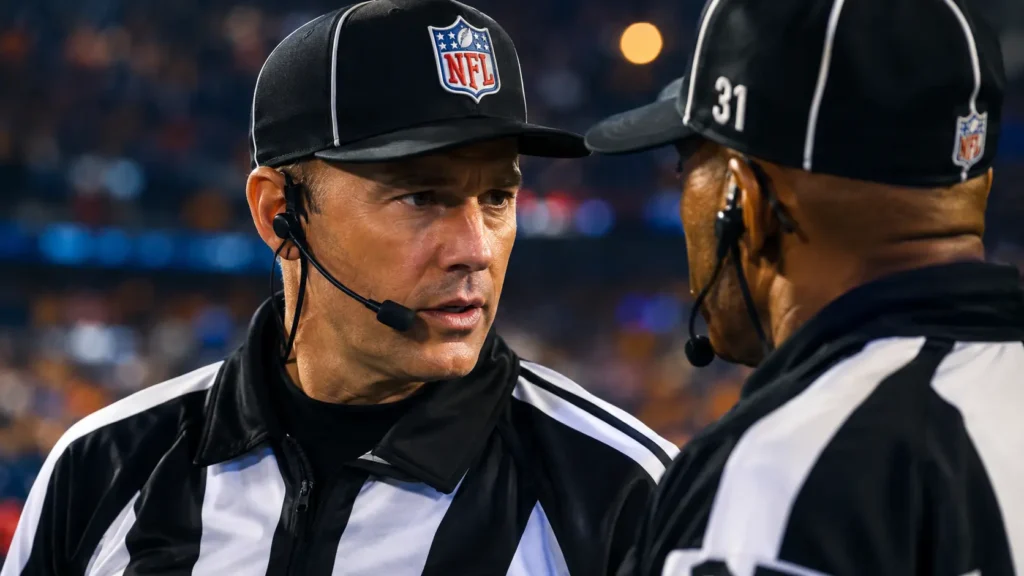
I still remember standing on the sideline at a preseason game in Ohio, close enough to hear the referees talking to each other between plays. What struck me wasn’t the shouting or the chaos everyone imagines. It was the quiet. Calm voices, quick eye contact, small nods. That moment changed how I understood officiating forever. It’s not guesswork. It’s a system, refined over decades, running inside seven human brains at once.
The Crew Isn’t Just One Person
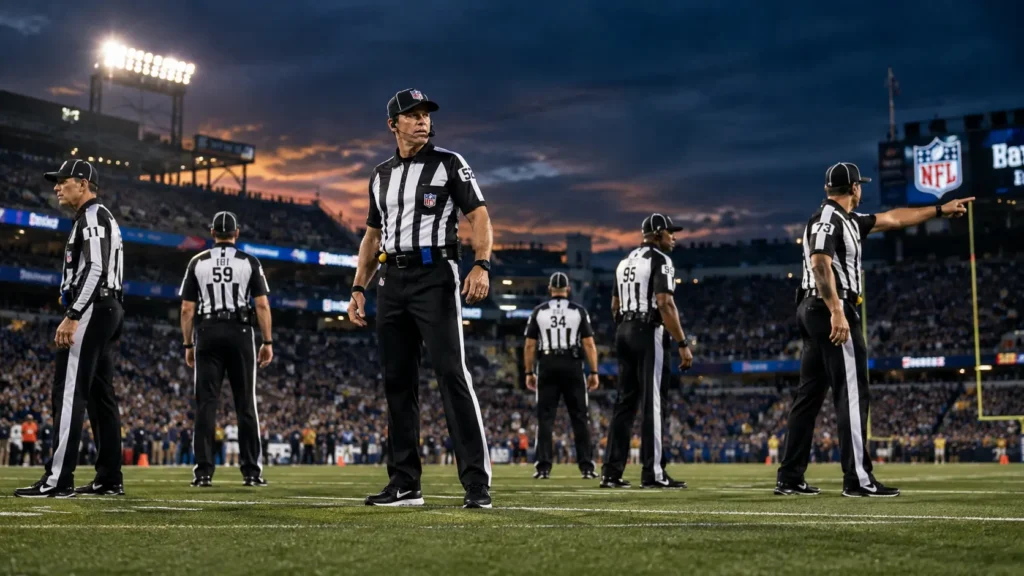
Most fans think of “the ref” as a single figure making every call. In reality, an NFL crew has seven officials, each assigned a specific zone on the field. The referee watches the quarterback and backfield. The umpire watches the offensive line for holding or illegal contact. The line judge and head linesman track the sidelines and line of scrimmage. The back judge, side judge, and field judge cover deep coverage and pass plays.
This division of labor is the real secret. No single person is trying to see everything. Each official has a narrow, defined responsibility, which means their eyes are locked onto one specific area when the ball snaps. That’s why a holding call near the line and a pass interference call downfield can happen on the same play without either official missing their assignment.
Training That Never Really Stops
Experience matters more than people realize. Most NFL officials have fifteen to twenty years of football officiating before they ever step onto an NFL field, often starting in high school and college leagues. During the season, every crew reviews video of their previous game with league officiating supervisors, breaking down each call frame by frame.
I spoke once with a former college official who transitioned into training programs, and he described it simply: “By the time you’re on an NFL field, your eyes already know where to look before the play even starts.” That instinct isn’t magic. It’s muscle memory built from thousands of reps watching the same formations, the same routes, the same blocking schemes.
The Split Second Decision Process
Here’s where it gets interesting. When a flag worthy moment happens, say a receiver gets tackled early on a deep route, the official covering that zone has roughly half a second to process three things: what happened, whether it violated a specific rule, and whether it affected the play enough to warrant a penalty.
That third part is often misunderstood by fans. Contact alone isn’t always a foul. Officials are trained to judge whether contact restricted the receiver’s ability to make a play on the ball. This is why two very similar looking hits can result in one flag and one no call. It isn’t inconsistency. It’s context that the television camera angle often doesn’t fully capture.
Communication Is the Hidden Engine
Modern officiating relies heavily on communication equipment. Referees wear microphones connected to each other, allowing quick confirmation calls like “I’ve got holding, ten” or “no flag, I saw contact but it was incidental.” This constant chatter happens in the two or three seconds after a play ends, before anyone even reaches for a flag or throws a signal.
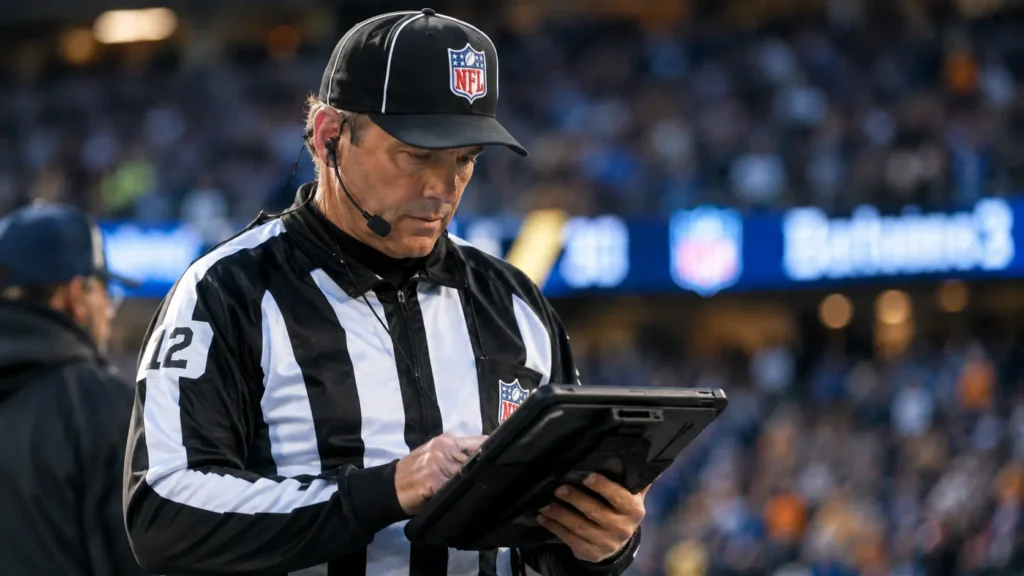
Replay adds another layer. Since instant replay expanded, a booth official in New York can flag certain plays for automatic review, particularly scoring plays and turnovers. The on field referee then walks to a tablet on the sideline, reviews the angle, and either confirms or overturns the call. This process, often criticized for slowing games down, actually reflects the league’s attempt to balance human judgment with technological accuracy.
Why Mistakes Still Happen
Even with all this structure, referees are human. Speed, angle, and even lighting affect what a person can see in a fraction of a second. A famous example many fans still bring up is the missed pass interference call in the 2019 NFC Championship Game, a moment that eventually pushed the league to expand replay reviews. Officiating isn’t perfect because live sports aren’t perfect. What separates a good crew from a struggling one is consistency across a full game, not the absence of mistakes.
What This Means for Fans Watching at Home
Understanding this system changes how you watch football. Next time you see a flag thrown, notice which official threw it. That tells you exactly what zone they were watching and what kind of violation they were trained to catch. It’s a small habit, but it turns confusing calls into something you can actually follow logically.
Officiating in the NFL isn’t about one person making a dramatic decision alone. It’s teamwork under pressure, built on training most fans never see and communication that happens faster than a replay can even load. The next time a flag flies, remember there’s a whole system behind that single motion, refined over years, trying to get a fast, physical, unpredictable game just a little more fair.
Read also this: How Instant Replay Changed Modern Sports Officiating
Read also this: The Hidden Technology Behind Live Sports Broadcasts
© AiwalaNews | Global Tech & Privacy Edition | April 2026
