You opened YouTube with no plan. Forty minutes later, you are watching something you never searched for, from a channel you never heard of, on a topic you did not know you cared about. You think you got lucky. You got algorithmmed.
YouTube serves over 2 billion logged-in users every month. Every single one of them sees a different homepage. Every single one of them is being guided not by chance, not by popularity, but by one of the most powerful recommendation systems ever built.
Here is exactly how it works.
The Algorithm Is Not One System – It Is Three
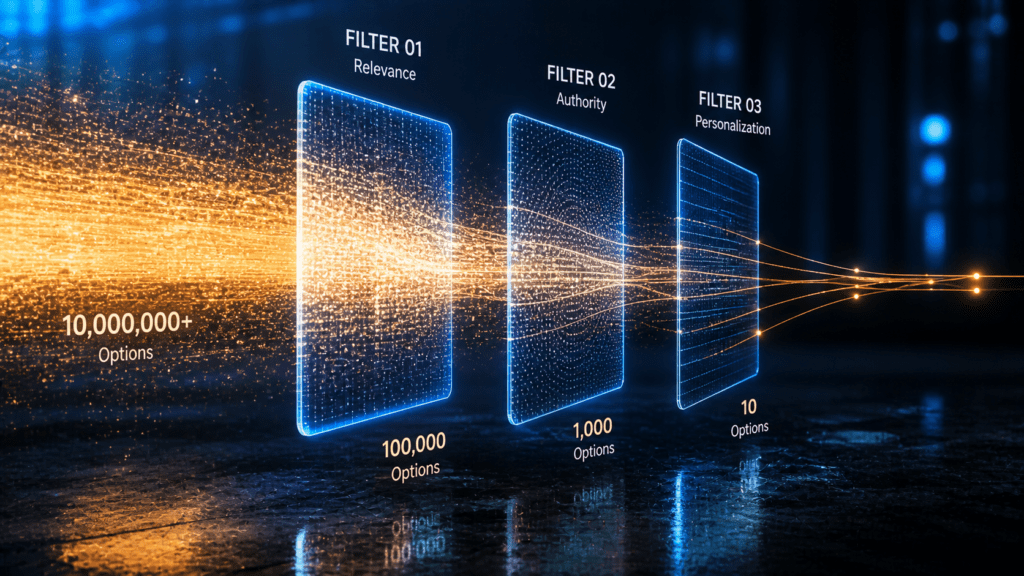
Most people imagine YouTube’s algorithm as a single engine. It is not. It is three separate systems working in sequence, each with a different job.
The first system is Candidate Generation. This layer scans YouTube’s entire library over 800 million videos and narrows the field down to hundreds of candidates that might be relevant to you specifically. It does this using your watch history, search history, and behavioral signals to find videos that match your demonstrated interests.
The second system is Ranking. From those hundreds of candidates, this layer scores and orders each video based on predicted satisfaction — not just predicted clicks. YouTube learned the hard way that optimizing purely for clicks created a platform full of misleading thumbnails and hollow content. Ranking now weighs watch time, likes, shares, surveys, and post-watch behavior.
The third system is Filtering. Before anything reaches your screen, videos pass through filters that remove content flagged for policy violations, content you have already seen, and content YouTube has determined is not suitable for your context. What survives this filter is what you see.
What the Algorithm Actually Watches About You
The algorithm does not just track what you watch. It tracks how you watch.
Click-through rate tells it whether your thumbnail and title were compelling enough to earn a tap. But a high click-through rate on a video nobody finishes is a red flag, not a reward.
Average view duration and percentage viewed are far more powerful signals. A ten-minute video watched for nine minutes tells the algorithm something very different from a ten-minute video abandoned at forty seconds.
Post-watch behavior is the signal most creators do not know about. What you do immediately after a video ends whether you watch another, search for something, close the app, or sit idle is interpreted as a satisfaction signal. A viewer who immediately searches for more content from the same creator sends an enormously positive signal. A viewer who closes the app sends the opposite.
Survey data is collected silently and continuously. YouTube periodically asks users to rate their satisfaction with recommended videos. Those responses feed directly into the ranking model, calibrating it against real human satisfaction rather than purely behavioral proxies.

Why Controversial Content Spreads Faster
This is the part YouTube does not advertise.
Emotional arousal accelerates engagement. Videos that trigger strong emotions anger, fear, outrage, intense curiosity generate higher click-through rates, longer watch sessions, more comments, and more shares. The algorithm reads all of these as positive signals.
For years, this created a documented radicalization pathway where users who watched moderate political content were recommended progressively more extreme content because each step generated slightly higher engagement signals than the last.
YouTube has made significant changes to its recommendation system since 2019, reducing recommendations of borderline content and adding information panels to contested topics. But the fundamental tension remains content that provokes strong emotion performs better, and an engagement-optimized algorithm will always have to fight its own instincts to avoid amplifying it.
The Role of Recency and Consistency
Recency matters enormously but not in the way most people think.
A new video from a channel you watch regularly gets an immediate boost in the first 24 to 48 hours as YouTube tests it against your subscriber base. The early engagement signals from that test window determine whether the video gets pushed to non-subscribers.
Channel consistency is a ranking factor that creators understand intuitively but rarely articulate precisely. A channel that uploads regularly in a defined niche builds a predictable audience profile which makes it easier for the algorithm to identify who else should see its content. An inconsistent channel confuses the audience model and gets lower distribution as a result.
Thumbnail and title optimization is the entry point of the entire system. Before any watch-time or engagement signal can be collected, someone has to click. This is why the visual and textual packaging of a video has become its own discipline because the algorithm cannot reward content nobody clicks on.

What Happens in the First 48 Hours
The launch window of a new video is the most critical period in its entire lifecycle.
YouTube exposes a new video to a small test audience first typically a portion of the channel’s existing subscribers. It measures click-through rate and early watch time against the channel’s historical benchmarks.
If the video performs above benchmark, distribution expands first to more subscribers, then to non-subscribers with similar interest profiles, then to Browse Features (the homepage), and potentially to Trending.
If it underperforms in the test window, distribution contracts. The video does not disappear, but it stops being actively recommended. It becomes discoverable through search but invisible through suggestion.
This is why creators say a video either “takes off or dies” in the first two days. They are describing a real algorithmic reality.
How the Homepage Is Built For You Specifically
Your YouTube homepage is rebuilt every single time you open the app.
It is not a static list. It is a real-time prediction of what you are most likely to watch right now not yesterday, not in general, but in this moment, in this context.
Time of day matters. Your Thursday evening watch patterns are different from your Saturday morning patterns, and the algorithm has modeled both. Device matters your phone homepage may differ from your desktop homepage because your consumption behavior differs by device. Recent activity matters watching three cooking videos this week shifts your homepage immediately.
The result is a homepage that is a mirror of your behavioral patterns including patterns you may not be consciously aware of.
What This Means for the 2 Billion People Watching
YouTube’s algorithm is not trying to inform you. It is not trying to educate you or expose you to diverse perspectives. It is trying to keep you watching.
That single objective, pursued at the scale of 2 billion users, shapes culture, drives trends, determines which creators succeed, and influences what billions of people believe, fear, and desire.
The algorithm does not have opinions. But its outputs have consequences that reach far beyond entertainment.
Understanding the system does not make you immune to it. But it makes you a less passive participant inside it. The next time YouTube recommends something unexpected, you will know it was not random. It was a calculated prediction about you, made by a machine that has been studying you for years.
Watch accordingly.
📖 Read Also: How Amazon Prices the Same Product 5 Different Ways in One Hour
How Tech Companies Use Color, Sound, and Timing to Control Your Emotions
© AiwalaNews | Global Tech & Privacy Edition | April 2026
