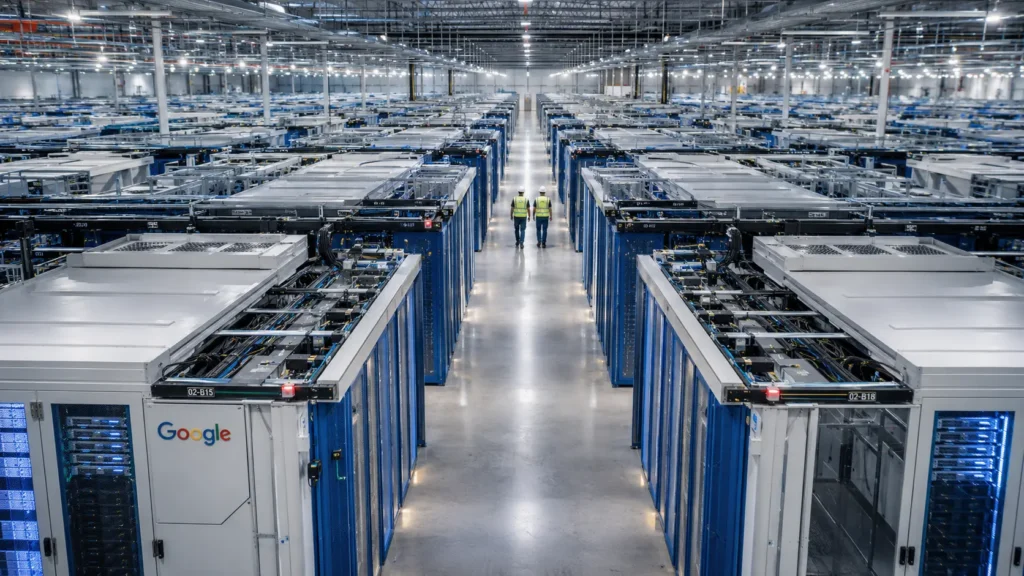
Every second, Google processes over 99,000 search queries. Every one of those queries travels from your device to a server, gets processed against an index of hundreds of billions of web pages, and returns an answer all before most people finish lifting their finger from the keyboard.
That speed isn’t magic. It’s the result of over 25 years of infrastructure investment one of the most complex, expensive, and deliberately hidden engineering systems ever built by a private company. Here’s exactly how it works.
The Scale: A Network That Spans the Entire Planet
The numbers behind Google’s physical infrastructure are almost impossible to visualize.
The Google global network connects over 200 countries via 10 million kilometers of fiber. To put that in perspective: the circumference of the Earth is roughly 40,000 kilometers. Google’s fiber network wraps around the planet approximately 250 times.
Today, this network spans over 2 million miles of lit fiber, including 33 subsea cable investments, with 202 network edge locations and more than 3,000 media content delivery network (CDN) locations across the globe. It connects 42 Google Cloud regions and 127 zones.
Those subsea cables running along the ocean floor between continents are the reason a search query from Mumbai can reach a Google server and return results in under 200 milliseconds. Without them, intercontinental data would have to travel via satellite, adding hundreds of milliseconds of delay to every single query.
The Three Layers: How Google Actually Moves Your Data
Google’s network infrastructure operates across three distinct elements that work together seamlessly.
Google’s network infrastructure has three distinct elements: data centers are the heart of Google content and services. Google has built a large, specialized data network to link all of its data centers together so that content can be replicated across multiple sites for resilience, and services can be delivered closest to the end user. Google operates a large, global meshed network that connects our edge PoPs to our data centers.
The Points of Presence or PoPs are the critical middle layer. Google has built hundreds of POPs around the world to bring content closer to local internet service providers (ISPs) and, in turn, end users. Traffic flows over Google’s dedicated network, optimized for speed and reliability until it reaches these POPs. From there, ISPs handle local delivery to customers who have requested that content.
In plain terms: your search query doesn’t travel all the way to a Google data center in Virginia before returning to you. It travels to the nearest PoP often within your own city or region which dramatically cuts the distance data needs to travel and reduces latency to milliseconds.
Google Global Cache The Copy of the Internet in Your Neighborhood
Beyond PoPs, Google has deployed an even more localized system that most people have never heard of.
Google maintains a voluntary program called Google Global Cache (GGC) that allows ISPs to host caches that serve Google traffic within their own network. These caches temporarily store static content that is popular with the ISP’s subscribers. This allows ISPs to retrieve this content from within their own network, thus avoiding the need to carry the traffic from a Google POP to their network.
In practice, this means that the YouTube video you’re about to watch, or the Google Images results you’re about to browse, may already be stored on a server inside your own internet provider’s network positioned there in advance because Google predicted it would be popular in your area. The content arrives fast not because Google sent it quickly, but because it was already nearby before you asked for it.
The Software Backbone: B4 and Espresso
The physical cables are only half the story. The software routing those cables is equally impressive.
Google develops cutting-edge networking technologies that allow Google’s global WAN to be zero touch, building some of the largest scale software defined networks (SDNs) infrastructure ever deployed including B4 and Espresso and scales Google’s global content delivery networks (CDNs) that support Google services.
B4 is Google’s privately built software-defined wide area network the system that intelligently routes traffic between Google’s data centers globally, optimizing for speed, cost, and reliability simultaneously. Espresso manages how Google’s traffic hands off to the public internet at the edge of its network. Together, they ensure that your search query takes the fastest available path at every stage of its journey, automatically rerouting around congestion or failures without any human intervention.

How AI Now Manages the Network Itself
In 2026, the network managing your searches is itself managed by AI.
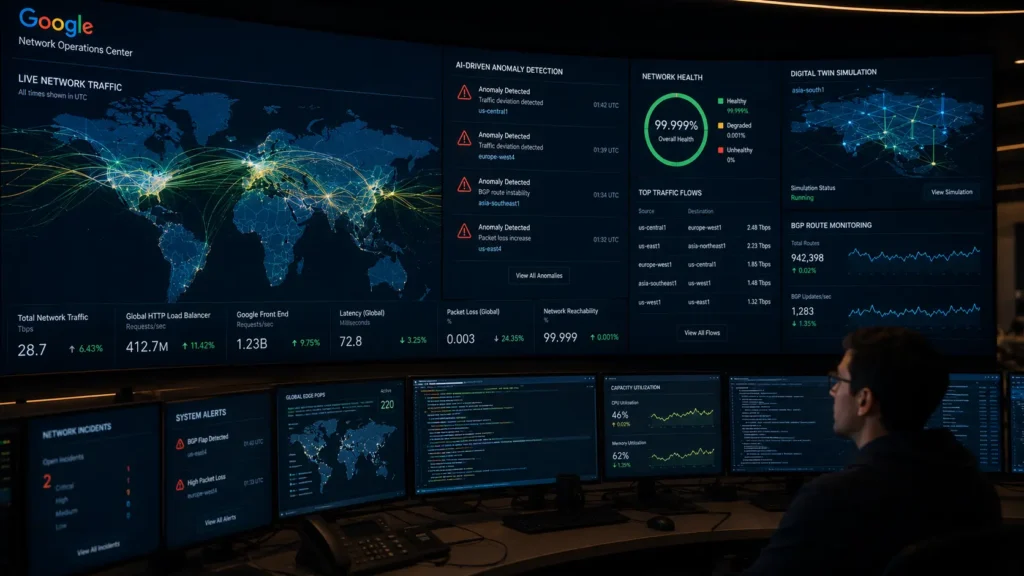
Google manages this network with agentic AI and digital twins to predict and prevent outages. This autonomous approach reduces outage durations by up to 93% shortening mitigation times from hours to minutes and shifts operations from reactive to predictive.
A digital twin is an exact virtual replica of the physical network allowing Google’s AI to simulate changes, predict failures, and test fixes before applying them to the real infrastructure. Instead of waiting for something to break and then fixing it, the system identifies the conditions that precede failures and corrects them in advance.
Google has designed and deployed techniques that can detect, pinpoint, and mitigate network problems within a few minutes without human intervention, using predictive analytics to anticipate some types of problems and adjust traffic engineering, or to plan capacity increases.
The 7x Bandwidth Growth Built for the AI Era
The scale of Google’s recent network expansion reflects a demand curve that has nothing to do with ordinary search.
From 2020 to 2025, Google’s WAN bandwidth grew a whopping 7x. The driver behind that expansion isn’t just search traffic it’s AI. Training large language models, running inference at scale, and delivering AI-powered answers in real time requires orders of magnitude more bandwidth than returning a list of blue links.
From streaming YouTube videos to training the most advanced AI models, the Google global network delivers high bandwidth and low latency networking to customers worldwide. The same infrastructure that delivers your search result in 200 milliseconds is simultaneously training Gemini models across multiple data centers on different continents treating a planetary fiber network the way a normal computer treats its internal memory bus.
The Bottom Line
The next time a Google search result appears before you’ve finished thinking about your question, you’re experiencing the output of 10 million kilometers of fiber, 33 undersea cables, 202 edge locations, 3,000 CDN nodes, AI-managed routing, predictive maintenance, and a network that grew its bandwidth sevenfold in five years.
For over 25 years, Google has been relentlessly pushing the boundaries of network technology, building a global infrastructure that powers Google for billions of users globally.
None of it is visible. All of it is working. Every single time you press Enter.
Read Also:
- 🔗 The Secret Buildings That Keep America’s Internet Running
- 🔗 How Banks Move Billions of Dollars Every Day Without Losing Track
© AiwalaNews | Global Tech & Privacy Edition | June 2026
