
Imagine spending three hours tailoring your resume, polishing every action verb, aligning margins, and exporting a pristine file, only to have it rejected six minutes later. No phone call. No email feedback. Just an automated system sending a boilerplate notification.
For millions of job seekers navigating today’s talent acquisition landscape, this outcome feels personal. The common assumption is that an Applicant Tracking System (ATS) simply scanned for keywords and found a gap. However, modern corporate recruitment relies on something far more insidious than simple text matching.
Enterprise companies now rely on predictive scoring models driven by machine learning algorithms. These engines evaluate background data, historical tenure, and contextual phrasing to determine if a human recruiter should ever click on your candidate profile.
The Evolution from Parsing to Predictive Scoring
Early talent acquisition software functioned like a basic search bar. If a hiring manager needed a candidate with Python and SQL, the system highlighted profiles containing those specific terms. Candidates adapted quickly by adding hidden text or pasting entire job descriptions into white fonts at the bottom of their documents.
Today, that approach fails completely. Enterprise platforms like Workday, Taleo, and Greenhouse utilize advanced natural language processing (NLP) algorithms trained on thousands of previous hiring decisions. The software no longer looks for standalone terms; it maps entire career trajectories.
| Processing Stage | System Action | Candidate Impact |
| Data Parsing | Strips styling and extracts clean text into database fields | Formatting bugs risk corrupted data |
| Contextual Mapping | Evaluates job titles, company sizes, and role duration | Non-standard titles get misaligned |
| Semantic Comparison | Measures contextual proximity to the ideal candidate benchmark | Generic phrasing lowers overall match |
| Predictive Ranking | Assigns an automated fit score to control recruiter visibility | Below-threshold files go unread |
When an application enters the pipeline, the system extracts candidate data into structured arrays. It analyzes semantic relevance by comparing your past company profiles against the hiring organization. If you worked at a 50 person startup and applied to a global enterprise, the algorithm applies an invisible penalty based on historical retention data from similar transitions.
Inside the Screening Interface: What Recruiters Actually See
Recruiters rarely review raw candidate documents during initial triaging. Instead, they view a unified dashboard displaying candidates sorted by an algorithmically generated match score.
Consider a recent scenario involving a senior product manager applying to a financial technology firm. The candidate possessed eleven years of direct industry experience, led major platform launches, and held degrees from top universities. Yet, their application sat untouched in position 142 on the recruiter screen.
The issue was subtle. The candidate used internal corporate jargon like Velocity Driver instead of standard industry terms like Agile Scrum Master. The system failed to map those internal terms to the job requirements, resulting in a low relevance rating. Because recruiters rarely scroll past the top twenty candidates in a large pool, the profile remained unread.
| Candidate Profile | Match Score | System Action | Dashboard Visibility |
| Applicant A | 94% | Shortlisted for Interview | Top Priority Row |
| Applicant B | 88% | Sent to Human Queue | Page 1 |
| Applicant C | 82% | Sent to Human Queue | Page 1 |
| Target Candidate | 41% | Archived Automatically | Hidden on Page 8 |

How Companies Train Selection Models
These predictive engines do not operate in a vacuum. They are trained on a company’s internal historical hiring dataset. If a business historically promoted candidates who stayed at previous jobs for precisely three years, the algorithm assigns higher weight to that specific tenure pattern.
This reliance on past data introduces significant systemic bias:
- Company Prestige Bias: Candidates from well-known tech firms receive higher baseline rankings regardless of actual individual contributions.
- Title Inflation Disconnect: Standard roles given unique internal titles get flagged as non-matching data points.
- Employment Gap Penalty: Breaks in employment trigger automatic point deductions in predictive stability metrics.
When thousands of candidates apply for a single open role, human HR teams depend entirely on these preliminary scores to filter the noise. If your score falls below a predetermined threshold, your application moves straight to the archive folder.
Beating the System Without Keyword Stuffing
Navigating these recruitment gatekeepers requires treating your resume as a structured data document rather than a creative design project.
First, standard titles matter far more than corporate internal terminology. Aligning your title header with universally recognized industry roles ensures proper data classification.
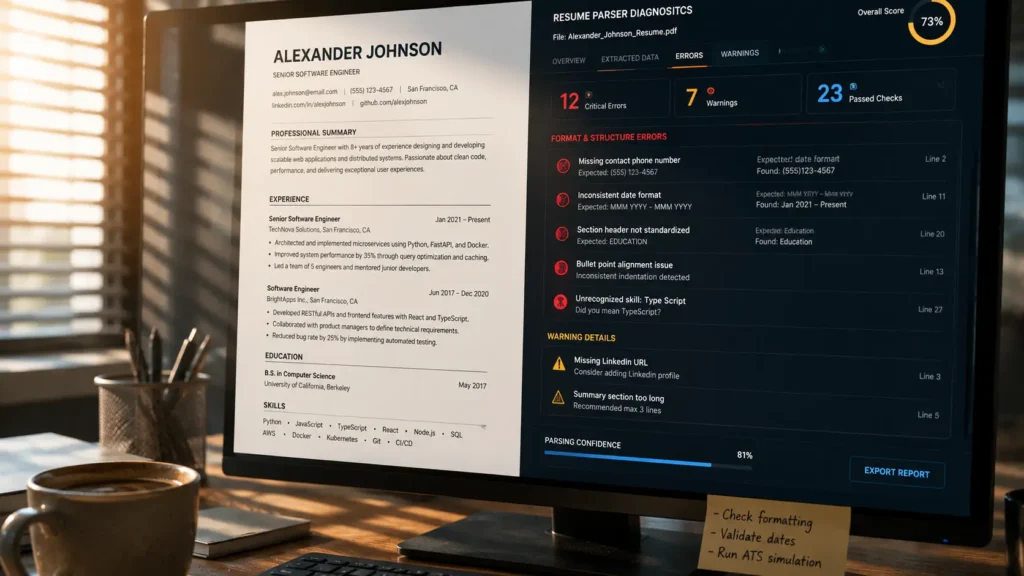
Second, format choices directly impact parser accuracy. Complex multi-column layouts, custom icons, graphics, and embedded text boxes frequently corrupt data extraction pipelines. When the parser misreads dates or merges separate text blocks together, the predictive scoring engine assigns a lower confidence value to the entire document. Simple single-column layouts remain the most reliable choice for parsing success.
Third, context replaces simple keywords. Instead of listing skills in an isolated bullet list at the bottom of the page, integrate core competencies directly into impact statements that demonstrate clear outcome metrics.
| Layout Element | Low-Confidence Design | High-Confidence Design |
| Document Structure | Multi-column, text boxes, and skill progress bars | Clean single-column layout with standard margins |
| Section Titles | Creative headers like “Where I’ve Been” | Standard headers like “Work Experience” |
| Skill Presentation | Isolated keyword lists at the bottom | Contextual metrics embedded in work experience |
Understanding that an algorithm evaluates your profile before a person ever sees it changes how you present your career history. By optimizing for algorithmic readability and structural clarity, you ensure your credentials reach the decision maker who actually makes the call.
Read also:
- Read also this: https://aiwalanews.com/how-ai-recruitment-tools-parse-data/
- Read also this: https://aiwalanews.com/privacy-implications-of-automated-hiring/
© AiwalaNews | Global Tech & Privacy Edition | April 2026
