
You didn’t sign a contract with them. You’ve never visited their website. You probably can’t even name one. Yet right now, somewhere in a server farm, a company you’ve never heard of is selling a detailed profile of your life your income, your health concerns, your political leanings, even whether you’re likely to be pregnant to the highest bidder.
These companies are called data brokers, and they are one of the largest, least understood industries on the internet.
What Exactly Is a Data Broker?
Data brokers are organizations that collect large amounts of raw personal information online and offline, analyze it, and then sell it to other companies advertisers, financial entities, and insurance providers who mostly use it for marketing purposes.
Also called information product companies, data brokers gather information about people, analyze and organize it, and sell it to other organizations typically for marketing purposes. They compile everything from basic contact details to extremely detailed personal profiles, including your interests, purchase habits, demographic information, and online behavior.
This isn’t a small, fringe industry. There are over 5,000 data brokers worldwide, and the global data broker industry is expected to eclipse $365 billion by 2029. Some estimates put current annual revenue from harvesting and selling personal data including email addresses alone at $247 billion in the U.S. alone.
🔍 How They Get Your Information Without You Noticing
The methods are far more ordinary than most people realize.
One common way data brokers gain access to your personal information is when you accidentally give them consent for example, when you sign up for a sweepstakes, free trial, or newsletter, the fine print may state that your information can be shared with “partners.”
Data brokers also use web scraping with specialized software, cookies, or scripts to pull information directly from public social media profiles, web browsing activity, mobile apps, and loyalty programs you’ve signed up for.
Data brokers also collect information from businesses you interact with directly for example, music streaming services may collect and pass along your playlists.
Nearly 6 in 10 Americans frequently skip reading privacy policies, which means most people are unknowingly handing over their information to these businesses every single day.
What They Actually Know About You
The depth of these profiles often surprises people the most.
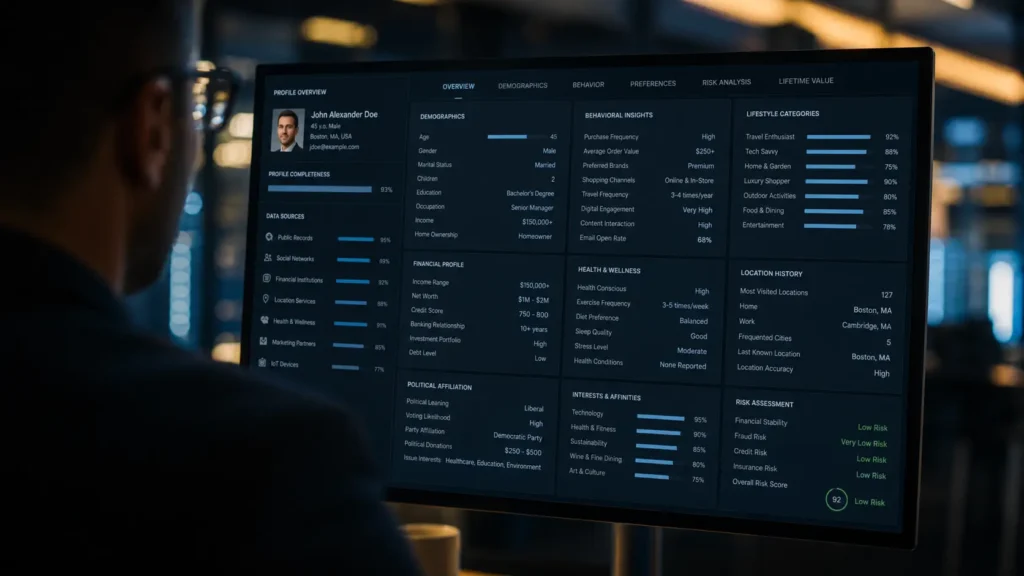
Data points collected include your name, age, height, weight, where you live, where you work, family, friends, likes, dislikes, phone number, email, health conditions, buying habits, credit score, political beliefs, religious beliefs, and even who you text.
Data brokers aggregate this information to build user segments like “new mothers” or “fitness enthusiasts” which they then sell to other companies for commercial purposes. Some categories become especially intrusive when they focus on sensitive medical or personal circumstances.
And the system isn’t always accurate. Despite the volume of information collected, data brokers don’t always get it right buying baby clothes for a relative might get you incorrectly tagged as a parent, or buying medication for an elderly family member might get misread as a reflection of your own health status.
Who’s Actually Buying This Data?
This is where the story gets genuinely uncomfortable for most people.
Some businesses use data purchased from brokers to crack down on fraud, checking whether a loan applicant’s stated information matches what brokers have on file, or calculating a consumer’s likelihood to default on a loan.
Health insurance companies can use information about the drugs you buy and symptoms you search online to determine what rates you should be charged for coverage based on your data profile.
But it goes well beyond marketers and insurers. Data brokers also sell information to law enforcement and government agencies, which can use location and other data for surveillance effectively bypassing the need for a warrant, since there are no laws preventing law enforcement from simply buying information that they would otherwise need a warrant to obtain.
Even more alarming: a Duke University study found that data brokers can sell personal data about U.S. military members to foreign countries, leading a Senate Intelligence Committee member to describe the data broker industry as posing “a serious threat to U.S. national security.”

The Real Cost When Things Go Wrong
This isn’t a hypothetical risk it has already cost Americans real money.
A congressional investigation revealed that breaches at data brokers have cost American consumers more than $20 billion in identity theft, stemming from just four recent data breaches involving major brokers.
Beyond financial loss, widely available personal data gives scammers more ammunition for spam and more convincing material for targeted phishing attempts, while also reducing your overall anonymity by connecting your identity across multiple platforms even when you try to stay private.
What’s Actually Changing And What You Can Do
The good news is that regulation is finally catching up, at least in some states.
California’s Delete Act established a deletion mechanism enabling consumers to request deletion of personal information held by data brokers. The Delete Request and Opt-Out Platform, called DROP, launched January 1, 2026, representing the first state-hosted platform where consumers can submit deletion requests to all registered data brokers with a single submission.
Starting August 1, 2026, all data brokers and their processors must access this mechanism and comply with all deletion requests within 45 days.
For residents outside California, the picture is murkier. For residents outside California, removal remains more challenging due to the lack of comprehensive federal privacy legislation.
In the meantime, practical steps can meaningfully reduce your exposure:
1. Avoid online quizzes and personality tests.
These often use your answers directly as harvestable data.
2. Use a separate email for subscriptions and online orders.
This reduces the amount of data linked to your real identity, since old, unused accounts can continue feeding data to brokers for years.
3. Review and limit app permissions.
Most apps and online services default to collecting more data than they actually need review what your apps and software know about you, and turn off anything unnecessary.
4. Submit opt-out requests directly or automate it.
Data brokers must legally allow you to opt out, but the process is rarely easy, often requiring hundreds of hours to manually opt out of every individual people-search site and brokers will likely republish your information later anyway. Automated removal services exist specifically to handle this ongoing process.
The Bottom Line
You’ll never see their logo. You’ll never get a bill from them. But data brokers are quietly one of the most powerful and least visible industries shaping your digital life today. The internet didn’t get this personalized by accident. It got this personalized because, behind the scenes, your data has been for sale the entire time.
Read Also:
- 🔗 The Dark Technology Behind Every “Recommended for You” — How Big Tech Controls What You See
- 🔗 How Your Bank Decides to Block a Transaction in 0.08 Seconds — The Fraud AI Behind It
© AiwalaNews | Global Tech & Privacy Edition | June 2026
